How Prediction Markets Work (Part 1): Regulation and Exchanges
Every prediction market is built on the same 5 layers. Part 1 of this series covers how regulators classify prediction markets around the world, and why apps like Coinbase and Wealthsimple route orders to exchanges they don't own.

Software Engineer
Everyone is launching prediction markets. Robinhood, Coinbase, Crypto.com, FanDuel, and Fanatics all launched one in the last year, chasing a market that hit $58.7 billion in trading volume in July 2026. While Polymarket and Kalshi still account for 92% of the total (Artemis Analytics), more companies are entering the sector, including Meta.
Underneath the branding, they all have to solve the same problems: one legal question, and five architectural layers on top of it.
- Part 1 (this article) covers how prediction markets are regulated, and who actually runs the exchanges
- Part 2 (opens in a new tab) covers tokenization and market types
- Part 3 (coming soon) covers trading mechanisms, oracles, resolution, and settlement
- Part 4 (coming soon) covers data infrastructure
What's a prediction market?
A prediction market is a market where you trade contracts tied to the future outcome of real-world events. For example, will Anthropic or OpenAI IPO first? Will stablecoins hit $500B before 2027? Will Bitcoin be up or down in the next 5 minutes?
The contract price is a crowd's live probability estimate. When you buy a "yes" share for $0.67, that means the market currently puts the odds at 67%. Each contract pays $1 if the event happens and $0 if it doesn't. So you're paying $0.67 for $1 that you get only if you're correct.
The five layers of a prediction market
Every prediction market has to solve the same five problems:
- Layer 1: Tokenization or position representation, how outcomes become tradable assets
- Layer 2: Trading mechanism, how buyers and sellers find each other
- Layer 3: Resolution, how the market learns what actually happened
- Layer 4: Settlement and fees, how winners get paid and the platform sustains itself
- Layer 5: Data infrastructure, how everything above becomes queryable, displayable, and auditable
How a platform solves them depends on whether they're centralized or onchain.
Centralized exchanges like Kalshi, ForecastEx, Rothera, and Nadex are exchanges in the traditional sense. No blockchain is involved. Your position is a balance carried by a clearinghouse, and the exchange itself determines the outcome against a settlement source written into the contract's terms and approved by the CFTC.
Onchain platforms like Polymarket, Limitless, and Predict.fun push those same functions into smart contracts. Your position is a token you hold in your own wallet, settlement executes onchain, and because no single party is trusted to declare the outcome, resolution needs an oracle.
| Layer | Centralized exchange | Onchain platform |
|---|---|---|
| Tokenization or position representation | Account balance carried by a clearinghouse | Tokenized, held in the user's wallet |
| Trading mechanism | Order book, matched internally | Order book, AMM, or pooled liquidity |
| Resolution | Exchange determines the outcome against the settlement source named in the contract terms | Oracle proposes, with a dispute process |
| Settlement and fees | Clearinghouse, fully collateralized, cash in segregated bank accounts | Smart contract, fully collateralized, collateral locked onchain |
| Data infrastructure | Internal database and market data feed | Indexers reconstructing state from chain events |
On the centralized side, futures exchanges have run the same way for decades. The onchain side is where the newer engineering is (and where most of this series covers).
Before any of that, though, there's a question of regulation. What is a prediction market contract, legally? The answer varies by jurisdiction.
Layer 0: How are prediction markets regulated?
As of August 2026, there are roughly four classifications for how prediction market contracts are treated: as a derivative, as gambling, under a dedicated regime built for prediction markets, or not regulated at all. These cover where most volume and active rulemaking currently is. Other jurisdictions may handle it differently.
Classification is also why the market has split in two. Getting licensed is slow and expensive, so many platforms don't, opting to route orders to one that's licensed instead.
Four legal classifications for prediction markets
| Classification | The contract is treated as | Where | What it requires |
|---|---|---|---|
| Derivative | An event-based financial instrument | US (CFTC), Canada (CIRO) | Exchange registration, clearing, surveillance, position reporting, intermediated access via licensed brokers |
| Gambling | A bet | UK, France, Spain, Netherlands, Portugal, Hungary, Belgium, Germany, Italy, Australia, Singapore, New Zealand | Operator gaming licence, responsible gambling duties, advertising rules |
| Bespoke regulatory framework | Its own regulated activity | Gibraltar | Purpose-built authorization, contract-level settlement standards, governance and safeguarding rules |
| Prohibited or unclassified | Illegal, or legally undefined | China, Brazil, Thailand, Taiwan, India, Iran (prohibited); Denmark, South Korea, most of Latin America (unclassified) | No lawful domestic path, or no law addressing it yet |
1. Derivative
In the derivative classification, prediction market contracts are considered a financial instrument (opens in a new tab), so they're met with a securities or commodities regulator. The venue has to register as an exchange, clear trades, run market surveillance, report positions, and reach retail through licensed intermediaries instead of directly. Trades route through futures commission merchants (FCMs), the licensed-broker role Schwab and Fidelity play between a retail customer and a regulated exchange, applied to event contracts.
Polymarket and Kalshi are the prime examples in the US. Kalshi registered as a CFTC Designated Contract Market (DCM) and litigated its way to listing election contracts. Polymarket took the opposite path first, blocking US users and operating offshore before acquiring QCEX, a CFTC-licensed exchange and clearinghouse. This allowed them to serve US users.
But many consumer-facing US and Canadian prediction markets don't operate their own exchange.
- Coinbase and Wealthsimple Predict route to Kalshi to leverage their CFTC license.
- Interactive Brokers connects to Kalshi, CME Group, and ForecastEx (opens in a new tab) (its own affiliate exchange), with an order router that compares net prices across all three.
- Robinhood did the same on Kalshi and ForecastEx before acquiring a venue of its own (opens in a new tab) with Susquehanna International Group.
- FanDuel Predicts launched on CME Group and added Crypto.com's OG Prediction Markets in June 2026 (opens in a new tab). Fanatics Markets and Underdog distribute OG contracts too.
In CFTC terms, this split is DCM and FCM – exchange and broker. Licensed venues do the listing and clearing while consumer apps handle distribution. Onchain, this is mirrored as protocols and frontends.
In Canada, the Canadian Investment Regulatory Organization (CIRO) authorized event contract trading in March 2026 (opens in a new tab), regulating them as derivatives, but only in three categories (economic indicators, financial markets, and climate) and only with settlement periods of 30 days or longer. Sports and politics are excluded. Interactive Brokers Canada and Wealthsimple are so far the only authorized dealer members, both using Kalshi under the hood.
2. Gambling
In the gambling classification, contracts are considered a bet, so they go to a gaming regulator. That means an operator licence, responsible-gambling duties like deposit limits and self-exclusion, and advertising restrictions.
This is the European default. The UK puts prediction markets under the Gambling Commission (opens in a new tab), meaning an operator serving British customers needs a gambling license. The Financial Conduct Authority (FCA) treats the financial ones as binary options, which are banned for retail.
Being classified as gambling doesn't guarantee a path to a licence either. Through 2026, France, Spain, the Netherlands, Portugal, and Hungary all moved to block Polymarket (opens in a new tab), Australia, Singapore, and New Zealand reached the same result under their own gambling statutes. So serving retail in Europe means holding a national gambling licence, and the main US platforms don't.
3. Bespoke regulatory framework
In this case, a prediction market contract is neither a derivative nor a bet. It's its own thing, with rules written for how prediction market platforms operate instead of borrowing from sportsbooks or futures exchanges.
Gibraltar is currently the only jurisdiction with a prediction market-specific framework. Its Prediction Market Regulations (opens in a new tab), passed in July 2026, state that activity under them isn't betting, gaming, or a lottery. ADI Predictstreet and WagerWire's Wire Markets are both in the regime so far.
An authorization in Gibraltar is neither a gambling licence nor a securities registration, and individual event contracts need regulator approval before they can be listed. This is a sharp contrast with the US derivatives model where a CFTC DCM can self-certify its own contracts.
4. Prohibited or unclassified
This is the "other" category where there's either no legal way to run a prediction market domestically or no law that addresses the question.
Prohibited: Prediction markets are prohibited in many countries like China (where gambling and crypto platforms are outright banned), Taiwan, Brazil, India, and Iran.
Unclassified: Denmark is the clearest example. Platforms are accessible because the Danish regulator says it can't block them without evidence they're targeting local users. Grey areas like this tend not to last. South Korea was in the same position until a probe into Polymarket users opened.
How platforms respond to regulations
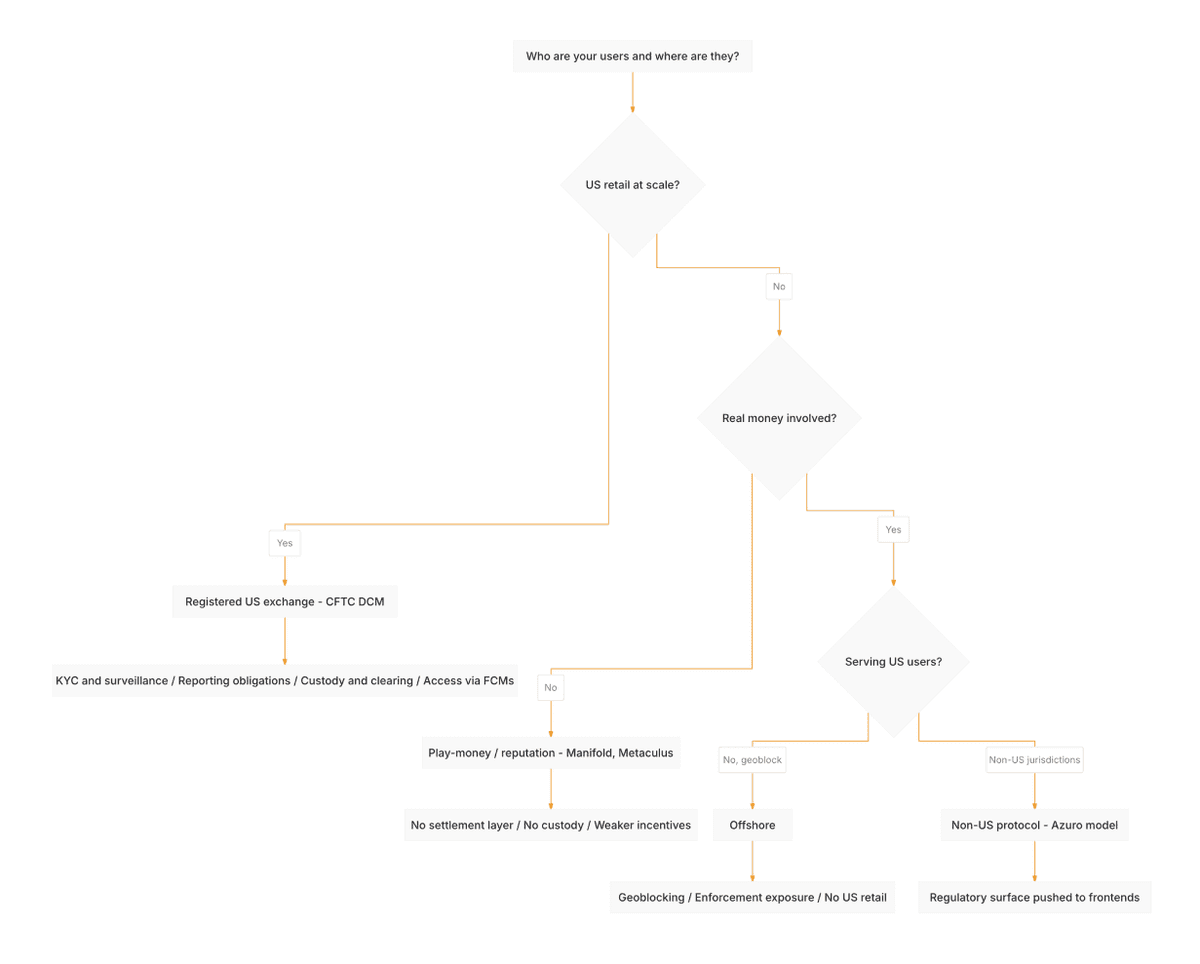
Prediction markets don't choose their classification; it's decided by the jurisdiction the users are from. Platform operators typically respond in one of five ways:
- Get a license. Register as an exchange or hold an operator license like Kalshi. Buying one works too: Polymarket acquired QCEX, Crypto.com acquired Nadex, Robinhood acquired MIAXdx, DraftKings acquired Railbird, and Underdog acquired Aristotle Exchange. This is the heaviest compliance burden and the only way to serve retail at scale in a regulated market.
- Distribute on someone else's license. Build the app and route orders to a licensed venue instead of becoming one. Coinbase, Wealthsimple, and Interactive Brokers all list Kalshi's contracts this way, and Fanatics Markets does the same on Crypto.com's.
- Geoblock and operate offshore. This is the path Polymarket took before becoming licensed via their QCEX acquisition. Lighter regulatory load, no access to the largest markets, and exposure to enforcement action.
- Use play money. Manifold uses an internal currency (mana) and Metaculus runs on reputation scores. Both skip financial stakes entirely, removing the need for complex financial settlement infrastructure and regulators. Meta's Arena is the same choice, being points-based and able to reach Facebook and Instagram's user base without a CFTC registration or gaming license. Reporting suggests money could be added later, though.
- Ship a protocol. Azuro and similar platforms build the liquidity and settlement layer and let frontends carry the regulatory surface in their own jurisdictions.
Options 1 and 2 aren't permanent positions. Robinhood is the clearest example. It launched on ForecastEx in 2024, scaled with Kalshi through 2025, then acquired MIAXdx with Susquehanna and relaunched it as Rothera in January 2026. Robinhood now lists contracts from ForecastEx, Kalshi, and Rothera.
Whichever route a platform takes, the trading mechanism, oracle, and settlement design all inherit the decisions.
List of prediction market platforms
Two jobs have to get done in every prediction market.
- Listing and clearing. Writing the contract, matching the orders, holding the collateral, paying out on resolution. In the US this requires a DCM registration.
- Distribution. Onboarding, KYC, funding, the interface, support. In the US this usually means an FCM registration, which is lighter and faster to obtain than a DCM.
A company can do one or both (and are increasingly doing both). Underdog owns UDX and runs the app in front of it. DraftKings owns Railbird and runs DraftKings Predictions. Crypto.com owns OG Prediction Markets and also sells access to other apps. So rather than sorting platforms into exchanges and apps, the table below sorts by whether each one owns a licensed exchange, and what else it lists.
US regulated platforms (CFTC)
| Platform | Owns an exchange | Also lists contracts from | Notes |
|---|---|---|---|
| Kalshi (opens in a new tab) | KalshiEX | Also the venue behind Coinbase, Wealthsimple Predict, Robinhood, Interactive Brokers | |
| Polymarket US (opens in a new tab) | QCEX | Offshore exchange plus regulated Polymarket US (via QCEX) | |
| Robinhood (opens in a new tab) | Rothera (opens in a new tab) | Kalshi, ForecastEx | Robinhood + Susquehanna joint venture, formerly MIAXdx (and LedgerX before that as part of FTX) |
| DraftKings Predictions (opens in a new tab) | Railbird (DKeX) | CME Group, Crypto.com | Launched on CME in December 2025, moved to its own exchange in June 2026 |
| Underdog (opens in a new tab) | UDX | Formerly Aristotle Exchange. Ran on Crypto.com and Kalshi before launching it in July 2026 | |
| CME Group (opens in a new tab) | CME | Distributed through Interactive Brokers and FanDuel Predicts. Holds 51% of the FanDuel joint venture | |
| Crypto.com (opens in a new tab) | OG Prediction Markets (opens in a new tab), also branded CDNA (formerly Nadex) | Runs the OG consumer app on top of its own exchange, and sells contracts to FanDuel and Fanatics | |
| Interactive Brokers (opens in a new tab) | ForecastEx (affiliate) | Kalshi, CME Group | Order router picks the best net price across all three |
| Coinbase (opens in a new tab) | No | Kalshi | |
| Wealthsimple Predict (opens in a new tab) | No | Kalshi | Canada, under CIRO authorization |
| FanDuel Predicts (opens in a new tab) | No | OG Prediction Markets, CME Group | Joint venture with CME, which holds 51%. Sports contracts execute on OG |
| Fanatics Markets (opens in a new tab) | No | OG Prediction Markets |
Offshore, protocol, and play-money platforms
Outside the CFTC perimeter, the same functions get performed without the registration. Offshore venues geoblock the jurisdictions they can't serve. Azuro publishes the settlement logic as a protocol and lets frontends deal with the regulatory exposure. Manifold, Metaculus, and Arena don't involve real financial positions at all.
| Platform | Regulatory approach | Notes |
|---|---|---|
| Polymarket (opens in a new tab) | Offshore (geoblocked) | Runs alongside the regulated Polymarket US |
| Limitless (opens in a new tab) | Offshore (geoblocked) | Short-duration crypto markets on Base. Has a pending CFTC DCM application |
| Opinion (opens in a new tab) | Offshore (geoblocked) | AI oracle resolution; positions itself as infrastructure for other platforms |
| Myriad (opens in a new tab) | Offshore (geoblocked) | Markets embedded in news articles via browser extension |
| Predict.fun (opens in a new tab) | Offshore (geoblocked) | Onchain on Blast and BSC |
| Azuro (opens in a new tab) | Protocol | Single shared pool behind many frontends |
| Manifold Markets (opens in a new tab) | No financial stakes | Internal currency (mana); anyone can create a market |
| Metaculus (opens in a new tab) | No financial stakes | Calibrated forecasting on reputation scores; no trading |
| Arena (opens in a new tab) (Meta) | No financial stakes | In development; points-based, reported to use AI for market creation and resolution |
Everyone is buying an exchange
A recurring theme is for apps to launch a prediction market with someone else's license first and bringing listing in-house within a year. Polymarket, Crypto.com, Robinhood, DraftKings, and Underdog have all bought a CFTC-licensed exchange. Coinbase went a layer down, acquiring The Clearing Company (opens in a new tab) for its pending clearing registration and a team from Polymarket and Kalshi.
Several reasons to buy an exchange:
- Fee capture. Exchange trading fees go to whoever runs the marketplace. An app routing its own users to a third party hands over a very profitable part of its own product.
- More revenue streams. Owning the venue adds exchange and market-making economics on top of consumer platform fees.
- Market making. Running a desk against your own book lets you quote tighter two-way prices, which is what keeps traders on the platform.
- Product velocity. A DCM self-certifies its own contracts, so owning one means listing new markets on your own schedule rather than someone else's.
DraftKings is the clearest worked example. It launched on CME Group and Crypto.com in December 2025, and every contract traded through DraftKings Predictions earned fees for those exchanges until DKeX went live in June 2026 (opens in a new tab). Analysts covering the deal put market-making economics ahead of fee capture (opens in a new tab) as the reason it mattered.
But a limit is forming. In August 2026, the CFTC proposed rules (opens in a new tab) on exchanges that also operate affiliated trading desks. Kalshi was first, running KalshiEX alongside Kalshi Trading. The CFTC's position is that an exchange's duty to police its own market conflicts with its commercial interest in an affiliate's positions, and that internal firewalls don't resolve it.
The proposal wouldn't ban affiliate trading. It would require any affiliate to quote two sides continuously, get filled only after unaffiliated members at every price level, and take no directional positions beyond what quoting requires. Owning the exchange, the broker, and the market maker is where integration runs into a rule that hasn't been written yet.
US rules are being rewritten right now
Prediction market regulations in the US are continuously evolving (multiple times a year!) – treat anything specific as provisional. The direction is moving toward reviewing individual contracts instead of banning whole categories, which suits a market where each DCM self-certifies its own listings.
A federal licence isn't the end of the question either. State gaming regulators dispute that CFTC registration preempts state gambling law, and several have taken action. Tennessee ordered Polymarket, Kalshi, and Crypto.com to shut down sports contracts and refund wagers, Nevada's Gaming Control Board filed for an injunction against Polymarket, and New York filed an enforcement suit against Kalshi.
Classification decides what a platform can list, who can trade it, and whether it needs its own licence or someone else's. But it doesn't decide what asset a user ends up holding. On a centralized exchange that's a balance in a clearinghouse. Onchain, it's a token in a wallet.
Read about prediction market trading mechanisms and market types in Part 2 (opens in a new tab).
 Solana
 Polymarket
 Ethereum
 HyperEVM
 Plasma
 Tempo
Tempo Base
Base Bitcoin
 Polygon
 Unichain