How Prediction Markets Work (Part 1): Regulation, Tokenization, and Market Types
Every prediction market is built on the same 5 layers. Part 1 of this series covers how regulators classify prediction markets around the world and how an outcome becomes a tradeable asset.

Software Engineer
Prediction markets have gone from academic curiosity to multi-billion-dollar cultural phenomenon in a few years. Global prediction market trading volume hit $58.7 billion in July 2026, with Kalshi and Polymarket alone making up 92% of that. The field has gotten crowded along the way. Other venues like Limitless and Opinion scaled fast, and a wave of regulated US entrants (Robinhood, Coinbase, Crypto.com, FanDuel, Fanatics) arrived behind them.
They all follow the same five decisions. Which legal regime the contract falls under, how outcomes become assets, how buyers and sellers find each other, how the market learns what happened, and how any of it gets queried.
- Part 1 (this article) covers regulation and tokenization
- Part 2 covers trading mechanisms and oracles
- Part 3 covers the data infrastructure layer
What's a prediction market?
A prediction market is a venue where you trade contracts tied to the future outcome of real-world events. For example, will Anthropic or OpenAI IPO first? Will stablecoins hit $500B before 2027? Will Bitcoin be up or down in the next 5 minutes?
The contract price is a crowd's live probability estimate. When you buy a "yes" share for $0.67, that means the market currently puts the odds at 67%. Each contract pays $1 if the event happens and $0 if it doesn't. So you're paying $0.67 for $1 that you get only if you're right.
The five layers of a prediction market
Every prediction market is built on five base components:
- Tokenization, how outcomes become tradeable assets
- Trading mechanism, how buyers and sellers find each other
- Oracle and resolution, how the market learns what actually happened
- Settlement and fees, how winners get paid and the platform sustains itself
- Data infrastructure, how everything above becomes queryable, displayable, and auditable
There's also a question that comes first, though. What is a prediction market contract, legally? The answer varies by jurisdiction and determines who can use a prediction market platform, which markets can be listed, if KYC is required, and where settlement happens.
Layer 0: How are prediction markets regulated?
As of August 2026, there are roughly four ways: as a derivative, as gambling, under a dedicated regime built for prediction markets, or not regulated at all. These cover where most volume and active rulemaking sit right now. Other jurisdictions may handle it differently.
Four legal classifications for prediction markets
| Classification | The contract is treated as | Where | What it requires |
|---|---|---|---|
| Derivative | An event-based financial instrument | US (CFTC), Canada (CIRO) | Exchange registration, clearing, surveillance, position reporting, intermediated access via licensed brokers |
| Gambling | A bet | UK, France, Germany, Italy, Spain | Operator gaming licence, responsible gambling duties, advertising rules |
| Bespoke regulatory framework | Its own regulated activity | Gibraltar | Purpose-built authorization, contract-level settlement standards, governance and safeguarding rules |
| Prohibited or unclassified | Illegal, or legally undefined | Australia, China, Singapore, Thailand, South Korea, Japan | No lawful domestic path; platforms operate offshore and geoblock, or get blocked |
1. Derivative
In the derivative classification, prediction market contracts are considered a financial instrument, so they're met with a securities or commodities regulator. The venue has to register as an exchange, clear trades, run market surveillance, report positions, and reach retail through licensed intermediaries instead of directly. Trades route through futures commission merchants (FCMs), the licensed-broker role Schwab and Fidelity plays between a retail customer and a regulated exchange, applied to event contracts.
Polymarket and Kalshi are the prime examples in the US. Kalshi registered as a CFTC Designated Contract Market (DCM) and litigated its way to listing election contracts. Polymarket took the opposite path first, blocking US users and operating offshore before acquiring QCEX, a CFTC-licensed exchange and clearinghouse. This allowed them to serve US users.
Perhaps surprisingly, most consumer-facing US and Canadian prediction markets aren't operating their own exchange. Coinbase, Robinhood (for now), Wealthsimple, and Interactive Brokers' prediction markets all route to Kalshi to leverage their CFTC license. Crypto.com and CME operate their own venues, with Fanatics Markets and FanDuel Predicts distributing on top. That split, licensed venues doing the listing and clearing while consumer apps handle distribution, mirrors what the onchain world arrived at independently. (See Part 3, coming soon)
In Canada, the Canadian Investment Regulatory Organization (CIRO) authorized event contract trading in March 2026, regulating them as derivatives, but only in three categories (economic indicators, financial markets, and climate) and only with settlement periods of 30 days or longer. Sports and politics are excluded. Interactive Brokers Canada and Wealthsimple are so far the only authorized dealer members, both using Kalshi under the hood.
Gambling
In the gambling classification, contracts are considered a bet, so they go to a gaming regulator. That means an operator licence, responsible-gambling duties like deposit limits and self-exclusion, and advertising restrictions.
This is the European default. The UK puts prediction markets under the Gambling Commission while leaving financial-instrument derivatives with the FCA, and France, Germany, Italy and Spain classify them as betting. This classification is rarely contested which makes the regime predictable, but it caps both what can be listed and how it can be marketed.
Bespoke prediction market regulatory framework
In this case, a prediction market contract is neither a derivative nor a bet. It's its own thing, with rules written for how prediction market platforms operate instead of borrowing from sportsbooks or futures exchanges.
Gibraltar is the only jurisdiction with one in force. Its Prediction Market Regulations, passed in July 2026, state that activity under them isn't betting, gaming, or a lottery. An authorization there is neither a gambling licence nor a securities registration, and individual contracts have to meet objective settlement standards and regulatory review before they can be listed.
Malta is also evaluating a framework and the European Commission has the question under review as part of MiCA.
Prohibited or unclassified
This is the "other" category where there's simply no legal way to run a prediction market domestically.
Prediction markets are prohibited in many countries like Australia, China (where gambling and crypto platforms are outright banned), Singapore, Brazil, France, India, and Iran.
In Japan, prediction markets are unclassified. Prediction markets aren't ruled against, so access is possible while the legal question stays open, leaving platforms and users to a classification that could come later.
How platforms respond to regulations
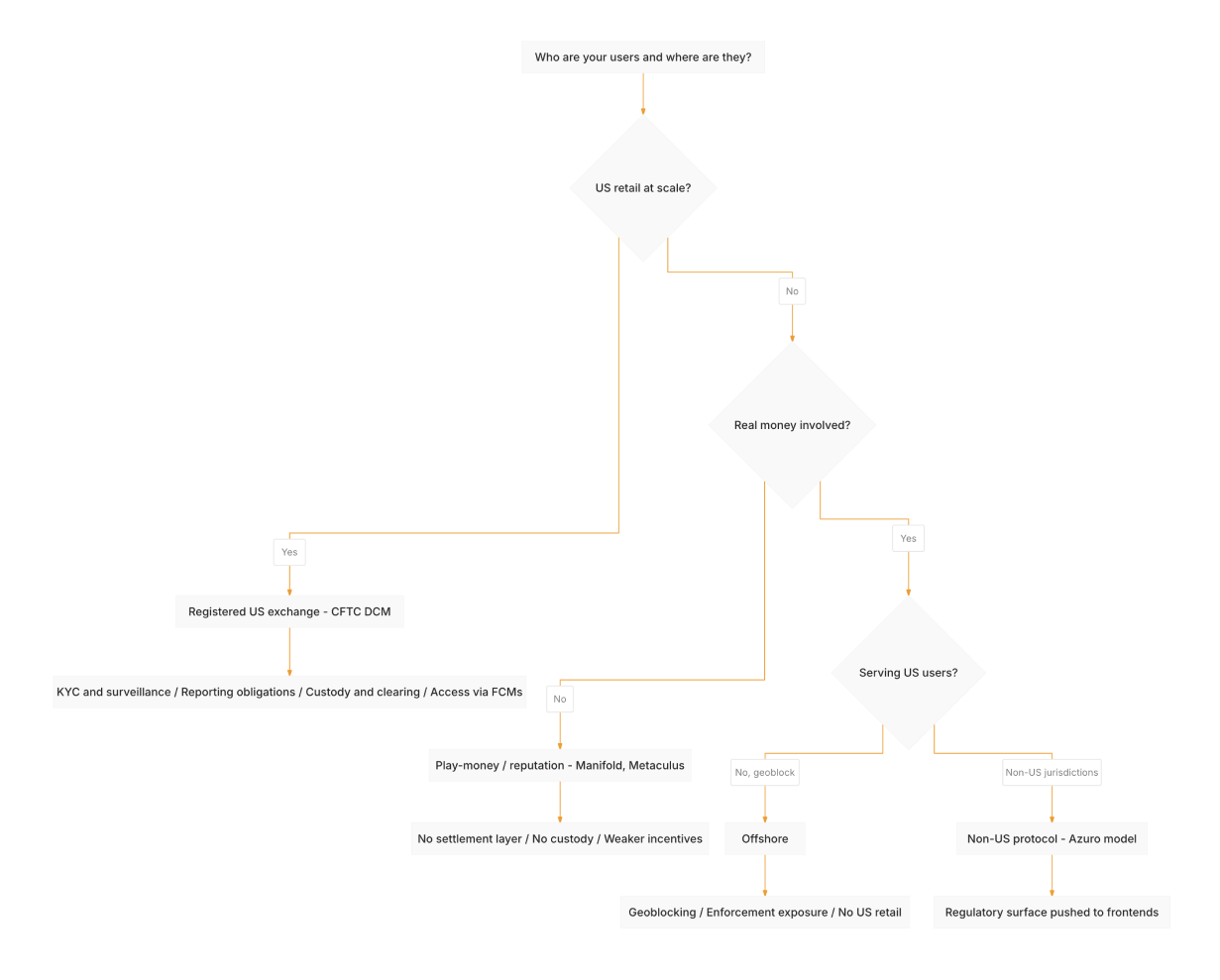
Prediction markets don't choose their classification; it's decided by the jurisdiction the users are from. Platform operators typically respond in one of five ways:
- Get a license. Register as an exchange or hold an operator license like Kalshi. Buying one works too: Polymarket acquired QCEX, and Crypto.com acquired Nadex. This is the heaviest compliance burden and the only way to serve retail at scale in a regulated market.
- Distribute on someone else's license. Build the app and route orders to a licensed venue instead of becoming one. Coinbase, Wealthsimple Predict, and Interactive Brokers all list Kalshi's contracts this way, and Fanatics Markets does the same on Crypto.com.
- Geoblock and operate offshore. This is the path Polymarket took before becoming licensed via their QCEX acquisition. Lighter regulatory load, no access to the largest markets, and exposure to enforcement action.
- Use play money. Manifold uses an internal currency (mana) and Metaculus runs on reputation scores. Both skip financial stakes entirely and are architecturally simpler because they don't require complex financial settlement infrastructure.
- Ship a non-US protocol. Azuro and similar platforms build the liquidity and settlement layer and let frontends carry the regulatory surface in their own jurisdictions.
Options 1 and 2 aren't permanent positions. Robinhood distributed Kalshi's contracts for a year, then bought its own venue (MIAXdx, now renamed Rothera) like Polymarket did. It now routes core contracts through Rothera while leaving others on Kalshi. Buying an existing license turned out to be faster than earning one.
Interactive Brokers went further. Their unified prediction markets platform connects Kalshi, CME Group, and its own affiliate exchange ForecastEx in one interface, with an order router that compares prices across all three and executes wherever the net price is best.
Whichever route a platform takes, the trading mechanism, oracle, and settlement design all inherit the decisions.
List of prediction market platforms compared
| Platform | Classification | Trading mechanism | Notes |
|---|---|---|---|
| Kalshi | Derivative (US DCM) | Centralized CLOB | Also the venue behind Coinbase and Wealthsimple Predict |
| Polymarket | Derivative (US DCM) + onchain | Hybrid CLOB | Offshore exchange plus regulated Polymarket US |
| ForecastEx | Derivative (US DCM) | Centralized CLOB | Interactive Brokers' affiliate exchange, also distributed via Robinhood |
| CME Group | Derivative (US DCM) | Centralized CLOB | Event contracts; JV behind FanDuel Predicts |
| Rothera | Derivative (US DCM) | Centralized CLOB | Robinhood's exchange, formerly MIAXdx |
| Nadex | Derivative (US DCM) | Centralized CLOB | Crypto.com's exchange, designated in 2004 as HedgeStreet |
| Limitless | Onchain | Fully onchain CLOB | Base, short-duration crypto markets |
| Opinion | Onchain (BNB Chain) | Conditional tokens on a shared liquidity metapool | AI oracle resolution; positions itself as infrastructure for other platforms |
| Myriad | Onchain (BNB Chain) | AMM | Markets embedded in news articles via browser extension |
| Predict.fun | Onchain (Blast, BSC) | Order book on conditional tokens | Taker-only fees with maker rebates |
| Azuro | Non-US protocol | Peer-to-pool via virtual AMMs | Single shared pool behind many frontends |
| Manifold | Play money | AMM | Anyone can create a market |
| Metaculus | Reputation | None | Calibrated forecasting, no trading |
With the legal groundwork out of the way, we can get to the part that's more fun: how a question about the future becomes something you can buy.
Layer 1: How do predictions become tradeable assets?
Through tokenization. Each possible outcome becomes its own token, and the collateral backing them sits locked in a contract until the oracle says which token is worth a dollar. Mechanically, you deposit $1, receive one token per outcome, and those tokens trade independently from that point on. Almost every real-money platform does some version of this.
The Conditional Token Framework (CTF)
The industry standard is the Gnosis Conditional Token Framework, a single Solidity contract built on ERC-1155 (a multi-token standard where one contract manages many distinct token types, unlike ERC-20's one-token-per-contract model) that tokenizes outcomes across any number of markets. Both Polymarket and Omen, Gnosis's own prediction market, now succeeded by its Presagio relaunch, are built on it.
Preparing a condition:
conditionId = keccak256(oracle, questionId, outcomeSlotCount)
An oracle address, a question identifier, and the number of possible outcomes are hashed together into a unique condition. This binds the condition to a specific oracle, so only that address can later resolve it.
Splitting collateral into outcome tokens:
splitPosition(collateralToken, parentCollectionId, conditionId, partition, amount)
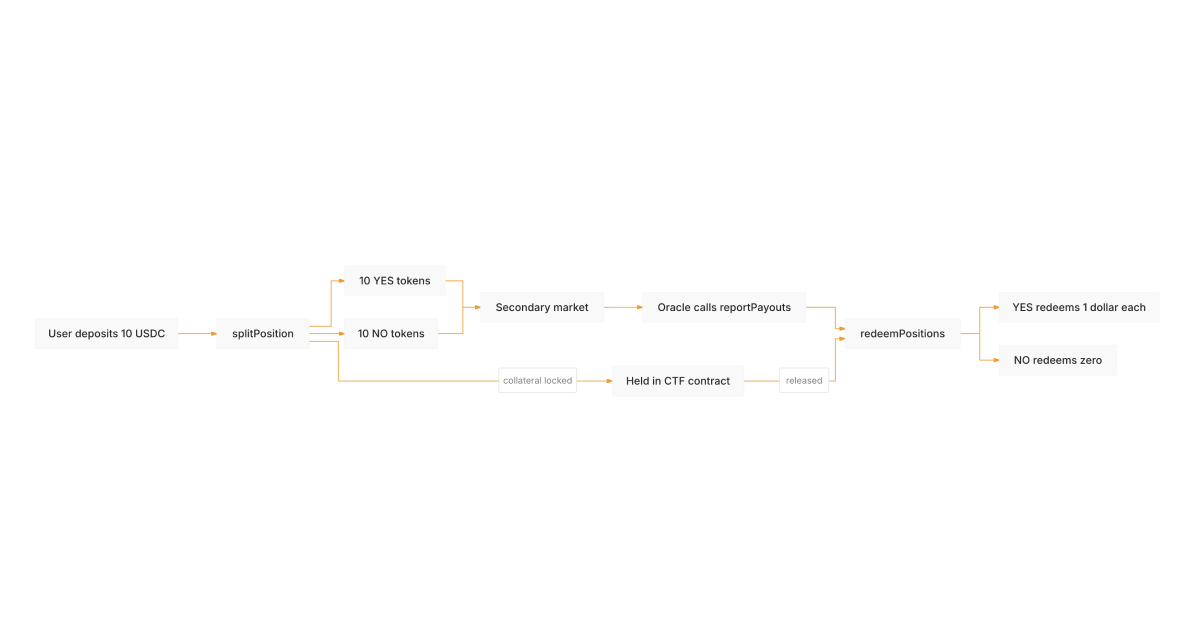
A user deposits 10 USDC into the CTF contract and receives 10 "Yes" tokens plus 10 "No" tokens for a binary market. The collateral is locked. The tokens are independent ERC-1155 assets that can be transferred, traded, or composed with other DeFi protocols.
Resolution and redemption:
reportPayouts(questionId, [1, 0])  // "Yes" wins
redeemPositions(...)               // Winners claim collateral
When the oracle reports that "Yes" won, each "Yes" token becomes redeemable for $1 of collateral. "No" tokens become worthless.
Why the settlement token is now a design decision
The CTF is collateral-agnostic and works with any ERC-20, which platforms have started treating as an opportunity instead of a default.
Polymarket's V2 upgrade, deployed April 28, 2026, migrated collateral from USDC.e to pUSD, a Polygon ERC-20 backed 1:1 by USDC with the backing enforced on-chain. Day to day nothing changes for a trader. The reason to issue your own wrapped collateral is control: over compliance hooks, on and off-ramps, approval UX, and potentially yield on the backing. Myriad made a related choice, standardizing its BNB Chain markets on USD1 as the base settlement asset.
The mechanics of splitting and redeeming are unchanged either way. What changed is that the collateral token became something platforms pick deliberately.
Combinatorial positions
The elegance of the CTF is composability. You can create tokens that pay out only if multiple conditions all resolve a certain way. Split on Condition A, take the "A wins" tokens, split those on Condition B, and you hold a position that pays only if both resolve as expected. This is how platforms handle correlated markets like "Party X wins the presidency AND carries swing state Y."
Market types: binary, multi-outcome, and scalar markets
The CTF supports three structures, and they behave quite differently.
| Market type | Outcome tokens | Payout | Example |
|---|---|---|---|
| Binary | 2 (Yes, No) | Winner takes $1, loser $0 | Will X happen by December 31 |
| Multi-outcome | 1 per candidate | One winner, rest worthless | Who wins the election |
| Scalar | 2, redeemed proportionally | Split by where the number lands | What will Q4 GDP growth be |
Binary markets are the simplest. Yes or No, two outcome tokens, one wins. Most of what you see on Polymarket falls here.
Multi-outcome markets ("Who wins the election?" with 10 candidates) introduce a correlation problem. If you buy "Candidate A wins" at $0.30, you are implicitly selling all other outcomes. Polymarket handles this with a Neg Risk CTF Adapter, a wrapper contract that decomposes multi-outcome events into binary Yes/No pairs while managing the negative correlation between them. Without it, arbitrage gaps between the binary pairs and the constraint that all probabilities sum to 1 would make the market incoherent.
Scalar (range) markets differ in kind rather than degree. Instead of discrete outcomes, the payout is proportional to where a numeric value falls on a defined range. "What will Q4 GDP growth be?" across a 0% to 5% range pays out linearly against the actual figure. The CTF handles this through reportPayouts: instead of [1, 0], the oracle reports something like [0.6, 0.4] to indicate a result 60% of the way through the range, and each token redeems for its proportional share.
Scalar markets work well for continuous quantities like temperature, price, and economic indicators. They're harder to build good UX for, because reasoning about ranges and distributions is a harder interaction pattern than buying yes or no. Most production platforms concentrate on binary and multi-outcome markets even though the token framework handles all three.
The alternative: bet-as-NFT
Not every prediction market uses the CTF. Azuro represents each bet as an ERC-721 NFT containing the condition ID, outcome, odds at time of placement, and bet amount. There are no tradeable outcome tokens that fluctuate in price. You lock in odds when you bet, and the NFT is your receipt.
This sits architecturally closer to a decentralized sportsbook than a financial exchange. It simplifies the data model considerably and enables a secondary market for bet positions, though in practice few users resell bet NFTs compared to the volume of outcome token trading on CTF-based platforms.
Who gets to create markets?
Every platform has to decide who's allowed to open a market.
| Model | Who creates | Strength | Weakness |
|---|---|---|---|
| Curated | Platform team | Clean resolution criteria, concentrated liquidity | Narrow coverage |
| Permissionless | Anyone | Broad long-tail coverage | Quality variance, split liquidity, spam |
| Data-provider governed | Licensed data providers | Domain expertise in structured events | Poor fit for novel topics |
Curated (e.g. Polymarket, Kalshi, ForecastEx, Rothera, Nadex). The platform team creates markets. For regulated venues it's not really a choice. A DCM has to self-certify each contract with the CFTC, so someone at the exchange is accountable for every market listed. Curation is a regulatory requirement wearing a product decision's clothing. Polymarket curates too, though less by obligation. The upside either way is clean resolution criteria and liquidity concentrated where it's useful. The downside is coverage: if the team doesn't write a market for your topic, it doesn't exist.
Permissionless (e.g. Manifold, XO Market). Anyone can open a market on any topic. Coverage gets far broader, especially for niche or emerging topics, at the cost of poorly worded resolution criteria, duplicate markets splitting liquidity, and spam.
Data-provider governed (e.g. Azuro). Data providers control creation, defining conditions for the events they cover. This works for sports leagues and esports tournaments where the set of possible markets is well-defined and the provider has domain expertise. Less suited to open-ended or novel topics.
The trend is toward hybrids: permissionless creation with curation layers on top. Let anyone create a market, then surface the good ones through incentive design, community curation, or algorithmic ranking. Polymarket opened permissionless liquidity rewards in February 2026, letting anyone sponsor depth on any market, and has signaled permissionless market deployment and creator fees as the next step.
Regulations and tokenization determine what you're allowed to list and what the user ends up holding. Setting prices happens in the trading mechanism, where the four dominant architectures diverge, and in the oracle, which decides what outcome happened.
Read about prediction market trading mechanisms, resolution, and settlement in Part 2, coming soon.
 Solana
 Polymarket
 Ethereum
 HyperEVM
 Plasma
 Tempo
Tempo Base
Base Bitcoin
 Polygon
 Unichain