Introducing Boost: A global CDN that cuts up to 80% of your RPC costs
Boost is a CDN that works alongside your existing RPC providers to reduce your billable RPC calls, saving you money.



Software Engineer, Software Engineer
Boost is a CDN for your RPC
Goldsky Boost is a multi-region CDN that sits between your application and your RPC provider(s).
Since 2022, Goldsky has been indexing chain history to run our products (Turbo, Subgraphs, Edge RPC). That means:
- backfilling each chain from genesis
- keeping them fresh at the tip
- rewinding and reapplying during reorgs
- absorbing and normalizing hard forks and node upgrades
- running 24/7 from-genesis data quality checks
Every new chain arrives with its own quirks, and the ones we already support never stop moving. Our index currently spans 150+ chains, to the tune of 1T+ RPC calls.
Meanwhile, other teams are separately paying RPC providers to serve pieces of that same history back to them, one request at a time. We already have the answers, and we’re opening this up as a CDN to the ecosystem.
How does it work?
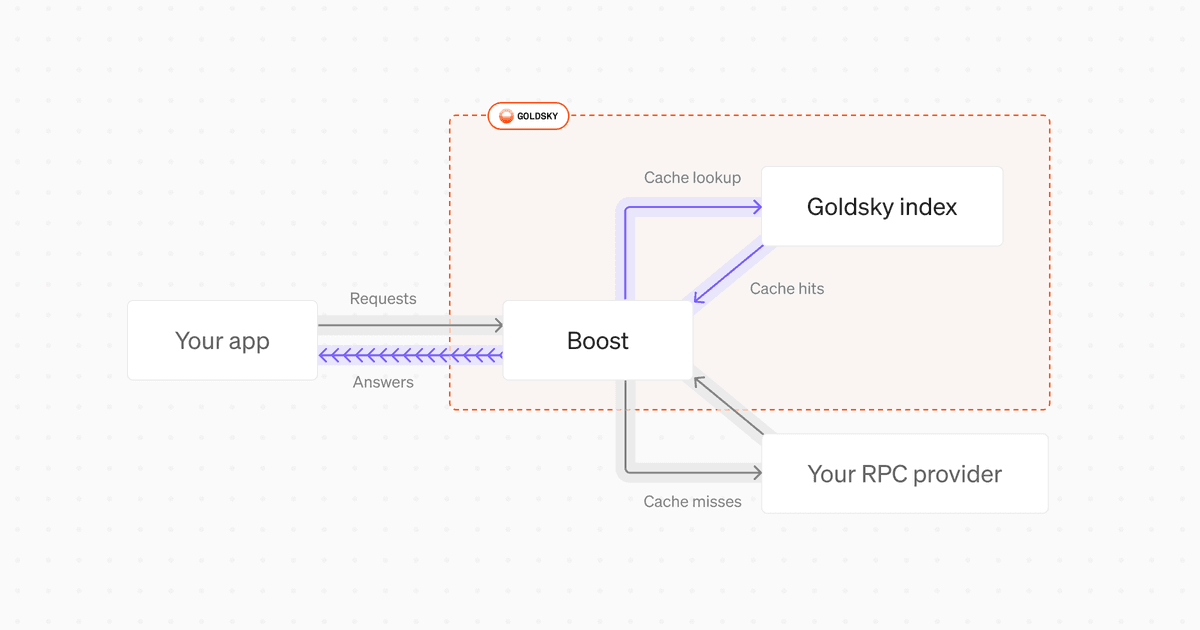
- Your app sends requests to a Boost endpoint instead of your provider's.
- We check whether the answer already exists in our indexed chain data.
- If it does, we return it. Your request hits our CDN instead of your RPC provider, so you won’t get billed for it, saving you money.
- If it doesn't, we forward the request to your provider and hand back their response exactly as they gave it.
Why use Boost?
- Cut your RPC bill: RPC providers bill per request. Boost means you send them less requests, without making less calls. We serve many via our CDN, completely for free.
- Keep your existing RPC provider(s): Boost doesn’t replace your RPC providers, so you don’t need to change your vendor agreements.
- Faster historical queries: We’ve replicated our CDN in four regions around the world, and answers come from the cache nearest your app.
- Easy install: Swap your existing RPC endpoint URL with Boost, which uses standard JSON-RPC formats. viem, ethers, foundry and every other client works unchanged.
- 100% free: Boost is free for organizations, subject to fair use.
Across recent production traffic, an average of 45% of requests were served from Boost’s cache.
Of course, your own rate depends on which chain you're on and which methods dominate your workload. Some teams see an 80% cache hit rate!
How is Boost different from Edge RPC?
Edge RPC is Goldsky's full RPC service, where we run the endpoints, the routing, and the failover. Boost is built into Edge, but does not serve 100% of requests itself; it requires you to have an upstream RPC account to serve requests that Boost can’t.
| Boost | Edge RPC | |
|---|---|---|
| What it is | A CDN in front of your provider | A replacement RPC endpoint |
| Main purpose | Cost savings | Reliability, coverage, data quality |
| Your provider | Unchanged | Becomes Goldsky |
| Failover | Manual, self-managed | Automatic, Goldsky-managed |
| Supported chains | 10 | 40+ |
| Regions | Multi-region | Multi-region |
| Effort to adopt | A URL swap | A URL swap |
| Who can use it | Organizations | Anyone (self-serve) |
| Cost | Free (limited time) | $5 per million requests |
| Choose it when | Your provider is fixed and your traffic is historical-read heavy | You want someone else to run RPC entirely |
Both are a one-line change to your RPC URL. However, Edge RPC is a vendor decision, whereas Boost isn’t, because you keep the provider you have.
Provider compatibility and credentials
Boost works in front of any endpoint reachable over https, including (but not limited to):
- Alchemy
- QuickNode
- Infura
- dRPC
- Ankr
- Chainstack
- and more.
Providers that authenticate with a bearer token or an API-key header work too. For Alchemy and QuickNode, you can enter an Admin API key and well manage the creation and configuration for you, end-to-end.
- Credentials are encrypted at rest. Your provider URL and any custom headers are stored encrypted, and you can replace or remove them in the dashboard at any time.
X-Forwarded-Forreaches your provider. They still see the caller's address, so per-IP rate limits, allowlists and analytics keep working.- You can keep several providers on file per chain. One is active at a time and you switch between them yourself.y
What gets cached?
Our documentation (opens in a new tab) goes into the details, but the summary of it is:
- If it’s a latency-sensitive request (eg. using a
latesttag), we forward to your provider to not get in the way of the view of the tip of the chain - If it’s an inherently uncacheable call, eg.
eth_getBalanceoreth_call, we forward to your provider as well
Otherwise, we try to cover as many requests as we possibly can. With no optimization or selective application of Boost, teams are seeing an average hit rate of about 45%. Routing to us intelligently only when there is a high probability of a Boost hit raises it to ~80%.
What does it cost?
For a limited time, Boost is free for organizations under fair use.
If pricing is introduced, it will always be a subset of the proven savings, so your total RPC bill will only go down. Play around with the Boost savings calculator for an idea of what you'll save.
For now, use Boost for free, and share your feedback with us!
Getting started with Boost
Activation requires a verified organization, so sign up with your work email. Personal accounts on public email domains will be asked to verify an organization first (ie. add a company email account as an admin, owner, or editor on their team).
Create a Boost endpoint and paste in the provider URL you already use.
For custom setup, organization-specific tuning, custom CDN regions, advanced observability, support commitments or performance SLAs, talk to us about Enterprise. View the docs (opens in a new tab) for the full method and header reference.
 Robinhood
 HyperEVM
 Arc
Arc Solana
 Ethereum
 Polymarket
 Base
Base Tempo
Tempo Bitcoin