Proof of reserves data: onchain balances of exchange-published reserve addresses
We read an exchange's published reserve addresses onchain: 13 month-end balances of USDC and USDT on Ethereum, and the share that the 5 largest addresses hold.

Account Executive
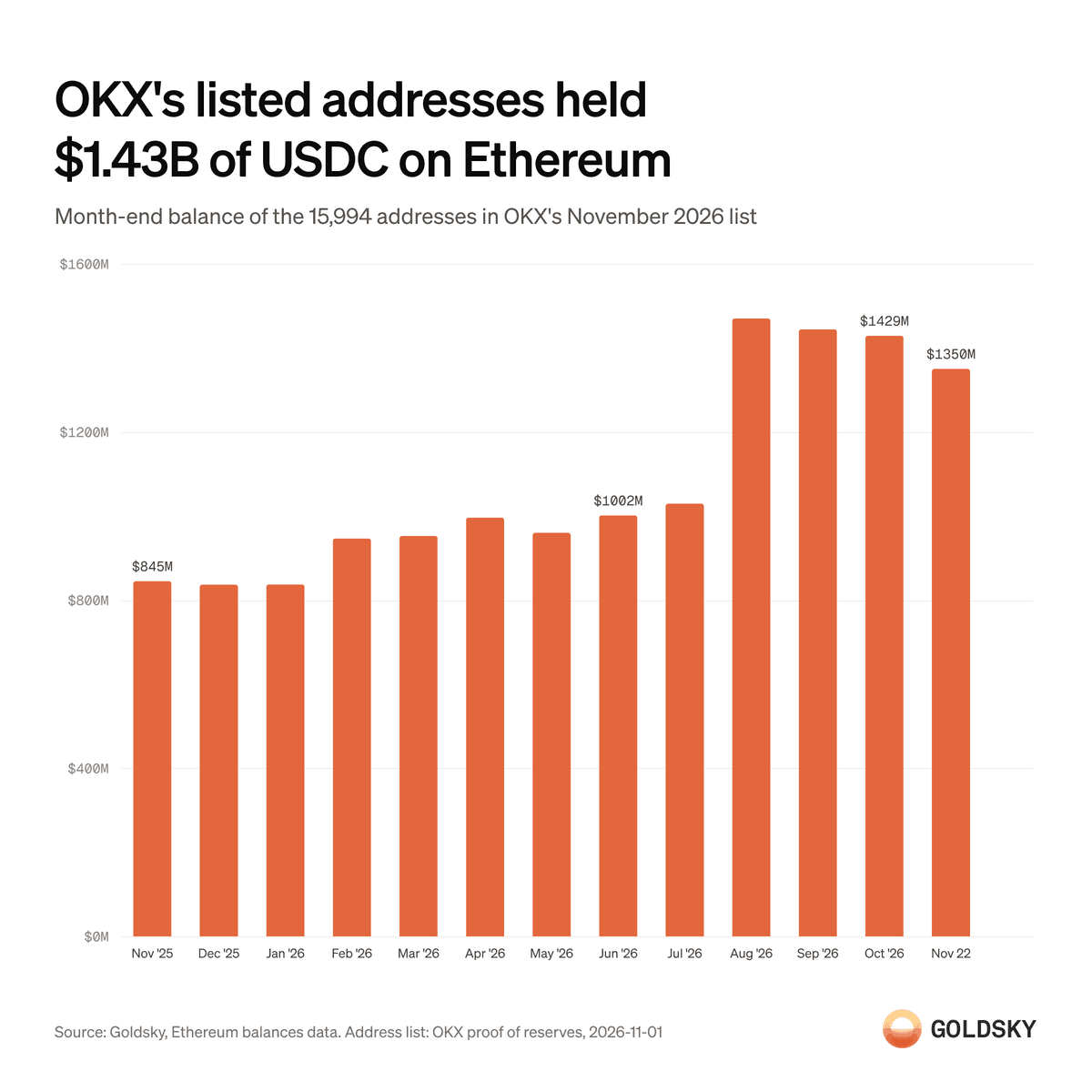
Some exchanges publish the addresses of their reserve wallets. Anyone can then read those balances onchain, at any block. We read OKX's list on Ethereum: 15,994 USDC addresses and 163 USDT addresses. At the end of October 2026 they held $1.43B of USDC and $7.66B of USDT with just five addresses holding 92% of the USDC.
Which exchanges publish an address list
Most proof-of-reserves programs publish a Merkle-tree or zero-knowledge proof of customer liabilities. Our post on how exchanges prove reserves onchain explains those methods. A proof of that type lets a customer check that the total includes the customer's balance. It does not show where the assets are.
An address list shows where the assets are. We looked at 9 large exchanges for a list that passes 4 tests. The list is complete, dated in the last 2 months, and published on the exchange's own site or repository. It is also stable enough for a 12-month history. Two exchanges had one. OKX publishes a signed file each month on its proof of reserves download page (opens in a new tab). HTX publishes a snapshot file in a GitHub repository (opens in a new tab). The other 7 did not pass in November 2026.
The 2 lists differ in detail. On Ethereum, OKX's November 2026 file has 6,959 addresses for ETH, 15,994 for USDC, and 163 for USDT. HTX's file has one address for ETH and one for USDC. A short list does not mean smaller reserves. It means the exchange discloses fewer addresses. The data below is for OKX's list.
Balance history of the listed addresses
| Month end | USDC | USDT | USDC addresses with a balance |
|---|---|---|---|
| 2025-11-30 | $845.2M | $6,103.3M | 9,656 |
| 2026-02-28 | $946.7M | $6,936.5M | 11,331 |
| 2026-05-31 | $960.2M | $9,890.3M | 12,829 |
| 2026-08-31 | $1,470.3M | $7,789.6M | 14,900 |
| 2026-10-31 | $1,429.1M | $7,664.1M | 15,982 |
| 2026-11-22 | $1,350.4M | $7,739.3M | 15,874 |
Chain: Ethereum mainnet. Each row is the balance at 23:59:59 UTC of the addresses in OKX's file of 2026-11-01.
The history uses one list, the current one. It shows what the addresses in the November 2026 file held at each earlier date. It is not OKX's reported reserve for those dates, because earlier files can have other addresses. A year before, 9,656 of the 15,994 USDC addresses had a balance. At the end of October, 15,982 did.
The USDC balance of these addresses was $845M at the end of November 2025 and $1.43B at the end of October 2026. The largest change in one month was from July to August 2026, when the balance went from $1.03B to $1.47B. OKX's report does not give a cause, and we do not state one. The report gives one total for each asset across all chains and no figure for each chain. For that reason we do not compare the Ethereum balance with the report.
Five addresses hold most of the USDC
| Asset | Addresses in the list | Addresses with a balance | Share in the 5 largest |
|---|---|---|---|
| USDC | 15,994 | 15,982 | 91.8% |
| USDT | 163 | 98 | 32.6% |
Reading: 2026-10-31, Ethereum mainnet.
The 2 assets have different shapes. Five addresses held 92% of the listed USDC, and the other 8% was in almost 16,000 addresses. The listed USDT was in fewer addresses, and its 5 largest held 33%. A check that reads only the largest wallets covers most of the USDC and one third of the USDT. A check of the full list must read 16,157 addresses for these 2 assets on one chain.
What an address list shows
An address list shows assets. Each address in OKX's file has a signature, which shows that the exchange controls the address. The balance at any block is public. The list does not show liabilities, so it does not show that assets cover customer balances. That is the job of the liability proof or of an auditor's attestation.
A list is also a snapshot. An exchange adds and removes addresses, and a balance history that uses one list does not see the removed ones. A team that monitors reserves must load each new list and keep the old ones.
Read a published address list with Goldsky
The work is a wallet-list problem. A Turbo pipeline (opens in a new tab) filters ERC-20 transfers against a dynamic table of addresses. You load the published list into that table, and the pipeline writes each transfer of a listed address to your database. When the exchange publishes a new list, you add the new rows and the pipeline starts to match them with no redeploy.
For a short list, the Feeds (opens in a new tab) Balances API returns the holdings of up to 10 EVM wallets in one request, with USD values. Our proof of reserves page covers the other direction: a check of a token's supply against its reserves on a schedule.
Method
The address list is OKX's proof-of-reserves file of 2026-11-01, for a snapshot on 2026-10-31. The balances come from our Ethereum balances data, which has one row for each change of a token balance. The balance of an address at a cutoff is its last row at or before the cutoff. The window is each month end from 2025-11-30 to 2026-10-31, and 2026-11-22.
WITH per_addr AS (
  SELECT owner_address, argMax(balance, block_number) AS bal
  FROM community.mainnet_raw_latest_balances_v2
  WHERE contract_address = '0xa0b86991c6218b36c1d19d4a2e9eb0ce3606eb48'
    AND owner_address IN ( /* 15,994 addresses from data/okx_eth_mainnet_usdc_addrs.txt */ )
    AND block_timestamp <= '2026-10-31 23:59:59'
  GROUP BY owner_address
  HAVING bal > 0
)
SELECT
  sum(bal) AS total,
  count() AS n_active,
  (SELECT sum(bal) FROM (SELECT bal FROM per_addr ORDER BY bal DESC LIMIT 5)) AS top5
FROM per_addr;We checked the balance of 3 addresses at block 26,313,798 against balanceOf on a public Ethereum RPC. Each one matched to the last unit.
Limits: the data covers USDC and USDT on Ethereum mainnet. It does not cover native ETH, Bitcoin, or the other chains in OKX's file. The dollar figures count one token as one dollar.
FAQ
Does a published address list prove that an exchange is solvent?
No. It shows assets at addresses that the exchange controls. It does not show liabilities. A liability proof or an auditor's attestation covers that part.
Can reserve addresses change?
Yes. An exchange can add and remove addresses in each new file. A history that uses one file shows only the addresses in that file.
Why is the Ethereum total lower than an exchange's total for the asset?
An exchange holds the same asset on several chains. OKX's file also lists addresses on Arbitrum, Base, Optimism, Polygon, and other chains, and this post reads Ethereum mainnet only.
How do I monitor a list of reserve addresses?
Load the list into a dynamic table and deploy a Turbo pipeline that filters transfers against it. For a list of 10 addresses or fewer, call the Feeds Balances API.
 Robinhood
 HyperEVM
 Arc
 Solana
 Ethereum
 Polymarket
 Base
 Tempo
 Bitcoin
