RWA tokenization platform for institutions: the data layer it needs
An institutional RWA tokenization platform needs five data services that a token contract does not give it: a holder registry, compliance monitoring, a NAV feed, reserve checks, and reconciliation.

Account Executive
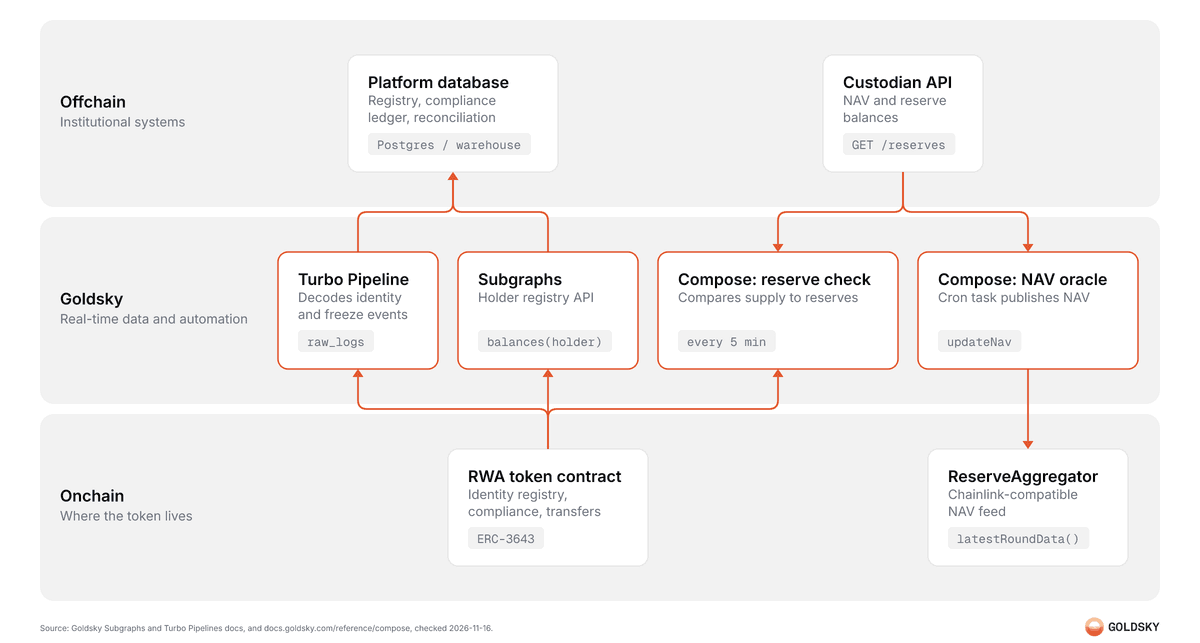
An institutional RWA tokenization platform needs five data services that a token contract does not give it. It needs a holder registry rebuilt from onchain events, and near real-time transfer and compliance monitoring. It also needs an onchain NAV or price feed, a reserve or backing check, and reporting that reconciles with its own books. Goldsky runs this data layer. Subgraphs and Turbo Pipelines read the chain, and Compose runs the checks and writes the oracle. Goldsky does not issue tokens, act as a transfer agent, or run KYC. The platform and its licensed partners keep those roles.
What a holder registry must read
Most RWA tokens add rules to a plain ERC-20 transfer. ERC-3643 (opens in a new tab), a standard for permissioned security tokens, adds an Identity Registry and a Compliance contract. Every transfer must pass both. A transfer reverts if the receiver has no verified identity, if either wallet is frozen, or if the Compliance contract's canTransfer check fails. An example of a failed check is a cap on holders per country.
Worked example: a fund issues an ERC-3643 token. Investor A has a verified identity. Investor B has no onchain identity. A sends 1,000 shares to B. The token calls isVerified(B) on the Identity Registry, gets false, and the transaction reverts before any balance changes. The same transfer to a third, verified investor succeeds and emits a Transfer event. A registry that watches only Transfer sees every successful move. It does not see why a transfer was blocked, because a reverted transaction leaves no log. A compliance feed must also read the Identity Registry and freeze events.
The five data services
1. Holder registry and cap table
A platform needs the current balance per holder, per token, per chain. It rebuilds that balance from every mint, burn, and transfer since the token's first block, for every share class. Subgraphs (opens in a new tab) give a GraphQL API over that history. Goldsky's tokenized equities guide (opens in a new tab) recommends a subgraph for a registry that a team queries by holder. Turbo Pipelines (opens in a new tab) stream the same events when the destination is the platform's own database.
The platform keeps the legal cap table and the transfer agent relationship. It also decides which address is the holder of record when a custodian holds the wallet.
A registry rebuilt from events updates with each block. A registry rebuilt from an overnight file is up to one day behind the chain.
2. Transfer and compliance monitoring
A compliance team needs identity and freeze events, such as IdentityRegistered, AddressFrozen, TokensFrozen, and RecoverySuccess, as they happen. Goldsky's securities compliance guide (opens in a new tab) decodes these events from raw_logs with a Turbo pipeline and writes each one to a compliance ledger.
The platform decides what counts as an eligibility breach. It also runs the KYC check that grants or removes the onchain identity.
With this ledger, the question "who could hold this token, and since when" is a query on a table. The platform does not rebuild the history from a block explorer.
3. NAV or price publishing onchain
A tokenized fund's NAV must reach every chain where the fund trades, on a schedule, in a format that existing contracts read. In Goldsky's NAV oracle guide (opens in a new tab), a Compose (opens in a new tab) task runs every 5 minutes. It gets the NAV from a custodian endpoint and writes it to a ReserveAggregator contract on each chain. The contract implements Chainlink's AggregatorV3Interface, so existing consumers read it with no change. Custom oracle infrastructure covers oracle design in more detail.
The platform keeps the NAV calculation and the custodian relationship.
In the guide, one task run writes to 2 chains. A failure on one chain does not stop the write on the other.
4. Reserve and backing checks
A platform must know that onchain supply is backed between quarterly reports. Goldsky's treasury and reserves guide (opens in a new tab) runs a Compose task every 5 minutes. The task reads onchain supply, gets reserves from a custodian API, and records the ratio onchain. It can send an alert, or pause the token, when backing falls below a threshold. For the current holdings of a reserve wallet, the Feeds Balances API (opens in a new tab) returns the balance in one call. Exchange proof of reserves onchain covers the exchange side of the same check.
The platform keeps the custodian relationship and the decision to pause the token.
A ratio checked every 5 minutes finds a shortfall in minutes. A quarterly attestation report finds it at quarter end.
5. Reporting and reconciliation
Every number above must reach the platform's own database or warehouse, with no missed blocks. Turbo Pipelines (opens in a new tab) write the stream into Snowflake, Databricks, BigQuery, or Postgres. Goldsky's real-time reconciliation guide (opens in a new tab) joins chain data to an internal ledger for payment settlements. A holder registry check is the same join, on holder instead of invoice. For the platform's own RPC reads, Edge RPC (opens in a new tab) cross-checks responses from several RPC nodes and checks block ranges for gaps.
The platform keeps the books of record. It also decides which differences go to an escalation.
An address that holds tokens with no matching book entry shows up as a row in the next query result.
What each part needs, and what runs it
| Data part | What it needs | Goldsky product | Docs |
|---|---|---|---|
| Holder registry and cap table | Full event history from the first block, every chain and share class, updated per block | Subgraphs or Turbo Pipelines | Tokenized equities (opens in a new tab) |
| Transfer and compliance monitoring | Identity and freeze events as they happen, custom ABI decoding | Turbo Pipelines | Securities compliance (opens in a new tab) |
| NAV or price oracle | Scheduled writes to every chain, Chainlink-compatible reads | Compose | NAV oracle (opens in a new tab) |
| Reserve or backing check | Onchain supply and offchain reserves, compared every few minutes | Compose, Feeds | Treasury and reserves (opens in a new tab) |
| Reporting and reconciliation | Complete data in the platform's own warehouse | Turbo Pipelines, Edge RPC | Data warehouse sinks (opens in a new tab) |
What 4 institutional platforms use
A holder registry that covers more than one issuer must read a different permission model for each one. Each row comes from the platform's own contracts, code, or docs.
| Platform | Chains (source) | What a registry must decode |
|---|---|---|
| Securitize | Solana and other chains, per fund (STAC on Solana (opens in a new tab)) | DS Protocol: a token plus a Registry Service (investors and their registered wallets) and a Compliance Service (DS Protocol repository (opens in a new tab)) |
| Franklin Templeton BENJI | Stellar, Polygon, Arbitrum, Avalanche, Aptos, Ethereum, Base, Solana, BNB Smart Chain (BENJI contracts (opens in a new tab)) | Stellar payment operations on Stellar, not EVM Transfer logs |
| Ondo USDY | Ethereum, BNB Chain since August 2026 (USDY on BNB Chain (opens in a new tab)) | An ERC-20 that checks an allowlist, a blocklist, and the Chainalysis sanctions oracle on each transfer (USDY repository (opens in a new tab)) |
| Superstate USTB and USCC | Ethereum and Plume (Superstate smart contracts (opens in a new tab)) | Upgradeable ERC-20 tokens plus Allowlist contracts. Superstate's admin address controls minting, allowlist changes, and forced burns. |
A registry that covers these 4 platforms reads 4 permission models. They are DS Protocol registry and compliance contracts, Stellar asset operations, allowlist and sanctions checks, and Superstate's allowlist contracts. A Transfer event alone shows none of them.
On Solana, Goldsky's solana.rwa_transfers dataset (opens in a new tab) already tracks BENJI and USTB transfers, with tokenized stocks, ETFs, and metals.
Run it on Goldsky
This is the compliance ledger pipeline from the securities compliance guide, as published:
name: erc3643-compliance
resource_size: s

sources:
  security_logs:
    type: dataset
    dataset_name: ethereum.raw_logs
    version: 1.2.0
    start_at: latest
    filter: address = lower('0xTOKENIZED_SECURITY')

transforms:
  events:
    type: sql
    primary_key: id
    sql: |
      SELECT
        id,
        address AS token,
        _gs_log_decode(
          _gs_fetch_abi('https://raw.githubusercontent.com/your-org/abis/main/erc3643.json', 'raw'),
          topics,
          data
        ) AS decoded,
        block_timestamp,
        transaction_hash,
        _gs_op
      FROM security_logs

  compliance_events:
    type: sql
    primary_key: id
    sql: |
      SELECT
        id,
        token,
        decoded.event_signature AS event,
        decoded.event_params[1] AS subject,
        to_timestamp(block_timestamp) AS at,
        transaction_hash,
        _gs_op
      FROM events
      WHERE decoded IS NOT NULL
        AND decoded.event_signature IN (
          'IdentityRegistered', 'IdentityRemoved',
          'AddressFrozen', 'TokensFrozen', 'TokensUnfrozen',
          'RecoverySuccess', 'Paused', 'Unpaused'
        )

sinks:
  compliance_ledger:
    type: postgres
    from: compliance_events
    schema: compliance
    table: security_events
    secret_name: MY_POSTGRES
primary_key: idThis pipeline writes to Postgres. Turbo Pipelines also write to ClickHouse, Kafka, S3, data warehouses, and other destinations, listed in Turbo supported sinks (opens in a new tab).
FAQ
Does Goldsky issue tokens, act as a transfer agent, or run KYC?
No. Goldsky reads onchain events and runs the checks and onchain writes that depend on them. Issuance, transfer agent duties, and KYC stay with the platform and its licensed partners.
Which Goldsky product does a platform start with?
The one for its slowest data today. A platform that reconciles holders overnight starts with Subgraphs or Turbo Pipelines. A platform that publishes NAV by hand starts with Compose.
Can this run in the platform's own cloud?
Yes. Goldsky's tokenized assets page covers on-premises and BYOC deployment, SOC 2 Type II, and dedicated infrastructure for regulated environments.
How does a platform check the registry against its books of record?
The registry is a table in the platform's own database. The check is a join, the same pattern the reconciliation guide uses for payment settlements. Each result row is an address that holds tokens with no matching book entry.
What if the platform already reads its fund NAV through Chainlink's interface?
The NAV oracle contract implements AggregatorV3Interface. A contract that reads a Chainlink feed reads this one with no code change.
 Robinhood
 HyperEVM
 Arc
 Solana
 Ethereum
 Polymarket
 Base
 Tempo
 Bitcoin
