How Polymarket automates 80,000+ markets a month
Polymarket's short-duration crypto markets crossed $5.6B in volume since inception, becoming their fastest-growing category with 9.9X trader growth. Learn how partnering with Goldsky made it possible.
9.9x
trader growth
59.4%
of all trades
80,000+
monthly markets
2x
fee efficiency
Polymarket has been using Goldsky since 2022, back when it was doing under $3 million in monthly volume. In March 2026, they cleared $11.3 billion in a single month. A growing share of that comes from a new category the two built together: short-duration crypto markets.
Meet Polymarket
Polymarket is the world's largest prediction market. Over 450,000 traders use the platform to bet on everything from presidential elections to whether Bitcoin will be up or down in the next five minutes. ICE (parent company of the New York Stock Exchange) led a $2 billion investment at a $9 billion valuation.
The platform runs on Polygon, settles in USDC, and resolves most markets through UMA's Optimistic Oracle - a system where a proposer submits an outcome, a challenge window passes, and the market settles. This model works well for the markets Polymarket built its name on.
In early 2026, Polymarket partnered with Goldsky to automate and scale a new category of markets: short-duration crypto predictions that resolve on a fixed schedule, as fast as every five minutes. The infrastructure powering this is Compose (opens in a new tab), Goldsky's orchestration framework for hybrid onchain/offchain workflows.
The opportunity in short-duration markets
Polymarket built its reputation on long-duration event markets like elections, geopolitics, sports, and macroeconomic outcomes. Those markets resolve over days or weeks.
But instead of betting on what will happen 4 months from now, or 4 weeks from now, what about predicting what will happen in 4 hours? 15 minutes? Or 5? Polymarket saw an opportunity in high-frequency crypto markets. Traders wanted to bet on whether Bitcoin would be up or down by the next candle close. Demand for these fast markets was growing, but they introduce a host of problems the other markets don’t have:
- Manually managing markets doesn’t scale to high-frequency assets. Each asset needs 288 new 5-minute markets, 96 new 15-minute markets, and 6 4-hour markets every day. Across BTC, ETH, SOL, XRP, DOGE, BNB, and Hyperliquid, that's 2,730 markets a day, each requiring onchain contract interactions. No team can do this by hand. Without automation, the high-frequency category can’t exist.
- Optimistic settlement doesn't fit a 5-minute bet. UMA's Optimistic Oracle is built for markets where an outcome can be proposed, challenged, and disputed, which is exactly right for an election or a geopolitical event. But a crypto market resolving on a fixed schedule has a single objective answer at closing: the price. It needs to settle instantly so traders and bots get their capital back and can roll into the next window. That's a different resolution model.
- One failed transaction means a market doesn't resolve. At thousands of resolutions a day, even a tiny error rate compounds into stuck payouts and customer support headaches. High frequency makes reliability a hard requirement.
How Compose automates the prediction market lifecycle
Compose is Goldsky's orchestration framework for hybrid onchain/offchain workflows. For Polymarket, it handles the full lifecycle of short-duration markets: creation, resolution, state tracking, and recovery.
- Schedule market creation: Compose tasks run on cron triggers, deploying new markets at fixed intervals (every 5 minutes, 15 minutes, or 4 hours depending on the market type).
- Automate market resolution: At market expiry, Compose fetches price data, determines the outcome, and posts the payout onchain. Settlement happens immediately, not hours later.
- Two-layer reorg protection: Polygon reorgs happen. Every transaction goes through a two-phase confirmation process:
- Shallow confirmation. The
writeContractcall waits for a configurable number of block confirmations before the promise resolves. This means the task doesn't advance until the transaction is in the chain with some depth. - Deep monitoring. After the promise resolves, Compose keeps watching the transaction for an additional ~250 blocks. If the transaction receipt disappears (it was reorged off the chain), Compose responds based on the configured strategy: replay the transaction with fresh gas parameters and a recalculated nonce, drop it, or hand off to a custom task.
Polymarket's transactions are idempotent and not time-sensitive, so replay is the right choice. But consider a different case: a transaction submitted when ETH was $3,000 gets reorged 250 blocks later after a crash to $2,000. Replaying that transaction could be the wrong call. Compose gives you the choice.
This is built into Compose's EVM context (opens in a new tab). Compose ships with default confirmation depths and reorg handling, so you get shallow and deep protection without configuring anything (though you can tune the values over time like Polymarket did).
- Shallow confirmation. The
- Full execution logs and audit trail: Every API call, fetch, database write, and blockchain transaction is logged with full inputs and outputs. If something goes wrong, Polymarket engineers can step through the logs to see exactly what happened. Beyond debugging, the audit trail gives Polymarket visibility into every action a Compose app takes.
“Polymarket creates thousands of these high-frequency crypto markets every day. At that frequency, reliability is critical. Goldsky Compose gave us the confidence to automate the entire workflow safely, and these markets are now one of the fastest-growing parts of the platform.” — Jon Amenechi, Head of Onchain Execution @ Polymarket
The impact
Goldsky helped Polymarket turn up/down crypto markets from a BTC-only experiment into one of the platform’s fastest-growing and most automation-native market categories.
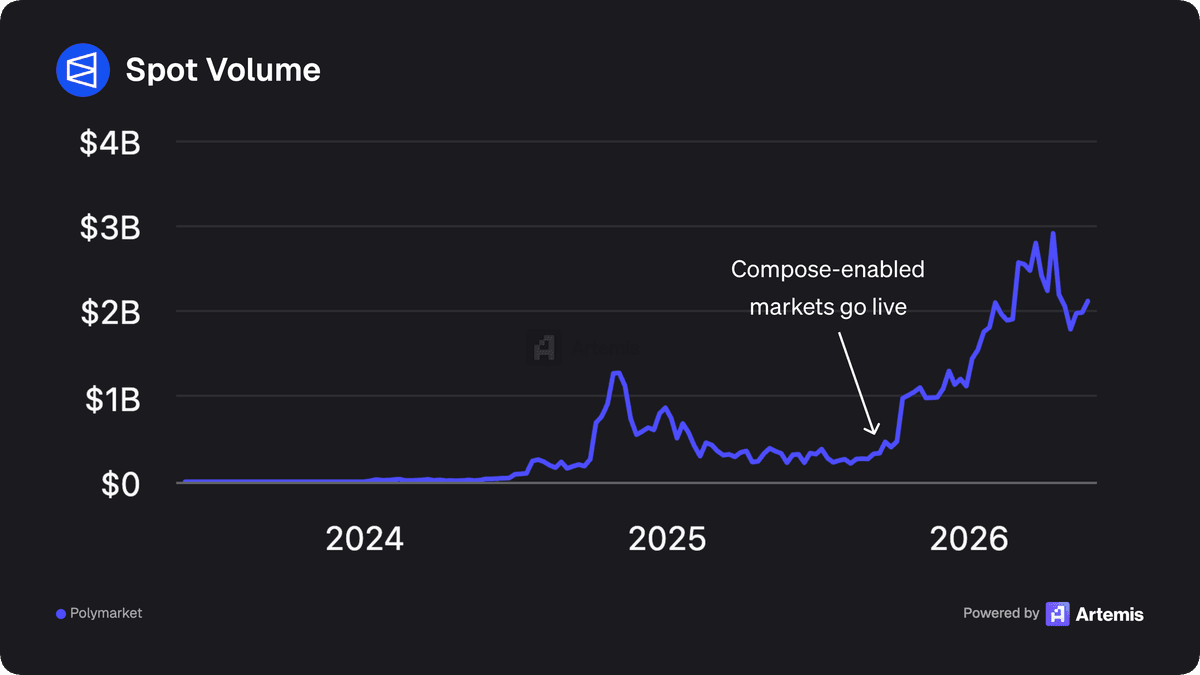
- $5.6B cumulative volume as of June 2026 (from $66.6M in month one)
- 9.9X trader growth – short-duration crypto is now Polymarket's fastest-growing market category
- 34.5% user penetration rate – 34.5% of all users have traded a short-duration crypto market
- 8X bot-attributed volume – bot-driven volume grew to $342M in June 2026, representing 64% of crypto market volume and 16% of total platform fees
- 2X fee efficiency – short-duration crypto markets represent 12.9% of platform volume but generate 25.5% of platform fee revenue
- Zero resolutions lost – Compose helped Polymarket automate 80,000+ market resolutions per month without losing any
How the flywheel spins
Polymarket’s short-duration crypto markets grew because four loops reinforced each other. Faster settlement improved bot economics, bots made markets more liquid, liquid markets supported expansion into more assets and timeframes, and that activity attracted more traders and developers.
Capital efficiency: instant resolution makes bot economics work
Short-duration markets only work if capital can keep moving. With Compose resolving markets the second they close, programmatic traders can cycle capital through consecutive windows instead of waiting hours to get paid.
That changes the economics for high-frequency traders. High-frequency traders are sensitive to idle capital. Faster settlement means less idle capital. Less idle capital makes more strategies viable. More viable strategies attract more bots. More bots tighten spreads, tighter spreads improve fills, and better fills attract even more participation.
The result is a step-change in automated activity:
- Bot-attributed volume went from $43M in September 2025 to $342M in June 2026, an 8X increase
- Automated trading represented 64% of crypto market volume by June 2026
- Automated traders grew 35X
Volume and expansion: new markets easy to launch
Once the creation and resolution workflow proved reliable on Bitcoin, Polymarket could expand the format without rebuilding the system each time.
Adding a new asset became a config change instead of an engineering project. Because bots are asset-agnostic, new markets could launch with activity from day one instead of a cold start.
- Polymarket expanded from BTC-only to 7 assets across 3 timeframes (5-minute, 15-minute, and 4-hour markets)
- Monthly crypto market volume grew from $66.6M in the first month to $533M in June 2026
New user adoption: crypto became the fastest-growing category
Short-duration crypto markets became Polymarket's fastest-growing category. It pulled in participants who weren't trading prediction markets before: high-frequency retail on one end, programmatic agents on the other.
More capital cycling through more markets means more resolved events, and more fee-generating activity per dollar of deposits than the slow event markets ever produced.
The result was broad adoption and outsized monetization:
- 9.9x trader growth from September 2025 to June 2026, making short-duration crypto Polymarket’s fastest-growing market category
- 34.5% trader penetration, with more than one-third of Polymarket users trading a short-duration crypto market
- 59.4% of all Polymarket trades now happen on short-duration markets, showing how strongly the format changed trading behavior
- 2x fee efficiency, with short-duration crypto generating 25.5% of platform fee revenue from 12.9% of platform volume
Developer ecosystem: more demand for better tooling
Polymarket supports a public agent integration ecosystem through GitHub, docs, and APIs, making it easier for developers to build trading agents around these markets.
That creates the fourth loop. More bot and agent activity creates more demand for better tooling. Better tooling lowers the barrier for developers. More developers bring more agents, more agents improve liquidity, and better liquidity makes the markets more attractive for everyone else.
Underpinning the loops: reliability and developer experience
Short-duration markets create a new operational burden. Thousands of markets have to be created, resolved, and finalized every month without manual intervention. A single missed resolution can break trader trust.
Compose gave Polymarket the reliability layer to operate that volume safely. Every transaction either confirms or gets replayed automatically, so markets can keep resolving even when the underlying chain is unstable.
- Zero resolutions lost to Polygon reorgs since launch, even during chain outages
- 80,000+ markets automated per month without incident
- Easy on the team because the same TypeScript runs locally and in Goldsky's cloud, so engineers test against production-identical behavior
What this means for prediction markets
On the surface, the short-duration category looks like a prediction market, but it trades like a perpetual future. They both have fast cycles, bot ecosystems, and high demand for instant settlement.
As durations shrink, the line between "prediction market" and "exchange" gets blurry, and Polymarket has been expanding into more trading products on exactly that bet.
It’s already working. Short-duration crypto is Polymarket’s fastest-growing category, with bot-driven volume up roughly 10X in six months. What decides who wins is whether you can reliably create, resolve, and audit thousands of time-sensitive markets a day without a human in the loop. That's an infrastructure problem, and Polymarket solved it with config changes in Compose.
Accelerate your onchain workflows
👋 Hey, we're Goldsky. We help teams like Polymarket automate high-stakes onchain workflows with Compose, our orchestration framework that connects offchain and onchain systems. Try Compose or get in touch to see if Compose is the right fit for your use case.
 Robinhood
 HyperEVM
 Arc
Arc Solana
 Ethereum
 Polymarket
 Base
Base Tempo
Tempo Bitcoin