Tokenized Treasury Data: Where It Lives Onchain
BlackRock's BUIDL pays daily yield as new tokens, so 97% of the mint events on its main Ethereum class are interest payments. Its burns mix redemptions, share-class swaps, and chain moves. Where tokenized treasury data lives and how to index it.

Solutions Engineer
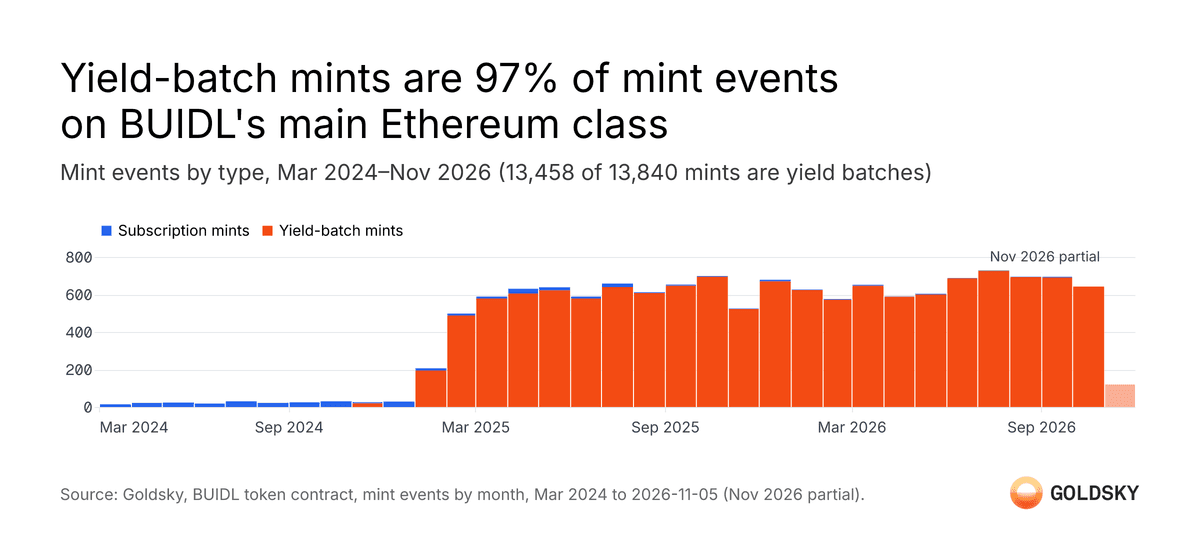
A tokenized treasury fund records its state in token events: mints, burns, and transfers. The same event can mean different things. BlackRock's BUIDL pays daily yield as new tokens, so 97% of the mint events on its main Ethereum share class are interest payments. Those mints carry less than 1% of the dollars minted. BUIDL's burns also mix redemptions, exchanges between share classes, and moves to other chains, and each burn carries a reason string that tells them apart.
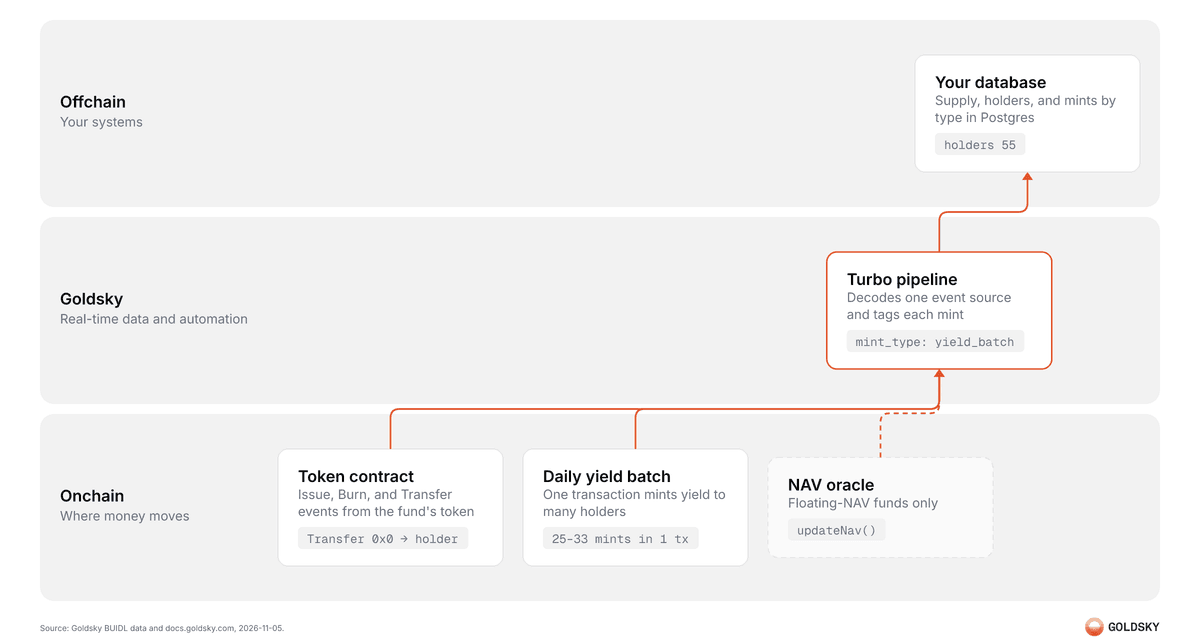
Mint, burn, and transfer: the token's own ledger
Goldsky's treasury-and-reserves guide (opens in a new tab) describes two ways a token records supply changes. Some tokens emit named events such as Mint and Burn. A standard ERC-20 token records a mint as a transfer from the zero address and a burn as a transfer to the zero address.
BUIDL does both. Its main Ethereum contract (opens in a new tab) emits an Issue event and a zero-address Transfer for every mint. It emits a Burn event and a zero-address Transfer for every burn. Goldsky's data shows that the two sets match one to one. A pipeline should read one of the two sources. If it reads both, it counts every supply change twice.
Mints: yield batches and subscriptions
Securitize's BUIDL page (opens in a new tab) states that the fund "seeks a stable $1 NAV". Dividends accrue each calendar day and are paid the next business day as new BUIDL tokens. Onchain, each payment is one transaction that mints to many holders.
On the main Ethereum class, a subscription mint credits one to four addresses. A yield-batch mint credits 25 to 33 addresses in one transaction. Very few transactions fall between the two groups. This post counts a transaction with 20 or more mint events as a yield batch.
| Mint type | Mint events | Dollars minted |
|---|---|---|
| Subscription | 382 | $2.25B |
| Yield batch | 13,458 | $21.4M |
| Total | 13,840 | $2.27B |
The first yield batch is on November 1, 2024. From January 2025, a yield batch appears on almost every business day. Subscriptions on this class were between $19M and $411M a month in 2025. In 2026 they are between $1M and $39M a month.
A monthly count of mint events on this contract is mostly a count of interest payments. To measure new money, filter the mints by type first.
Burns: three reasons in one event
BUIDL's Burn event has a third field, a reason string. On the main Ethereum class, three values appear.
| Reason string | Burns | Dollars burned |
|---|---|---|
| (empty) | 183 | $1.62B |
dstoken-swap | 23 | $411M |
bridge | 20 | $64M |
Every dstoken-swap burn has a matching mint of BUIDL-I (opens in a new tab), the fund's I Class share token on Ethereum, in the same transaction and for the same amount. The swaps in the other direction also match, 14 of 14. These burns are exchanges between two share classes of one fund, not redemptions. A bridge burn moves tokens to another chain. Securitize does not publish what an empty reason string means.
A pipeline that treats every burn as a redemption counts $475M of share-class swaps and bridge moves as money that left the fund. Split burns by the reason string before reporting outflows.
Where BUIDL's supply sits
BUIDL has two share classes on Ethereum and runs on seven other chains. A single contract does not show the size of the fund.
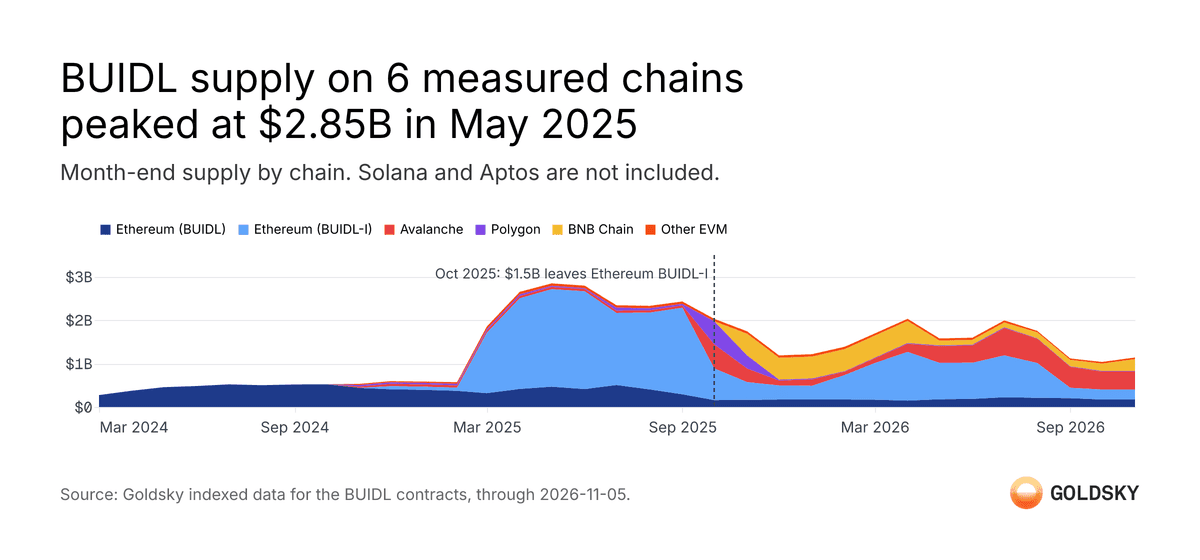
Supply on Ethereum, both classes combined, was highest in May 2025, at $2.71B. On October 20 and 23, 2025, two BUIDL-I burns removed $1.5B from Ethereum. On October 23, Avalanche and Polygon each recorded a $500M BUIDL mint to the same address.
| Network | Supply on November 5, 2026 |
|---|---|
| Avalanche | $417M |
| BNB Chain | $272M |
| Ethereum, BUIDL-I | $229M |
| Ethereum, BUIDL | $173M |
| Optimism, Arbitrum, Polygon | $50M |
Solana and Aptos are not in this table. RWA.xyz (opens in a new tab) shows BUIDL at $1.87B across all chains and tokenized treasury funds at $14.24B in total. A team that tracks a tokenized fund needs every share class on every chain in one pipeline. Otherwise a move between chains looks like a redemption on one chain and a subscription on another.
NAV: a fixed price or a separate oracle
A fund with a fixed $1.00 share price has no NAV series to index, because its yield arrives as mints. A fund with a floating share price must publish its NAV where a contract can read it. That is usually a separate contract, not a field on the token.
Goldsky's multi-chain NAV oracle guide (opens in a new tab) shows that second design. The oracle contract matches Chainlink's AggregatorV3Interface, so an existing Chainlink consumer can read it unchanged. A scheduled task reads the custodian's reported NAV and calls updateNav. For a floating-NAV fund, index those calls as a second time series next to the supply events.
Holders and compliance events
Every transfer debits one holder and credits another. Goldsky's tokenized-assets page describes a live holder registry built from that stream. BUIDL's main Ethereum class has 55 holders, and the top 10 hold 86% of its supply. BUIDL-I has 9 holders. With so few large holders, one holder's decision can move supply by hundreds of millions of dollars in one day.
Permissioned tokens also emit compliance events. ERC-3643 tokens check an investor registry on every transfer. BUIDL uses Securitize's DS Protocol, which registers its compliance services through a DSServiceSet event, not through one event per transfer.
Indexing it with Turbo Pipelines
Turbo Pipelines (opens in a new tab) indexes a tokenized treasury fund in five steps, following Goldsky's treasury-and-reserves pattern:
- List every share-class contract on every chain the fund uses.
- Decode each token's supply changes from the named events or the zero-address transfers. Use one source, not both.
- Tag each mint as subscription or yield by the number of mint events in its transaction. Tag each burn by its reason string.
- Route the same stream to a holder-balance table. Credit the recipient and debit the sender on every transfer.
- For a floating-NAV fund, also index the oracle's
updateNavcalls.
This is the supply query from the guide:
SELECT
  token,
  SUM(CASE WHEN event = 'Mint' THEN amount ELSE -amount END) AS circulating_supply
FROM treasury.supply_events
GROUP BY token;Goldsky's curated erc20_transfers dataset uses the same schema on every EVM chain it covers, as the EVM sources guide (opens in a new tab) shows. A pipeline for one chain needs only a new dataset name to run on another.
Why a team would use Goldsky for this
Turbo Pipelines decodes the token events on each chain into one database. Compose can publish a NAV for a floating-price fund on the same platform. Goldsky's post that introduces Compose describes it in more detail. To follow a balance from chain to chain after a mint, see the label pattern in Goldsky's digital asset lineage post.
Method
- Source: Goldsky's indexed logs for the BUIDL and BUIDL-I contracts on Ethereum, and the BUIDL contracts on Avalanche, Arbitrum, Optimism, Polygon, and BNB Chain. Data runs to November 5, 2026. Reorged logs are removed.
- Mint: a
Transferfrom the zero address. Burn: aTransferto the zero address. On Ethereum, theIssueandBurnevent counts match these exactly. - Yield batch: a transaction with 20 or more mint events, on the main Ethereum class only. BUIDL-I has at most 5 mint events per transaction, so the split does not apply to it.
- Share-class swap: a
dstoken-swapburn matched to a mint of the other class in the same transaction. - Supply and holders: computed by replaying every transfer. Ethereum supply and holder counts for both classes match Etherscan on November 5 and 6, 2026.
Frequently asked questions
Does every tokenized treasury fund publish a NAV onchain?
No. A fund with a fixed $1.00 share price pays yield as new tokens, so its price does not change. A fund with a floating share price usually publishes NAV through a separate oracle contract.
Why does BUIDL have so many mint events?
BUIDL pays its daily dividend as new tokens. Each payment is one transaction that mints to many holders. On the main Ethereum class, those yield mints are most of the mint events but a small share of the dollars.
Is every BUIDL burn a redemption?
No. The burn's reason string separates exchanges into the I Class (dstoken-swap) and moves to other chains (bridge) from other burns.
How does a team start indexing a tokenized fund with Goldsky?
Create a Goldsky account and build a Turbo pipeline that decodes each share-class contract's mint, burn, and transfer events into Postgres. For a floating-NAV fund, add the NAV oracle's update calls as a second source.
 Robinhood
 HyperEVM
 Arc
 Solana
 Ethereum
 Polymarket
 Base
 Tempo
 Bitcoin
