Credit ratings published onchain
What are credit ratings published onchain?
Credit ratings published onchain are a rating agency’s current rating for a tokenized bond, fund or note, written to a contract on the chain the instrument lives on.
Rating agencies publish them because vaults and lenders that hold the instrument apply rules to its rating, such as which assets they accept and at what haircut, and they need the current rating where their contracts run.
When your ratings system calls it, a Goldsky Compose task writes the new rating to the chain; the rating decision and its publication policy stay with your committee.
Who uses credit ratings published onchain?
Credit rating agencies that rate tokenized bonds, funds and notes, and want each rating readable by the contracts that hold them.
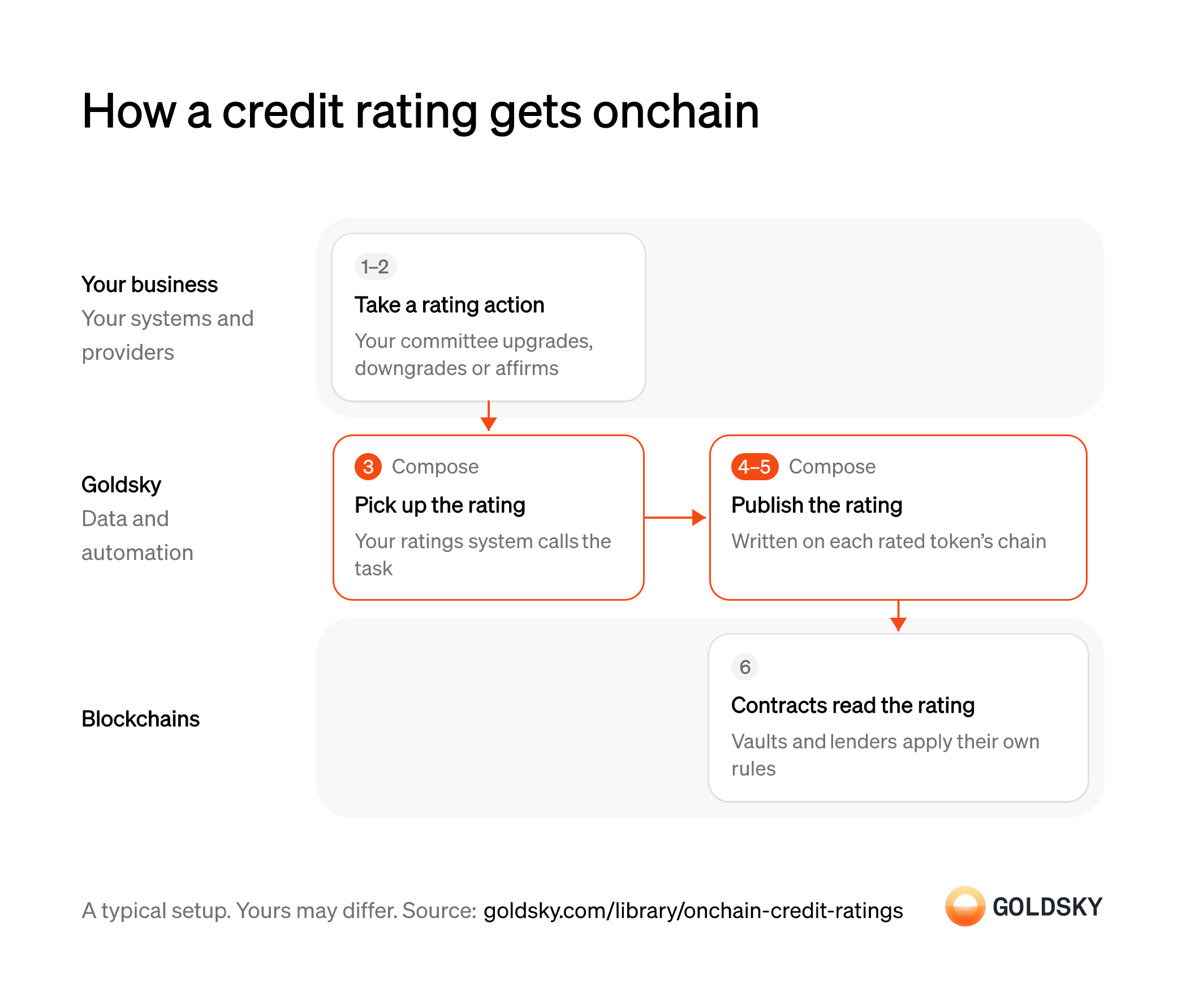
How a credit rating gets onchain
The diagram follows one rating action from your committee to the contracts that read it on the chain, and shows who does each step. Your setup may differ.
Take a rating action
A rating changes only when your committee upgrades, downgrades or affirms it.
The committee decides the action and your ratings system records the rating, the instrument and the effective date. Only actions your publication policy allows should go onchain, and the policy decides when.
Set up a contract for the rating on each chain
Apps can only read the rating from a contract on their own chain, so each chain needs one that stores it.
Deploy a contract on each chain that stores the latest rating and its date, and lets only your publishing wallet update it. If anyone can write to it, anyone can change the rating the apps read.
Pick up the rating action
Handled by Goldsky ComposeRatings change on no fixed schedule, so publishing starts when a rating action is released.
Your ratings system calls the publishing job with the instrument and the new rating. The call has to be authenticated, or anyone could change a rating on the chain.
A Compose task with an
Set up an HTTP trigger (opens in a new tab)httptrigger andauthentication: "auth_token"accepts the call only with a valid API token, and anip_whitelistcan limit it to your systems’ addresses.Publish the rating
Handled by Goldsky ComposeVaults and lenders read the rating on the chain where the instrument lives, so the new rating is written there.
Write the rating and its effective date to the ratings contract, and wait until the update is confirmed. If a reorg drops it, the old rating stays in force on the chain until it’s sent again.
With Goldsky Compose, the task writes the rating with
Handle confirmations and reorgs (opens in a new tab)wallet.writeContract, waits for theconfirmationsyou set and, withonReorgset toreplay, sends it again if a reorg drops it.Keep a record of every update
Handled by Goldsky ComposeIf an app or an auditor asks why a value was on the chain, the answer has to come from records of what was read and written.
The record ties each value on the chain to the source response it came from, the time it was read and the transaction that wrote it. Without it, rebuilding one update means searching logs on each side by hand.
Every call a Compose task makes, including each fetch from your source and each transaction it sends, is logged for auditing. If a run is interrupted, calls that already finished aren’t repeated, so a write isn’t sent twice.
How Compose logs each call (opens in a new tab)Contracts read the rating
Vaults and lenders apply their own rules to the rating, such as which instruments they accept and at what haircut.
Each contract reads the current rating and its date from the ratings contract on its chain. What it does with a downgrade is set by the contract’s owner.
What you control
- Your team
- Take a rating action
- Set up a contract for the rating on each chain
Security and deployment
- SOC 2 Type IIIndependently audited security controls.
- Dedicated infrastructureSingle-tenant options for production workloads.
- Data residencyCloud, on-premises or co-located.
More use cases that publish data onchain
- Publish tokenized fund NAVs and marks onchainPublish a tokenized fund’s NAV to every chain the fund is on, on a schedule.
- Tokenized private credit marksPublish valuations of private credit vaults and loans onchain.
- Index values published onchainPublish benchmark index values onchain for funds and products that track them.
- Crypto fund NAV calculation from onchain holdingsValue a fund’s wallet and vault positions at the cut-off so the administrator can compute and report NAV.
Publish credit ratings onchain with Goldsky
We’ll map it to your systems and show you what Goldsky runs, so your team builds the product, not the pipelines underneath it.
 Robinhood
 HyperEVM
 Arc
 Solana
 Ethereum
 Polymarket
 Base
 Tempo
 Bitcoin