Crypto fund NAV calculation from onchain holdings
What is crypto fund NAV calculation from onchain holdings?
Crypto fund NAV calculation from onchain holdings is working out a fund’s net asset value (NAV) from what its wallets and vault positions held at the valuation cut-off, read from the chain as of that moment.
Asset managers, tokenization platforms and custodian banks pin the holdings to the cut-off because balances keep changing after it, and a figure read late values a different portfolio from the one the NAV is struck on.
Goldsky finds the last block before the cut-off on each chain and reads every holding at that block on schedule; your pricing source values the positions and your fund administrator strikes and reports the NAV.
Who runs crypto fund NAV calculation from onchain holdings?
Crypto fund managers, issuers of tokenized funds and custodian banks that hold fund assets onchain, together with their fund administrators.
How crypto fund NAV calculation from onchain holdings works
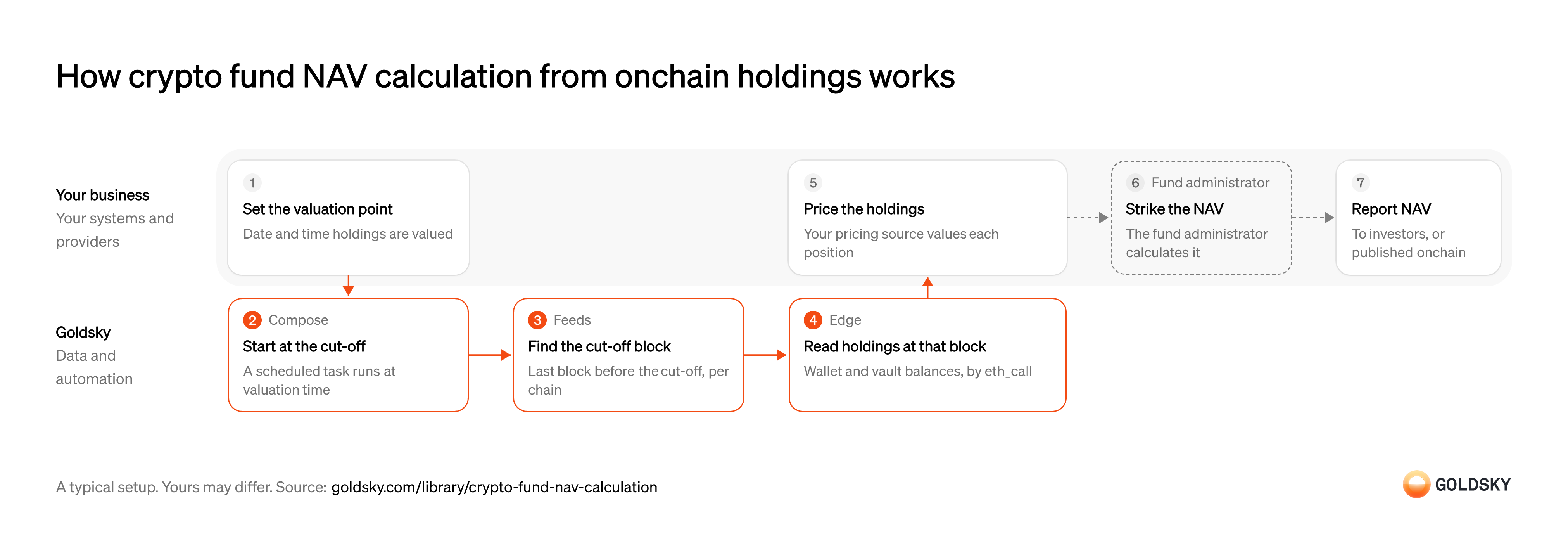
The diagram follows one valuation from the scheduled run at the cut-off to the NAV your team reports, and shows who does each step. Your setup may differ.
Set the valuation point
A NAV is struck as of one moment, so the fund has to fix that moment and what it covers.
The fund documents fix the valuation time, and your team keeps the list of wallets and vault positions in scope. A position left off the list is left out of the NAV.
Start the valuation at the cut-off
Handled by Goldsky ComposeThe read has to happen at the valuation time every period, without depending on someone remembering to run it.
Run the valuation on a fixed schedule set to the cut-off, and keep each run’s inputs and results. A run started by hand drifts from the cut-off and leaves no record of what it saw.
With Goldsky, a Compose task can run on a
Schedule a task with cron (opens in a new tab)crontrigger set to your valuation time, and every call it makes during the run is logged against that run.Find the cut-off block on each chain
Handled by Goldsky FeedsChains count time in blocks, so the cut-off has to be turned into a block number on every chain the fund holds assets on.
Take the last block at or before the cut-off on each chain. Using the first block after it pulls in transactions that belong to the next valuation.
The Feeds blocks endpoint returns the newest block at or before a Unix time when you pass
Turn a time into a block (opens in a new tab)timestamp_ltewithsort=number_desc.Read holdings at that block
Handled by Goldsky EdgeHoldings have to be what the fund held at the cut-off, not what it holds when someone checks.
Read each wallet’s token balances and each vault position at the cut-off block on its chain. A balance read at the latest block includes trades made after the valuation point.
Edge RPC runs
Read state at a block (opens in a new tab)eth_callat the block number you pass, so eachbalanceOfor vault read returns the position as it stood at the cut-off.Price the holdings
Token amounts become a value only when each one has a price as of the same cut-off.
Your pricing source values each position at the valuation time under the fund’s pricing policy. A price taken at a different time from the holdings misstates the NAV even when both are right on their own.
Strike the NAV
The fund administrator calculates the official NAV from the valued holdings, fees and liabilities.
The administrator receives the holdings and prices with the block each holding was read at. If it can’t trace a figure back to a block, it has to rebuild the holding itself before signing off.
Report the NAV
Investors and counterparties act on the NAV, so it has to reach them once it’s struck.
Your team sends the NAV to investors, publishes it onchain for a tokenized fund, or both, and keeps the holdings behind it. A published NAV that differs from the one the administrator struck has to be corrected in public.
What you control
- Your team
- Set the valuation point
- Price the holdings
- Report the NAV
- Your providers
- Fund administrator
Security and deployment
- SOC 2 Type IIIndependently audited security controls.
- Dedicated infrastructureSingle-tenant options for production workloads.
- Data residencyCloud, on-premises or co-located.
More use cases that publish data onchain
- Publish tokenized fund NAVs and marks onchainPublish a tokenized fund’s NAV to every chain the fund is on, on a schedule.
- Tokenized private credit marksPublish valuations of private credit vaults and loans onchain.
- Index values published onchainPublish benchmark index values onchain for funds and products that track them.
- Credit ratings published onchainPublish credit ratings onchain for tokenized instruments.
Use cases built the same way
- Crypto custody statementsProduce custody statements from onchain balances at a statement date.
- Month-end stablecoin supply for reserve reportsProduce the month-end supply across all chains that the monthly reserve report and its examination need.
- Digital asset audit evidenceGive auditors each wallet’s balance at the year-end cut-off block and the year’s transfers.
Calculate crypto fund NAV from onchain holdings with Goldsky
We’ll map it to your systems and show you what Goldsky runs, so your team builds the product, not the pipelines underneath it.
 Robinhood
 HyperEVM
 Arc
 Solana
 Ethereum
 Polymarket
 Base
 Tempo
 Bitcoin