Digital asset audit evidence
What is digital asset audit evidence?
Digital asset audit evidence is the record an auditor needs to confirm a company’s crypto holdings: every wallet it used in the period, each wallet’s balance at the year-end cut-off, the transfers in and out, the prices and proof that the company controls the keys.
Funds, crypto banks, exchanges and companies with crypto on their balance sheet put it together for their financial statement audit, because the auditor has to test that the assets exist, that the list of wallets is complete and that the company has the rights to them.
Goldsky finds the block at your cut-off, reads each wallet’s balance at that block and exports the year’s transfers into your warehouse; pricing, reconciling to your books, proving control of the keys and the auditor’s own testing stay with you, your providers and your auditor.
Who needs digital asset audit evidence?
Crypto funds and asset managers, crypto-native banks, exchanges and companies that hold digital assets on their balance sheet, and the fund administrators who keep their books.
How digital asset audit evidence gets put together
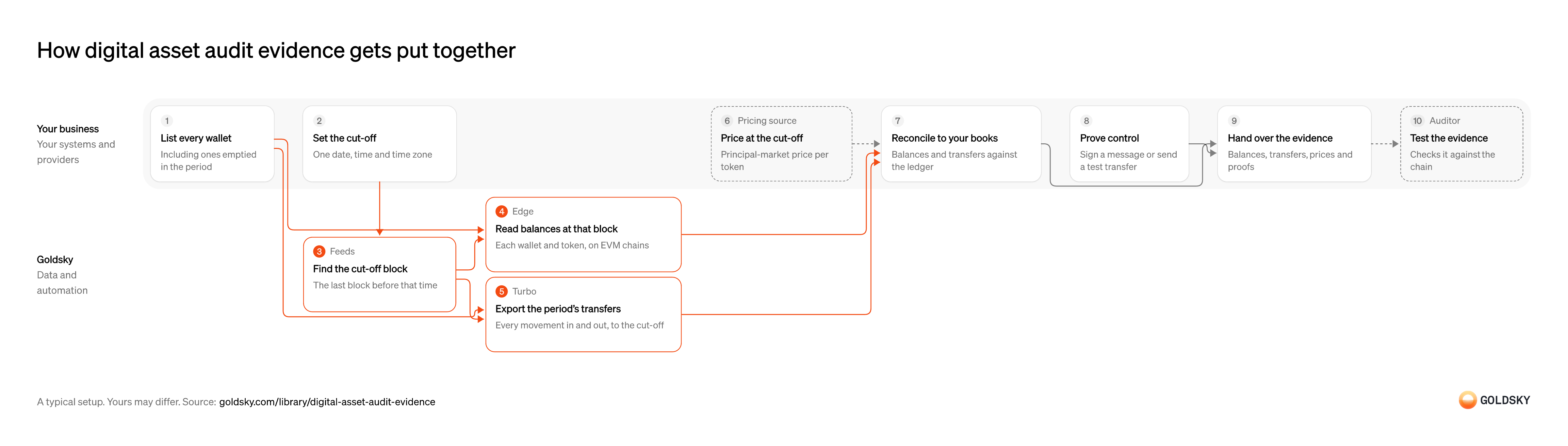
The diagram follows one year-end audit from the list of wallets you used to your auditor testing the evidence against the chain. Your setup may differ.
List every wallet you used in the period
Auditors test that your list is complete as well as that the assets exist, so the evidence has to cover every wallet you used.
Include wallets you emptied before year end, accounts at custodians and exchanges, and addresses you used with DeFi protocols. A wallet left off the list is a gap the auditor can’t close from your files.
Set the cut-off date, time and time zone
Crypto trades around the clock, so year end needs an exact moment for both balances and prices.
Pick a convention, such as midnight in your reporting time zone or a fixed UTC time, write it into your policy and use it every period. Transfers after the cut-off but before the period ends still need a look, because they can point to an impairment.
Find the block at the cut-off on each chain
Handled by Goldsky FeedsChains record time in blocks, so a balance at a moment is read at the last block before it.
Each chain has its own block times, so resolve the cut-off chain by chain and keep the block numbers in your evidence. A block after the cut-off pulls in transfers that belong to the next period.
The Feeds Blocks endpoint returns the newest block at or before a time when you call it with
Turn a timestamp into a block (opens in a new tab)timestamp_lte,sort=number_descandlimit=1.Read each balance at the cut-off block
Handled by Goldsky EdgeThe balance at the cut-off block is the figure your books have to agree with.
Read the native balance and each token’s balance for every wallet at that exact block, from a source whose reliability you can show your auditor, with a Bitcoin node or explorer for Bitcoin wallets. A read left at the newest block returns today’s balance without any error.
Goldsky’s Edge RPC routes historical requests to archive nodes, so
Read contract state at a block (opens in a new tab)eth_callto a token’sbalanceOfandeth_getBalancefor the native token both take the cut-off block number.Export the year’s transfers
Handled by Goldsky TurboAuditors trace activity during the year as well as the closing balance, so every movement in and out belongs in the file.
Pull every transfer to and from your wallets between the opening and closing cut-off blocks, with transaction hashes so each one can be found onchain. The opening balance plus the transfers should equal the closing balance; when it doesn’t, a wallet or a token is missing.
In job mode, a Turbo Pipelines pipeline runs once over a fixed block range and exits, so an EVM transfer backfill can stop at the cut-off block and write its rows to your warehouse.
Run a one-time backfill (opens in a new tab)Price each asset at the cut-off
Holdings measured at fair value need a price from their principal market at the same moment as the balances.
Your pricing source supplies the last price before the cut-off in each token’s principal market, with when and where it was taken. A price taken at a different moment than the balance leaves a gap your auditor will ask about.
Reconcile to your books
Your accounting records are what the financial statements report, so they have to agree with the chain.
Match each wallet’s balance and the year’s transfers to your subledger and general ledger, and explain every difference. Assets at a custodian or exchange are reconciled to its statements too, since they may sit in addresses shared with other clients.
Prove control of the keys
A balance only counts as your asset if you can move it.
You or your custodian sign a message the auditor chooses with the wallet’s key, or send a transfer the auditor specifies. Either shows access at one point in time; showing that nobody else can move the funds takes evidence about your key management controls.
Hand the evidence to your auditor
Auditors work from what you give them, so the files need to let them redo each figure.
Include the wallet list, the cut-off blocks, balances, transfers, prices, reconciliations and control proofs, plus any custodian statements and SOC reports. Note where each figure came from, because management has to show that its source of chain data is reliable.
Let the auditor test it against the chain
Your auditor checks your figures against sources they choose, so the evidence has to hold up to an independent read.
Auditors may compare your balances with block explorers or their own tools at the same block height, watch a signed message or test transfer, and confirm balances with your custodians. Giving them the block numbers you used lets them compare like with like.
What you control
- Your team
- List every wallet you used in the period
- Set the cut-off date, time and time zone
- Reconcile to your books
- Prove control of the keys
- Hand the evidence to your auditor
- Your providers
- Pricing source
- Auditor
Questions and answers
What is proof of control?
Proof of control is evidence that a company can use the private keys of the wallets it reports, usually by signing a message the auditor chooses or by sending a transfer the auditor specifies. It shows access to the keys at one point in time. Whether anyone else also holds the keys is a separate question, which auditors answer by testing the company’s key management controls. The key holder or its custodian produces the proof, because it takes the keys.
Security and deployment
- SOC 2 Type IIIndependently audited security controls.
- Dedicated infrastructureSingle-tenant options for production workloads.
- Data residencyCloud, on-premises or co-located.
More use cases that report on onchain activity
- Form 1099-DA data for brokersSupply the transfer history and USD values behind each customer’s Form 1099-DA.
- DAC8 and CARF reporting dataSupply the valued transfer history behind each user’s yearly DAC8 or CARF report.
- Onchain data for finance and BI reportingLoad onchain activity into the warehouse so finance and BI teams can report on it.
- DeFi accounting for positions and vaultsBook accrued rewards, vault shares and lending positions across DeFi protocols at period end.
- Crypto fair-value pricing from DEX tradesFeed DEX trade prices into principal-market fair-value marks and the VWAPs used to check them.
Use cases built the same way
- Crypto custody statementsProduce custody statements from onchain balances at a statement date.
- Month-end stablecoin supply for reserve reportsProduce the month-end supply across all chains that the monthly reserve report and its examination need.
- NCUA stablecoin reporting dataReport supply, mint and burn, and holder figures for a stablecoin issued by a credit union subsidiary under the NCUA’s proposed rules.
- Onchain data for crypto accountingSend priced onchain activity to a crypto subledger so finance can close the books.
Prepare digital asset audit evidence with Goldsky
We’ll map it to your systems and show you what Goldsky runs, so your team builds the product, not the pipelines underneath it.
 Robinhood
 HyperEVM
 Arc
 Solana
 Ethereum
 Polymarket
 Base
 Tempo
 Bitcoin