NCUA stablecoin reporting data
What is NCUA stablecoin reporting data?
NCUA stablecoin reporting data is the onchain side of what a payment stablecoin issuer owned by a federally insured credit union would report under the NCUA’s proposed rules: total supply, mints and burns, and who holds the token.
The rules are still proposals, from February and May 2026, and the May proposal would have issuers publish each month the number of stablecoins outstanding and the reserves behind them, and send the NCUA a quarterly report within 30 days of quarter end.
Goldsky can backfill every mint, burn and transfer of your token from its first block and keep the history in your warehouse; your team works out the figures, adds reserve data from your custodians and files the reports.
Who needs NCUA stablecoin reporting data?
Credit unions planning stablecoin subsidiaries, the subsidiaries that would issue the tokens, and the platforms that issue tokens for banks and credit unions.
How NCUA stablecoin reporting data is gathered
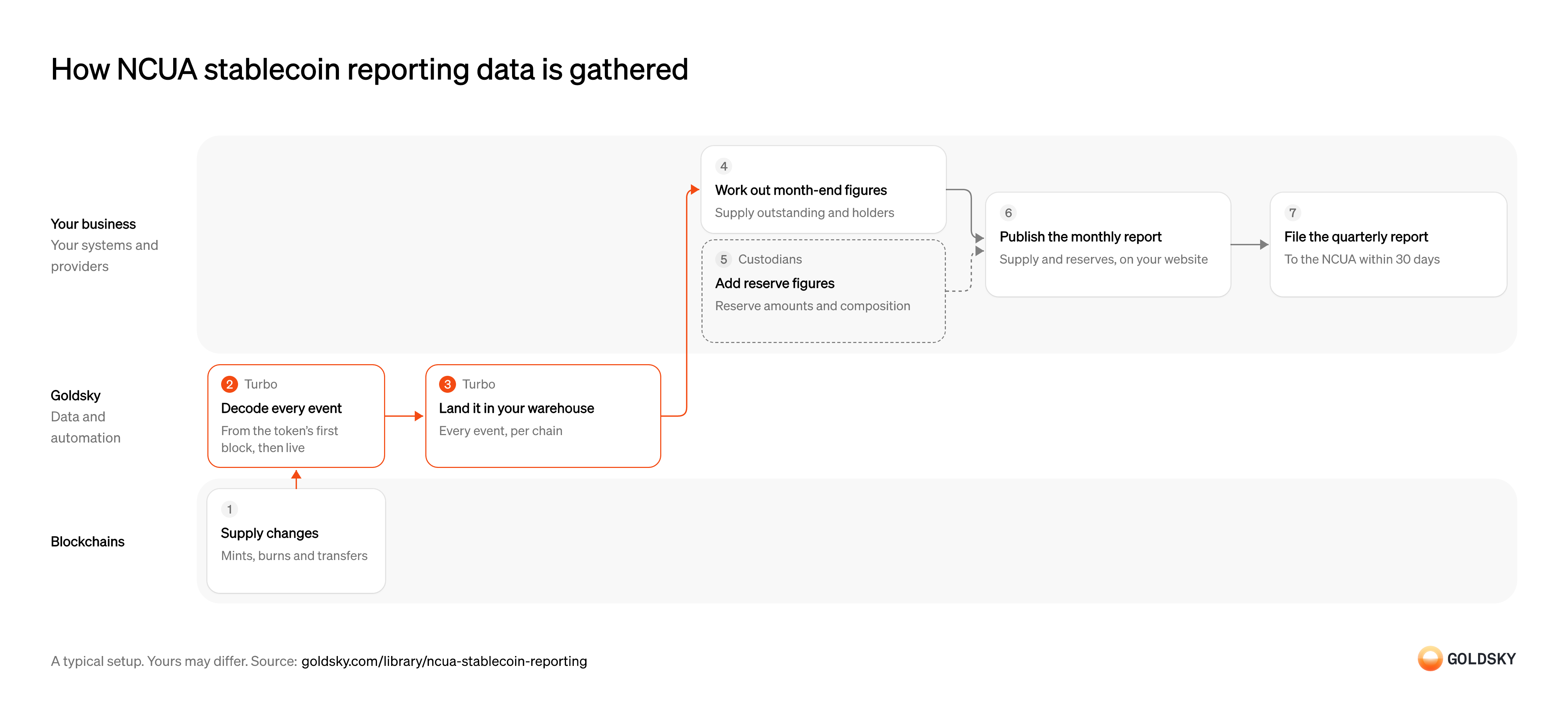
The diagram follows your token from each mint and burn on the chain to the reports your team files, and shows who does each step. Your setup may differ.
Capture every supply change
Supply outstanding and holder figures all come from what happened to the token on the chain.
Every mint, burn and transfer on every chain the token runs on counts. A chain left out, or a gap of a few hours, makes reported supply disagree with what anyone can see onchain.
Decode every event from the first block
Handled by Goldsky TurboSupply and holders at any month end depend on every event before it, so the history has to start at the token’s first block.
Past events are loaded once and new ones as they happen, with no gap between the two. Each event is decoded into readable fields with its chain, block and time.
With Goldsky, a Turbo Pipelines source filtered to your token’s address can start at the earliest block and keep running on new ones, and a transform decodes each log with
Learn about EVM sources and backfills (opens in a new tab)_gs_log_decode.Land the history in your warehouse
Handled by Goldsky TurboYour team works out the reports from a copy of the history it controls and can query.
Each event lands with its chain and a stable ID, and corrections after a reorg arrive as records of their own. Your warehouse has to apply them, or a replaced block still counts toward supply.
Turbo Pipelines can write the events as Parquet files to an S3-compatible bucket, partitioned by columns such as chain and date, for your warehouse to read.
Write events to S3 as Parquet (opens in a new tab)Work out the month-end figures
The proposed monthly report gives the number of stablecoins outstanding as of the last day of the prior month.
Your team totals mints and burns up to the month-end cutoff, per chain, and counts holders at the close. The cutoff has to be one fixed time across chains, or a move between chains counts twice or not at all.
Add reserve figures from your custodians
The monthly report sets supply outstanding beside the amount and composition of the reserves behind it, and those figures don’t come from the token’s events.
Your custodians supply reserve amounts for the same month end. If their dates don’t line up with yours, the report compares supply and reserves taken at different moments.
Publish the monthly report
Under the proposed rules, the issuer publishes its reserve composition and supply outstanding on its website each month.
Your team fills in the report from the month-end figures and the reserve data. Under the proposal, a registered public accounting firm then examines each month’s report the following month, so every figure needs a query and block number behind it.
Review and file the quarterly report
The proposed rules also ask for a quarterly report to the NCUA within 30 days of quarter end.
Your finance and compliance teams check the figures against the chain and your other records, then file the report. Keep the queries and the block numbers behind each figure, so a question from an examiner can be answered from the same data.
What to know about streaming NCUA reporting data
- The NCUA’s stablecoin rules are proposals; which figures the final reports need is for your regulatory team to settle.
- Goldsky loads the events; supply, holder counts and month-end totals are queries your team writes and owns.
- Reserve amounts come from your custodians, not the chain.
What you control
- Your team
- Work out the month-end figures
- Publish the monthly report
- Review and file the quarterly report
- Your providers
- Custodians
Security and deployment
- SOC 2 Type IIIndependently audited security controls.
- Dedicated infrastructureSingle-tenant options for production workloads.
- Data residencyCloud, on-premises or co-located.
More use cases that report to regulators
- GENIUS Act stablecoin reporting dataFile the weekly OCC PS-01 report from daily per-chain supply, freeze and holder data.
- Stablecoin holder concentration reportingList every wallet holding over 2% of supply and the top 20 redemption wallets each day, for the weekly PS-01 report.
- MiCA stablecoin reporting dataReport holder counts, issuance and volumes each quarter for asset-referenced tokens above €100M in issue, and for EMTs in non-EU currencies.
- CFTC digital collateral reporting dataReport totals of BTC, ETH and USDC held as margin, per asset and account class, each week during an FCM’s first three months under the CFTC pilot.
- Basel cryptoasset disclosure dataRead a bank’s cryptoasset holdings at the period-end block so it can classify them and complete its Basel disclosure tables.
Use cases built the same way
- Daily stablecoin supply by chain for PS-01 reportsKeep the daily per-chain supply, issued, redeemed, issuer-held, frozen and lost figures that feed the weekly OCC PS-01 report.
- Onchain data for finance and BI reportingLoad onchain activity into the warehouse so finance and BI teams can report on it.
- Power a blockchain data productFeed a resold data product with multi-chain data and fast backfills.
- Onchain data for index and benchmark calculationsSupply the onchain fundamentals an index or benchmark provider calculates from.
Gather NCUA stablecoin reporting data with Goldsky
We’ll map it to your systems and show you what Goldsky runs, so your team builds the product, not the pipelines underneath it.
 Robinhood
 HyperEVM
 Arc
 Solana
 Ethereum
 Polymarket
 Base
 Tempo
 Bitcoin