MiCA stablecoin reporting data
What is MiCA stablecoin reporting data?
MiCA stablecoin reporting data is the onchain part of the quarterly report that the EU’s Markets in Crypto-Assets Regulation (MiCA) asks of some stablecoin issuers under Article 22: how many holders the token has, how much is in issue and how much it’s used for transactions.
It applies to asset-referenced tokens above €100 million in issue and, through Article 58(3), to e-money tokens in currencies outside the EU, such as the dollar; euro tokens are not covered.
The issuer’s compliance team files it with its national regulator, so the counts have to come from a record the team can rebuild and explain.
Goldsky publishes every mint, burn and transfer to your Kafka topic as it happens; your team counts holders and volume, adds the reserve figures from your custodian and files the report.
Who needs MiCA stablecoin reporting data?
Issuers of asset-referenced tokens and of dollar or other non-EU-currency stablecoins in the EU, and the issuance platforms that run tokens for them.
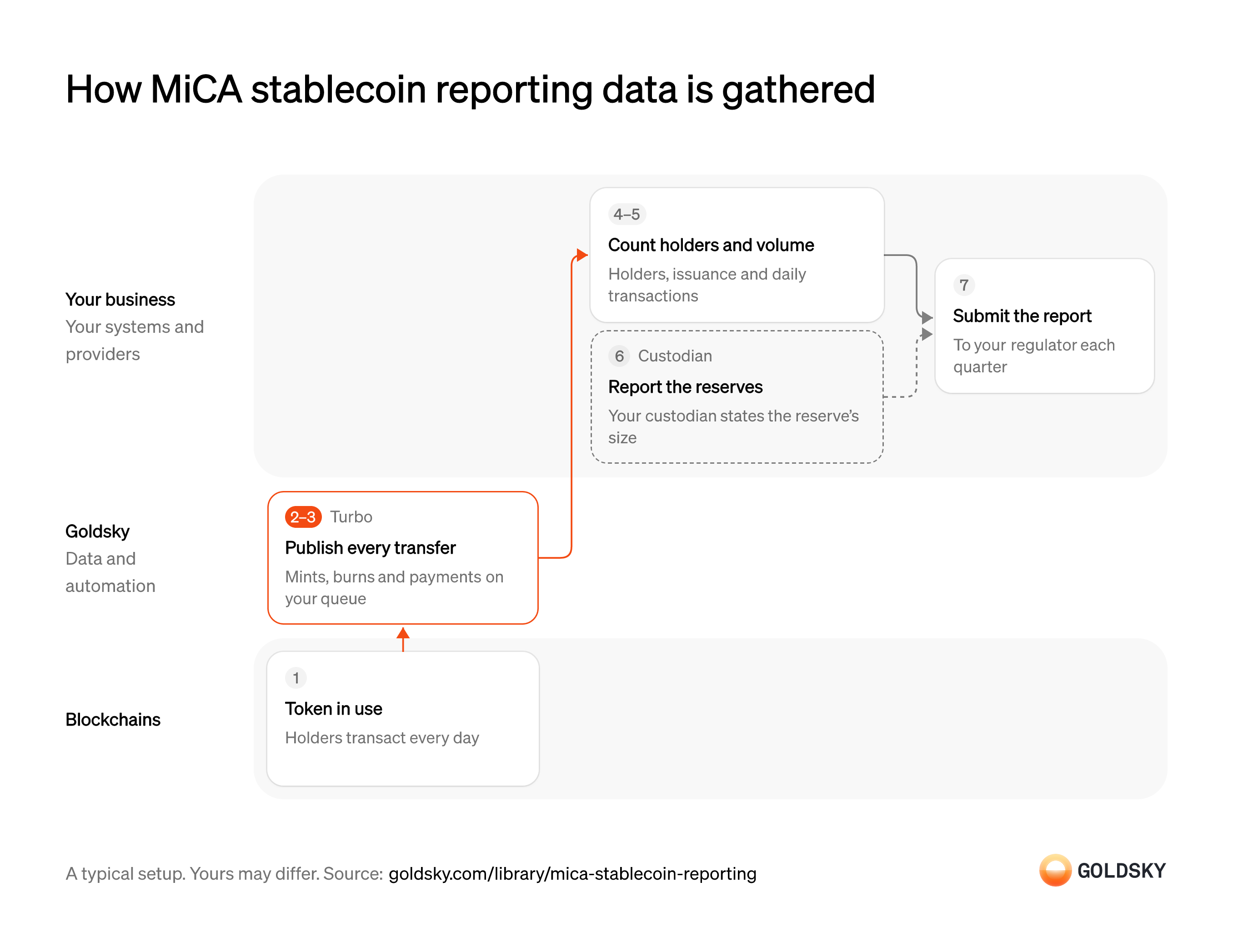
How MiCA stablecoin reporting data is gathered
The diagram follows a quarter of token use from transfers on the chain to the report your team submits, and shows who does each step. Your setup may differ.
Let the token be used
Holders mint, redeem and pay with the token every day, and the report measures that use.
Every mint, burn and transfer on every chain the token runs on counts toward the quarter. Missing a chain understates both holders and volume.
Decode every mint, burn and transfer
Handled by Goldsky TurboHolder counts and volume are built from each event, so each one has to be read into plain fields.
Events are decoded from the token’s logs with their chain, block and time, starting early enough to cover every holder’s history. Starting at the quarter’s first day misses holders who bought earlier.
A Turbo Pipelines transform filters your token’s logs and decodes them with
See the decode functions (opens in a new tab)_gs_log_decode, from past blocks through to new ones.Publish every event to your queue
Handled by Goldsky TurboYour reporting systems need each event as it happens, in a feed they already consume.
Each event goes out with a stable key so your consumer can drop repeats. A consumer that counts every message it receives counts retried messages twice.
With Goldsky, a Turbo Pipelines Kafka sink publishes each decoded event to your topic as Avro or JSON, keyed on its
Set up a Kafka sink (opens in a new tab)primary_key.Apply corrections after a reorg
If the chain replaces recent blocks, some published transfers no longer happened.
Corrections arrive as messages of their own, and your consumer deletes or updates the events they name. Skipping them leaves transfers in your counts that the chain no longer has.
Count holders, issuance and volume
The report asks how many holders the token has, how much is in issue and how much it’s used, for the quarter.
Your team totals mints minus burns for issuance, counts wallets with a balance, and sums transactions by day, using your regulator’s definitions and keeping them the same from quarter to quarter. Customers who hold the token at an exchange show onchain only as the exchange’s wallets, so Article 22(3) has crypto-asset service providers (CASPs) give the issuer the information it needs, including transactions made off the chain, and some issuers have each CASP holding the token send a daily holdings report (template S 08.00).
Report the reserves
The report also covers the reserve behind the token, which comes from your custodian, not the chain.
Your custodian states the size and makeup of the reserve as of the same date as your token figures. Figures from different dates can’t be compared.
Submit the report
The report is filed with your national regulator each quarter.
Your compliance team checks the figures against the chain and your records before filing. The data behind the report doesn’t make it complete or correct; that check and your firm’s sign-off do.
What you control
- Your team
- Apply corrections after a reorg
- Count holders, issuance and volume
- Submit the report
- Your providers
- Custodian
Security and deployment
- SOC 2 Type IIIndependently audited security controls.
- Dedicated infrastructureSingle-tenant options for production workloads.
- Data residencyCloud, on-premises or co-located.
More use cases that report to regulators
- GENIUS Act stablecoin reporting dataFile the weekly OCC PS-01 report from daily per-chain supply, freeze and holder data.
- Stablecoin holder concentration reportingList every wallet holding over 2% of supply and the top 20 redemption wallets each day, for the weekly PS-01 report.
- CFTC digital collateral reporting dataReport totals of BTC, ETH and USDC held as margin, per asset and account class, each week during an FCM’s first three months under the CFTC pilot.
- NCUA stablecoin reporting dataReport supply, mint and burn, and holder figures for a stablecoin issued by a credit union subsidiary under the NCUA’s proposed rules.
- Basel cryptoasset disclosure dataRead a bank’s cryptoasset holdings at the period-end block so it can classify them and complete its Basel disclosure tables.
Gather MiCA stablecoin reporting data with Goldsky
We’ll map it to your systems and show you what Goldsky runs, so your team builds the product, not the pipelines underneath it.
 Robinhood
 HyperEVM
 Arc
 Solana
 Ethereum
 Polymarket
 Base
 Tempo
 Bitcoin