Onchain data for index and benchmark calculations
What is onchain data for index and benchmark calculations?
Onchain data for index and benchmark calculations is the protocol activity, such as volume, fees and token supply, that an index methodology turns into a published level; index firms often call it onchain fundamentals or onchain metrics.
Index and benchmark providers need the full history to backtest a methodology before launch, then current, complete figures at every calculation, because licensees and products track the level they publish.
Goldsky loads and decodes the history and keeps delivering new rows to your warehouse; the totals, the methodology, the calculation and the published level stay with you.
Who uses onchain data for index and benchmark calculations?
Index and benchmark providers, crypto data vendors and research firms that calculate indexes from onchain activity.
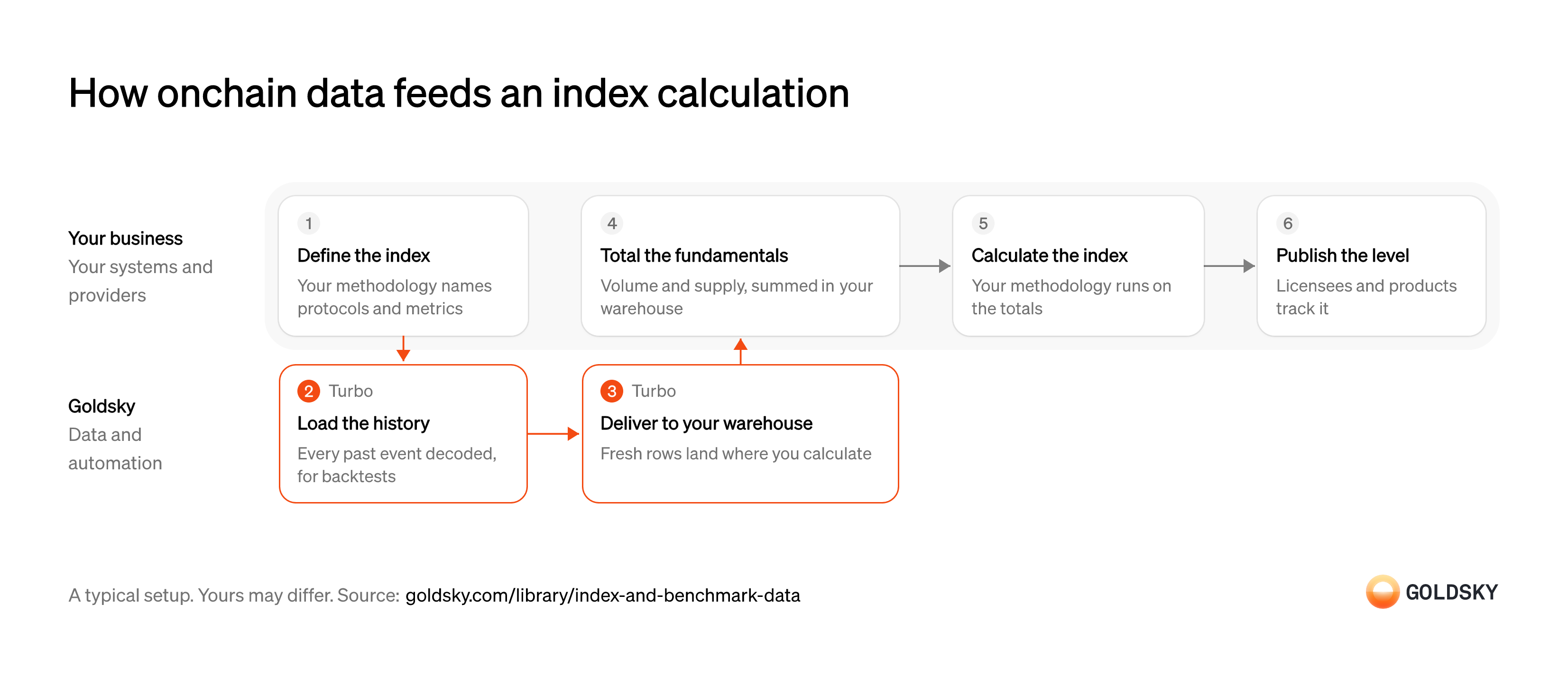
How onchain data feeds an index calculation
The diagram follows one index from the metrics its methodology names to the level you publish, and shows who does each step. Your setup may differ.
Define the index methodology
The methodology decides which protocols and metrics count, so it sets what data you need.
It names the protocols, the contracts behind them, the metrics (such as volume or supply) and how often the level is calculated. A metric nobody can trace to a contract can’t be checked by the people who license the index.
Load the history for backtests
Handled by Goldsky TurboA methodology is tested on years of past data before anyone tracks it.
Every past event for the named contracts is loaded and decoded the same way the live data will be. A backfill decoded differently from the live data produces a backtest the live index can’t reproduce.
Turbo Pipelines can load a fixed historical range as a one-time job that exits once its last block is written, using the same SQL transform as the live pipeline.
Run one-time backfills (opens in a new tab)Deliver fresh rows to your warehouse
Handled by Goldsky TurboEach calculation reads the latest data, so new events have to arrive before it runs.
Rows have to land complete for the period being calculated, with corrections when a reorg (the chain replacing its newest blocks) undoes an event. A calculation run on missing or reversed rows publishes a wrong level.
Goldsky’s Turbo Pipelines keeps streaming new blocks to your warehouse tables or bucket, and tables keyed on a
How corrections reach your tables (opens in a new tab)primary_keytake reorg corrections as updates and deletes.Total the fundamentals
An index works from per-period figures, such as daily volume per protocol, not from single events.
Your warehouse sums the decoded rows per protocol and period. Set a cutoff for each period and handle later corrections under your restatement policy, or the same period can produce two levels.
Calculate the index level
The methodology turns the totals into one number.
Your calculation applies the weights, caps and rebalancing rules to the totals. Keep each run’s inputs, so you can show how a published level was reached.
Publish the level
Licensees, funds and products track the level, so it has to go out on schedule.
You publish through your usual channels, and some providers also write the level to a chain. A late or restated level affects every product that tracks it, so corrections follow your published policy.
What you control
- Your team
- Define the index methodology
- Total the fundamentals
- Calculate the index level
- Publish the level
Security and deployment
- SOC 2 Type IIIndependently audited security controls.
- Dedicated infrastructureSingle-tenant options for production workloads.
- Data residencyCloud, on-premises or co-located.
More use cases that stream chain data to your systems
- Blockchain data in your own warehouseStream decoded chain data into your own warehouse for BI.
- Power a blockchain data productFeed a resold data product with multi-chain data and fast backfills.
- Blockchain indexing for app backendsKeep an app’s database in sync with the chain.
- Onchain data for risk ratings and scoringSupply wallet and protocol history to the models that rate DeFi risk or score borrowers.
- How to build a subgraphWrite a schema and mappings for your contracts and serve the index over a hosted GraphQL API.
- Speed up subgraph indexing and queriesCut the time a subgraph takes to sync, reindex and answer queries.
- Replace in-house blockchain ETL and cut its costRetire your own nodes and ETL jobs and load the same chain data tables from a managed pipeline.
Use cases built the same way
- NCUA stablecoin reporting dataReport supply, mint and burn, and holder figures for a stablecoin issued by a credit union subsidiary under the NCUA’s proposed rules.
- Onchain data for finance and BI reportingLoad onchain activity into the warehouse so finance and BI teams can report on it.
- DAO delegate dashboards and voting power analyticsTrack voting power, delegators and votes per delegate for a token-governed DAO.
- Daily stablecoin supply by chain for PS-01 reportsKeep the daily per-chain supply, issued, redeemed, issuer-held, frozen and lost figures that feed the weekly OCC PS-01 report.
Feed index and benchmark calculations with onchain data on Goldsky
We’ll map it to your systems and show you what Goldsky runs, so your team builds the product, not the pipelines underneath it.
 Robinhood
 HyperEVM
 Arc
 Solana
 Ethereum
 Polymarket
 Base
 Tempo
 Bitcoin