Blockchain data in your own warehouse
What is blockchain data in your own warehouse?
Blockchain data in your own warehouse means decoded onchain events, such as transfers, trades and mints, loaded into the warehouse your analysts already query, a job data engineers call blockchain ETL.
Finance, data and product teams want it there because their BI tools can then join chain activity with customers, revenue and the rest of the company’s data, under the access rules they already have.
Goldsky backfills your contracts’ history, decodes it and keeps it current, writing Parquet files to your storage bucket or rows straight into tables, while the warehouse, the models and the reports stay yours.
Who it’s for
Data and analytics firms, DeFi protocols and fintechs that keep their own ledger and want chain activity next to the rest of their data.
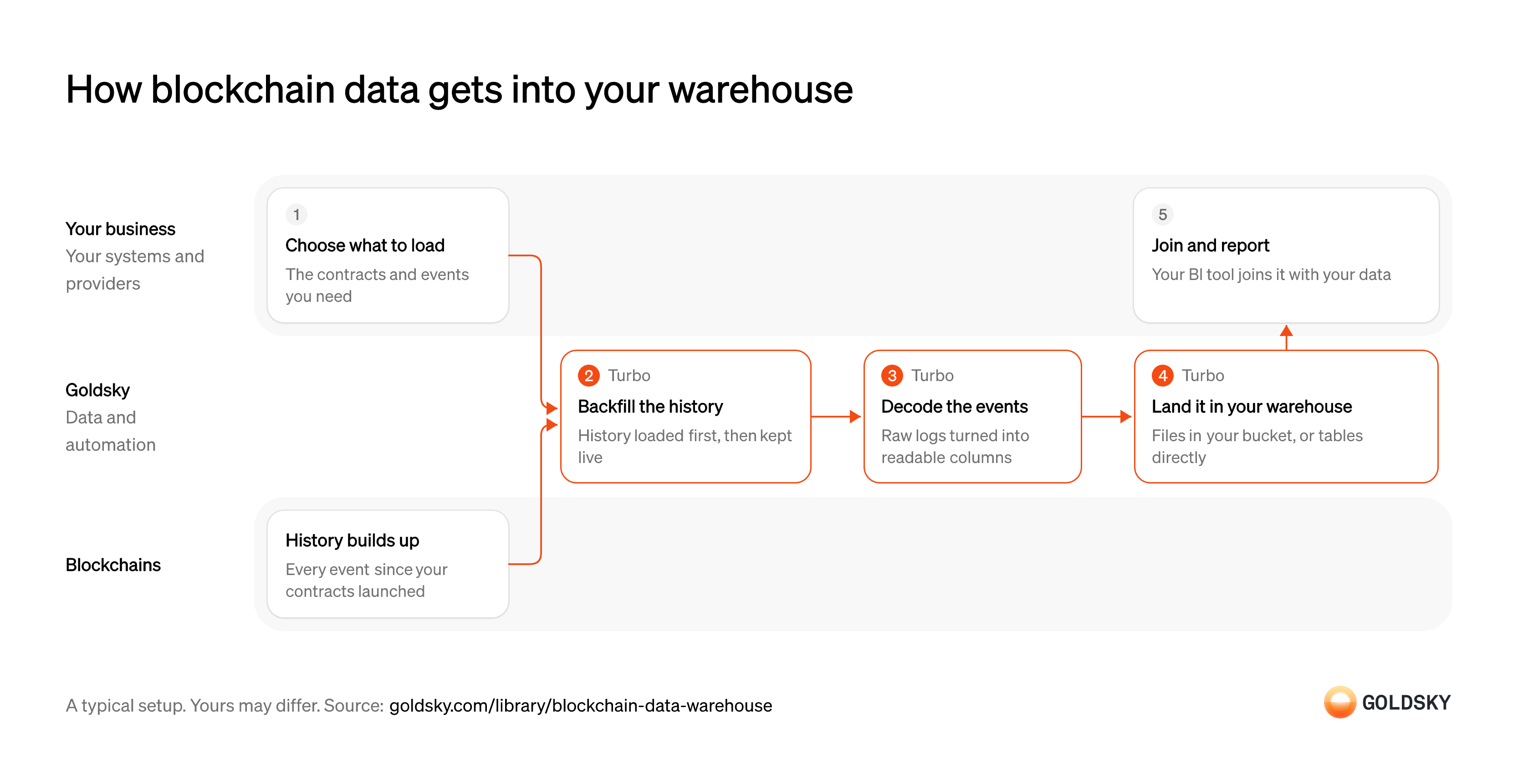
How blockchain data gets into your warehouse
The diagram follows your contracts’ events from the history already on the chain to the BI report that joins them with your own data, and shows who does each step. Your setup may differ.
Choose the contracts and events to load
A warehouse table is only as useful as the events in it, so start from the questions your reports have to answer.
List the contracts, chains and events you need, and get each contract’s ABI (the description of its events) so they can be decoded. An event left out now means a second backfill later.
Backfill the history
Handled by Goldsky TurboReports compare periods, so the warehouse needs every event since your contracts launched, not just new ones.
The load starts at the block where each contract was deployed and moves on to new blocks without a gap or an overlap at the switch. A backfill that skips a range shows up later as totals that don’t match the chain.
A Turbo Pipelines source set to
Set where a pipeline starts (opens in a new tab)start_at: earliestreads a dataset from the start of its history and then keeps streaming new blocks, so one pipeline covers both the backfill and the live data.Decode the events into columns
Handled by Goldsky TurboRaw logs are encoded bytes, and analysts need named columns such as sender, recipient and amount.
Each event is decoded with its contract’s ABI, and token amounts keep their full precision. Large token amounts overflow ordinary number columns, so they need a wide numeric type or a string.
A Turbo Pipelines SQL transform decodes logs as they stream with
Decode logs with _gs_log_decode (opens in a new tab)_gs_log_decode()and your contract’s ABI. For standard token transfers, the curated transfer datasets arrive already decoded.Land the data in your warehouse
Handled by Goldsky TurboYour analysts query the warehouse, so the decoded rows have to arrive in storage you control.
Rows arrive in batches. A crash can deliver a batch twice, and a reorg (the chain replacing its newest blocks) sends corrections for rows already written, so keyed tables absorb both while files and queue consumers need a dedupe step.
Goldsky’s Turbo Pipelines writes Parquet files to an S3 bucket you own, partitioned by date or chain if you choose, and warehouses such as Snowflake, Databricks and BigQuery load them with their own S3 ingestion, since Goldsky has no native sink for them. The same pipeline can also write rows into analytical database tables keyed on a
Load Parquet files into a warehouse (opens in a new tab)primary_key, or publish them to a Kafka topic for other systems.Join it with your data and report
Chain data answers business questions once it sits next to customers, accounts and revenue.
Your warehouse models join the event tables to your own on shared keys such as wallet address or account ID, and compute totals and period sums there. Without a mapping from address to customer, the reports show wallets, not customers.
What you control
- Your team
- Choose the contracts and events to load
- Join it with your data and report
Security and deployment
- SOC 2 Type IIIndependently audited security controls.
- Dedicated infrastructureSingle-tenant options for production workloads.
- Data residencyCloud, on-premises or co-located.
More use cases that stream chain data to your systems
- Power a blockchain data productFeed a resold data product with multi-chain data and fast backfills.
- Blockchain indexing for app backendsKeep an app’s database in sync with the chain.
- Onchain data for index and benchmark calculationsSupply the onchain fundamentals an index or benchmark provider calculates from.
- Onchain data for risk ratings and scoringSupply wallet and protocol history to the models that rate DeFi risk or score borrowers.
- How to build a subgraphWrite a schema and mappings for your contracts and serve the index over a hosted GraphQL API.
- Speed up subgraph indexing and queriesCut the time a subgraph takes to sync, reindex and answer queries.
- Replace in-house blockchain ETL and cut its costRetire your own nodes and ETL jobs and load the same chain data tables from a managed pipeline.
Use cases built the same way
- Stablecoin admin action logRecord every mint, burn, freeze, clawback and role change with its time and signer for risk and audit review.
- NCUA stablecoin reporting dataReport supply, mint and burn, and holder figures for a stablecoin issued by a credit union subsidiary under the NCUA’s proposed rules.
- Onchain data for finance and BI reportingLoad onchain activity into the warehouse so finance and BI teams can report on it.
- Unauthorized tokenization monitoringFind tokens that claim to represent your security without your consent.
Load blockchain data into your own warehouse with Goldsky
We’ll map it to your systems and show you what Goldsky runs, so your team builds the product, not the pipelines underneath it.
 Robinhood
 HyperEVM
 Arc
 Solana
 Ethereum
 Polymarket
 Base
 Tempo
 Bitcoin