Power a blockchain data product
What it is
Powering a blockchain data product means supplying the decoded, multi-chain history that a data provider models, packages and sells, whether as dashboards, an API or data files.
Blockchain data providers and research firms need it each time a client asks for a new chain, because the product can’t cover a chain until its full history is loaded and kept current.
Goldsky backfills and decodes each chain’s history and keeps delivering new blocks into storage you own; the metrics, the methodology and the client relationship stay with you.
Who it’s for
Blockchain data providers, crypto research and analytics firms, and index and data vendors that sell onchain metrics to their clients.
How a new chain gets into a blockchain data product
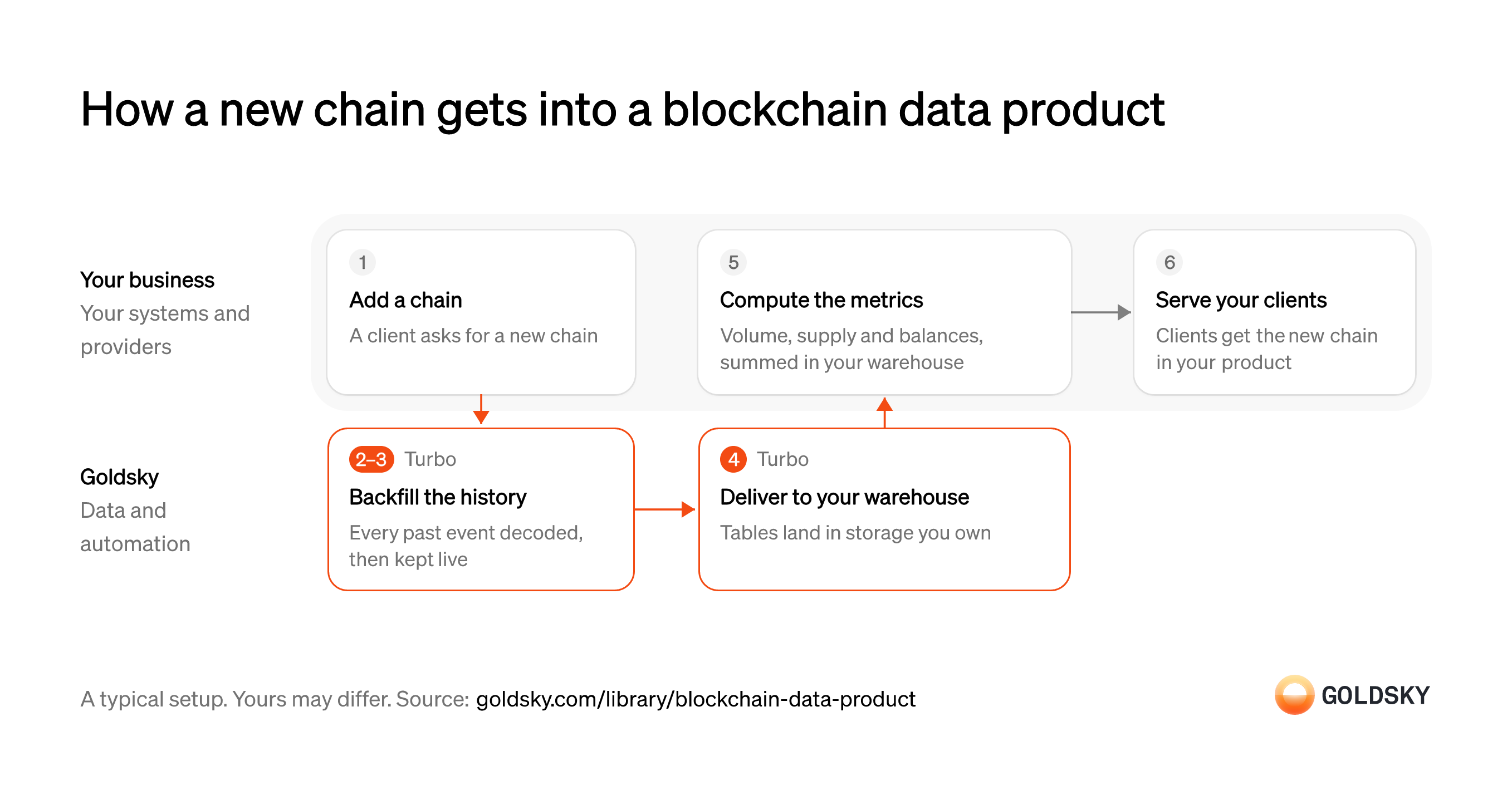
The diagram follows one new chain from a client’s request to that chain appearing in your product, and shows who does each step. Your setup may differ.
Scope the new chain
A client request names a chain, and your team decides which of its datasets and contracts the product needs.
List the datasets, protocols and history the product needs, and map the chain’s columns to your existing tables. A chain loaded in a different shape can’t be summed with the others without rework.
Backfill the chain’s history
Handled by Goldsky TurboClients compare a chain’s metrics over time, so the product needs its history from the first block.
The backfill has to finish before the chain goes into the product, then hand over to new blocks with no gap. Every new chain repeats this step, so a slow backfill holds up each client request.
Turbo Pipelines can run a backfill in job mode, as a one-time pipeline that exits once its block range is written, while a long-running pipeline keeps the chain current from there.
Run backfills in job mode (opens in a new tab)Decode the events the same way on every chain
Handled by Goldsky TurboYour metrics are built from named fields, such as amounts and addresses, not from raw logs.
Decoding has to give every chain the same column names and types, so one query covers them all. Each chain decoded its own way turns every metric into a set of per-chain queries.
Turbo Pipelines dataset sources share one schema per dataset type across chains, and SQL transforms decode contract logs with
See the pipeline sources (opens in a new tab)_gs_log_decode(), so a transform written for one chain carries over to the next.Deliver the tables to your warehouse
Handled by Goldsky TurboYour product reads from your own warehouse, so each chain’s tables have to land there.
Delivery repeats a batch after a crash and sends corrections after a reorg (the chain replacing its newest blocks), so tables need a key per row or a dedupe step on load. Without one, a metric counts the same transfer twice.
Goldsky’s Turbo Pipelines writes Parquet to a bucket, publishes to a queue, or writes rows into database tables keyed on a
See the supported sinks (opens in a new tab)primary_key, where reorg corrections arrive as updates and deletes.Compute the metrics
Volume, supply and balances are what clients buy, and they’re sums over the raw rows.
Your warehouse computes each metric per period and per chain from the decoded rows. A metric computed before the backfill finished understates the history, so check row counts against the chain before publishing.
Serve the new chain to your clients
The work pays off when the chain appears in your product next to the others.
Your dashboards, API or data files pick up the new chain’s metrics. Publish when coverage starts and how each metric is defined, so clients know what each figure includes.
What you control
- Your team
- Scope the new chain
- Compute the metrics
- Serve the new chain to your clients
Security and deployment
- SOC 2 Type IIIndependently audited security controls.
- Dedicated infrastructureSingle-tenant options for production workloads.
- Data residencyCloud, on-premises or co-located.
More use cases that stream chain data to your systems
- Blockchain data in your own warehouseStream decoded chain data into your own warehouse for BI.
- Blockchain indexing for app backendsKeep an app’s database in sync with the chain.
- Onchain data for index and benchmark calculationsSupply the onchain fundamentals an index or benchmark provider calculates from.
- Onchain data for risk ratings and scoringSupply wallet and protocol history to the models that rate DeFi risk or score borrowers.
- How to build a subgraphWrite a schema and mappings for your contracts and serve the index over a hosted GraphQL API.
- Speed up subgraph indexing and queriesCut the time a subgraph takes to sync, reindex and answer queries.
- Replace in-house blockchain ETL and cut its costRetire your own nodes and ETL jobs and load the same chain data tables from a managed pipeline.
Use cases built the same way
- NCUA stablecoin reporting dataReport supply, mint and burn, and holder figures for a stablecoin issued by a credit union subsidiary under the NCUA’s proposed rules.
- Onchain data for finance and BI reportingLoad onchain activity into the warehouse so finance and BI teams can report on it.
- DAO delegate dashboards and voting power analyticsTrack voting power, delegators and votes per delegate for a token-governed DAO.
- Daily stablecoin supply by chain for PS-01 reportsKeep the daily per-chain supply, issued, redeemed, issuer-held, frozen and lost figures that feed the weekly OCC PS-01 report.
Power a blockchain data product with Goldsky
We’ll map it to your systems and show you what Goldsky runs, so your team builds the product, not the pipelines underneath it.
 Robinhood
 HyperEVM
 Arc
 Solana
 Ethereum
 Polymarket
 Base
 Tempo
 Bitcoin