DAO delegate dashboards and voting power analytics
What it is
DAO delegate dashboards and voting power analytics show, for a token-governed DAO, how much voting power each delegate holds, who delegated it, how it moves and how often each delegate votes.
DAOs and foundations commission them so token holders can compare delegates before delegating, and so governance teams can spot concentrated power and measure delegate programs.
Goldsky decodes the delegation and vote events from the DAO’s token and governor contracts and keeps their full history current for you; offchain votes, participation rates and the dashboards stay with your team.
You can build a DAO delegate dashboard two ways: stream the token and governor events into your warehouse with Turbo Pipelines, or index them in a subgraph that serves delegates and votes over GraphQL.
Who it’s for
DAOs and chain foundations, the governance contributors and analytics firms they fund, and delegates tracking their own record.
How a DAO delegate dashboard gets built
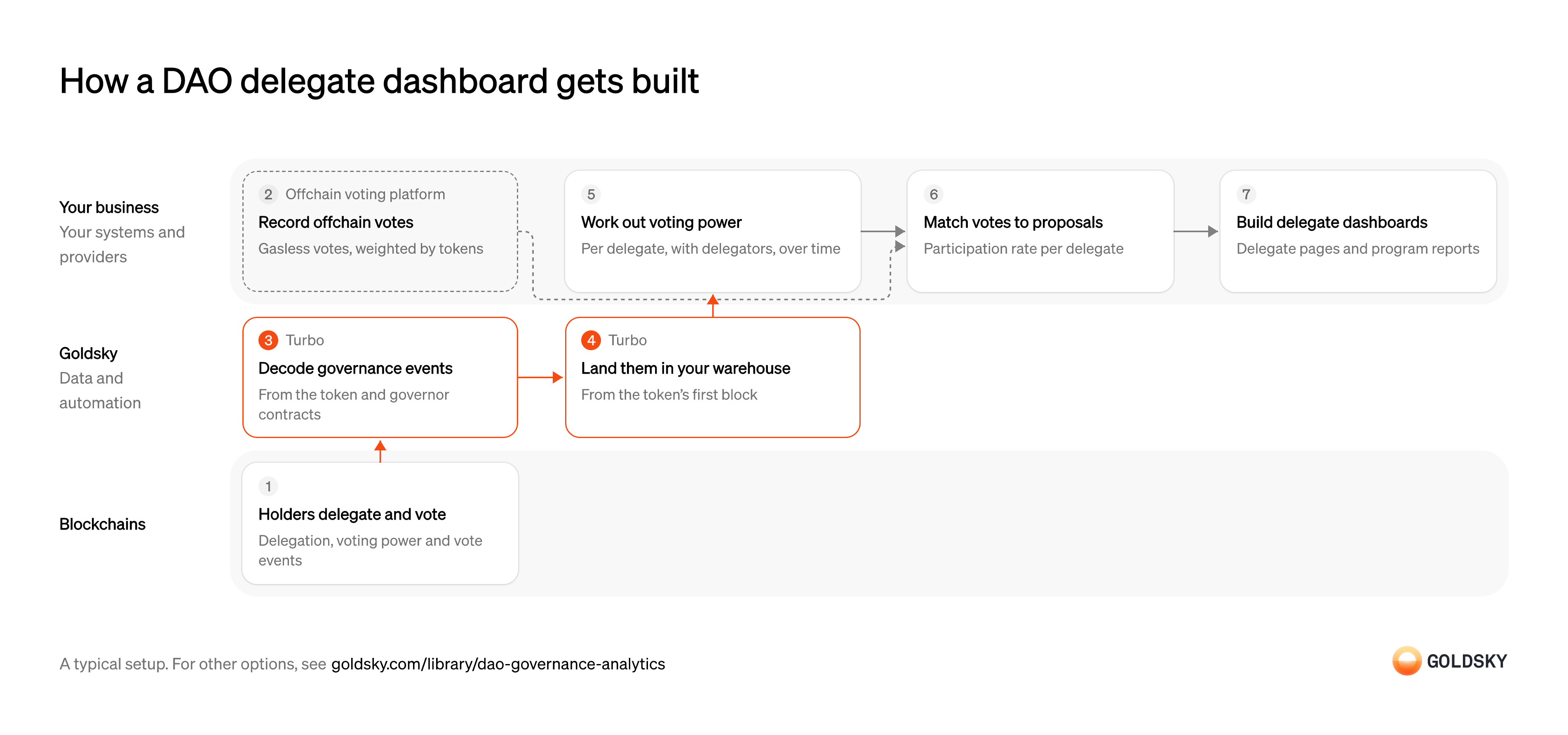
The diagram follows one delegation from the holder’s onchain choice to the delegate pages token holders compare. Your setup may differ.
Ways to build a DAO delegate dashboard
Streaming puts the full delegation and vote history in your warehouse for analysts to query in SQL; a subgraph keeps delegates, voting power and votes behind a hosted GraphQL API your app queries.
- Best for
- Governance analysis and program reports in SQL
- Products
- Turbo
- What you run
- The destination: your database, queue or bucket, or a Postgres database Goldsky hosts
- What you write
- Pipeline YAML and SQL; TypeScript transforms when needed
- Where your data lives
- In your own database or systems
- How results reach you
- Pushed to you
- Best for
- The DAO’s own delegate pages, queried live
- Products
- Subgraphs
- What you run
- Nothing; Goldsky runs indexing, storage and the API
- What you write
- A schema and mapping handlers, or a no-code or low-code config for simple contracts
- Where your data lives
- Hosted by Goldsky
- How results reach you
- You query; changes are pushed
| Usual setupOption 1: Stream to your warehouse | Option 2: Subgraph over the DAO contracts | |
|---|---|---|
| Best for | Governance analysis and program reports in SQL | The DAO’s own delegate pages, queried live |
| Products | Turbo | Subgraphs |
| What you run | The destination: your database, queue or bucket, or a Postgres database Goldsky hosts | Nothing; Goldsky runs indexing, storage and the API |
| What you write | Pipeline YAML and SQL; TypeScript transforms when needed | A schema and mapping handlers, or a no-code or low-code config for simple contracts |
| Where your data lives | In your own database or systems | Hosted by Goldsky |
| How results reach you | Pushed to you | You query; changes are pushed |
Holders delegate and vote
In a token-governed DAO, holders delegate their voting power to delegates, who vote on proposals.
The token emits
DelegateChangedwhen a holder picks a delegate andDelegateVotesChangedwhen a delegate’s voting power changes, and the governor emitsVoteCastfor each vote. A delegate page’s onchain figures all come from these events.Record offchain votes
Many DAOs also hold gasless, token-weighted votes offchain, often to test support before an onchain proposal.
Those votes never reach the chain, so pull them from the voting platform and store them with each proposal. Leave them out and a delegate who votes mostly offchain looks inactive.
Decode delegation and vote events
Handled by Goldsky TurboRaw logs have to be decoded into delegator, delegate, voting power and vote before anyone can count them.
Decode each contract’s logs with its interface (ABI), and include every governor contract the DAO has used, or votes cast on an older one go missing.
Goldsky’s Turbo Pipelines decodes each contract’s logs in a SQL transform with
Decode contract events (opens in a new tab)_gs_log_decodeand the contract’s ABI, which_gs_fetch_abican fetch from a block explorer.Land the full history in your warehouse
Handled by Goldsky TurboVoting power today is the result of every delegation since the token launched.
Load events from the token’s first block and keep new ones flowing into the same tables. When the chain replaces recent blocks in a reorg, events from those blocks have to be corrected, or a delegation that never settled shows up.
A Turbo Pipelines job mode pipeline backfills a fixed block range once and exits, a live pipeline writes new events to your warehouse, and sinks with a
Backfill history with job mode (opens in a new tab)primary_keyapply reorg corrections to the same rows.Work out voting power per delegate
Voting power and delegator counts are what token holders compare first.
Take each delegate’s latest voting power from the voting-power events and count the holders currently delegating to them. Show power as a share of all votable tokens, and keep the daily series to show how concentrated power is over time.
Match votes to proposals
Participation shows whether a delegate uses the voting power they were given.
Join each vote, onchain and offchain, to its proposal, and count the share of proposals each delegate voted on since their first vote. If you label delegates active or inactive, publish the threshold.
Build delegate dashboards
Token holders choose delegates, and governance teams judge delegate programs, from these pages.
Show each delegate’s voting power, delegators, votes and participation, with the time the data was last updated. Programs such as delegate incentives also need reports over a set period.
What to know about streaming governance events
- Goldsky runs the pipeline; you own the warehouse tables, the participation maths and the dashboards.
- Offchain votes come from the voting platform and join the onchain events in your warehouse.
- Sinks with a primary key apply reorg corrections as updates to the same rows.
Holders delegate and vote
In a token-governed DAO, holders delegate their voting power to delegates, who vote on proposals.
The token emits
DelegateChangedwhen a holder picks a delegate andDelegateVotesChangedwhen a delegate’s voting power changes, and the governor emitsVoteCastfor each vote.Record offchain votes
Many DAOs also hold gasless, token-weighted votes offchain, often to test support before an onchain proposal.
Those votes never reach the chain, so pull them from the voting platform and store them with each proposal. Leave them out and a delegate who votes mostly offchain looks inactive.
Index delegations and votes
Handled by Goldsky SubgraphsEach event becomes a record your pages can query, such as a delegate with their current voting power.
The mappings update a delegate’s record on every delegation and voting-power event and store each vote against its proposal. Index from the token’s first block, so current power reflects every past delegation.
Subgraphs runs the mapping code you deploy from source with
Deploy a subgraph from source (opens in a new tab)goldsky subgraph deploy, so a handler can update a delegate’s record on every event.Serve delegates over GraphQL
Handled by Goldsky SubgraphsYour delegate pages need the records behind an API they can query.
Query only the fields each page shows, and show when the data was last updated.
With Goldsky, each deployed subgraph gets a hosted GraphQL endpoint, and subgraph webhooks can push each new delegation or vote record to your backend.
Use GraphQL endpoints (opens in a new tab)Match votes to proposals
Participation shows whether a delegate uses the voting power they were given.
Join each vote, onchain and offchain, to its proposal, and count the share of proposals each delegate voted on since their first vote. If you label delegates active or inactive, publish the threshold.
Build delegate pages
Token holders compare delegates on these pages before they delegate.
Show each delegate’s voting power, delegators, votes and participation, with the time the data was last updated.
What to know about a subgraph for delegate dashboards
- Goldsky hosts the subgraph and its API; you write and maintain the schema and mappings.
- Subgraphs index EVM chains, and latency grows on contracts with very frequent events.
- Offchain votes stay outside the index, so your app adds them.
What you control
- Your team
- Work out voting power per delegate
- Match votes to proposals
- Build delegate dashboards
- Your providers
- Offchain voting platform
Security and deployment
- SOC 2 Type IIIndependently audited security controls.
- Dedicated infrastructureSingle-tenant options for production workloads.
- Data residencyCloud, on-premises or co-located.
More use cases that analyze onchain activity
- Stablecoin transaction volume and market share by chainMeasure real stablecoin or tokenized-asset volume by chain, with inorganic flows stripped out.
- Track stablecoin issuers and competitors onchainFollow competitors’ and issuers’ supply, mints, burns and holders.
- Protocol financial statements from chain dataBuild income statements (fees, revenue and costs) for chains and apps from their contracts.
- Onchain research on listed crypto companiesTrack listed companies’ onchain revenue and users before they report earnings.
- Digital asset treasury company holdings and mNAVTrack what listed treasury companies hold onchain, per share, and their mNAV.
- Grant and incentive impact trackingMeasure what grants and incentive programs did to users, volume and TVL, per grantee.
- Blockchain ecosystem growth metricsTrack a chain’s active, new and returning addresses, transactions, fees and usage per app, compared with other chains.
- Stablecoin market data for analytics: market cap, supply and activityTrack stablecoin supply and market cap by token, chain and issuer, with holders, active addresses, transfer counts and velocity over time.
Use cases built the same way
- Supply data for stablecoin issuance platformsGive an issuance platform one view of supply across every coin and chain it runs.
- NCUA stablecoin reporting dataReport supply, mint and burn, and holder figures for a stablecoin issued by a credit union subsidiary under the NCUA’s proposed rules.
- Onchain data for finance and BI reportingLoad onchain activity into the warehouse so finance and BI teams can report on it.
- DeFi data for apps and dashboards: positions, TVL and yieldsShow users their positions, the protocol’s TVL and yields, pool and market data and activity history in a DeFi app’s front end and dashboards.
Build a DAO delegate dashboard with Goldsky
We’ll map it to your systems and show you what Goldsky runs, so your team builds the product, not the pipelines underneath it.
 Robinhood
 HyperEVM
 Arc
 Solana
 Ethereum
 Polymarket
 Base
 Tempo
 Bitcoin