Grant and incentive impact tracking
What is grant and incentive impact tracking?
Grant and incentive impact tracking is measuring what a chain’s or DAO’s grants and incentive programs changed onchain: the users, volume and TVL each grantee brought in, compared with a baseline such as the weeks before the grant.
Foundations, grants councils and the analytics teams they hire run it to show token holders a return on each program and to check grantee milestones against onchain numbers.
Goldsky watches the grantee addresses you list and lands their activity, including the weeks before each grant, in your warehouse; the address list, the baseline, attribution and milestone decisions stay with your team.
Who uses grant and incentive impact tracking?
Chain foundations, DAO grants councils, and the analytics firms and grants platforms that report on their programs.
How grant and incentive impact tracking works
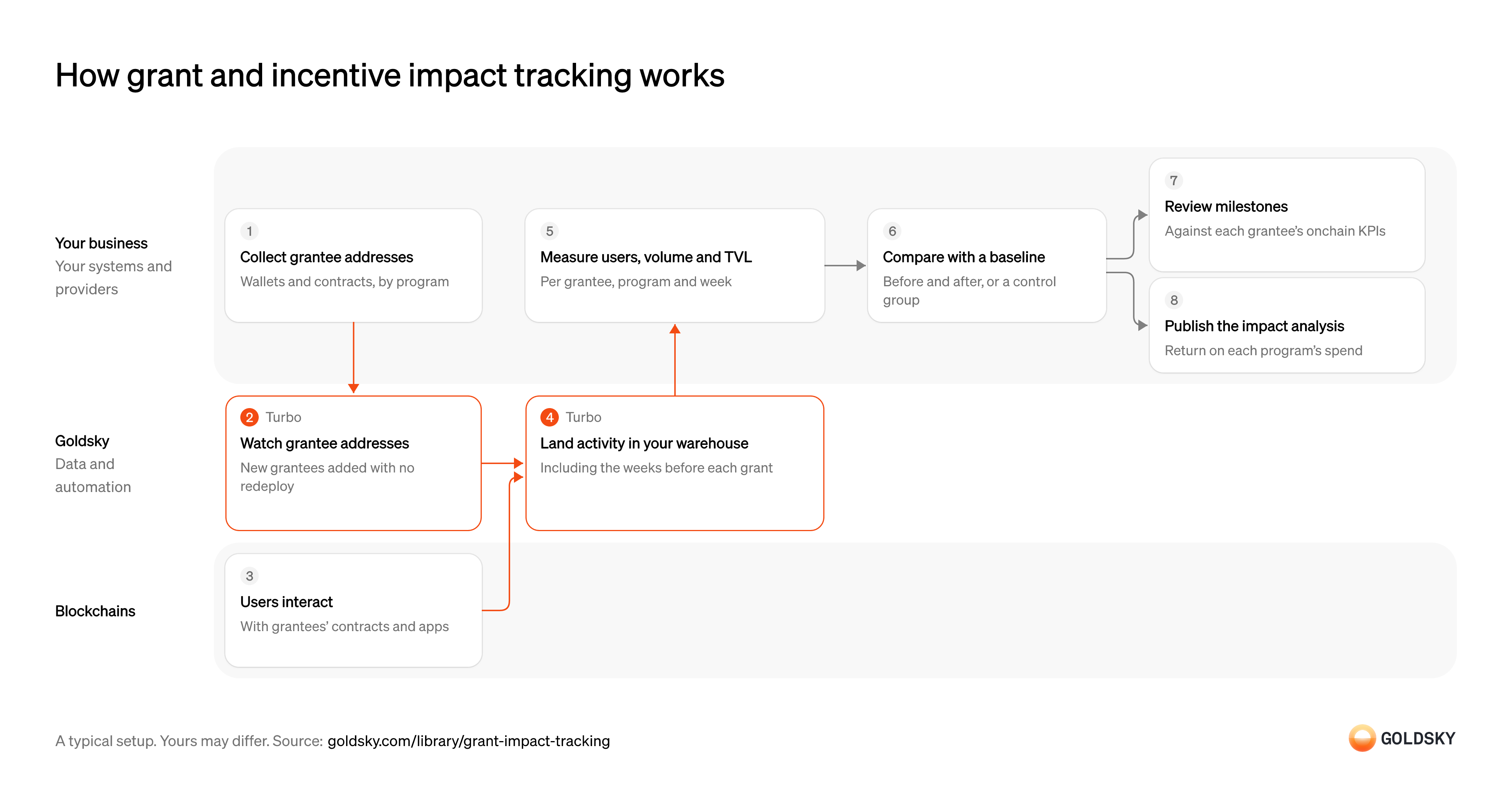
The diagram follows one grant program from the addresses its grantees submit to the impact analysis the DAO reads. Your setup may differ.
Collect grantee addresses
A grantee’s impact can only be measured once you know which wallets and contracts are theirs.
Ask each grantee for the wallets that receive the grant and the contracts users touch, and record the program, grant size and dates beside them. A contract left off the list makes a grantee look smaller than they are.
Watch grantee addresses
Handled by Goldsky TurboOnly activity at grantee addresses counts, and new grantees join each season.
Each new address has to start counting without restarting anything, or a grantee’s first weeks go missing.
Goldsky’s Turbo Pipelines keeps the address list in a dynamic table, which lives in a Postgres database, and filters activity with
Learn about dynamic tables (opens in a new tab)dynamic_table_check(); a row added mid-season applies to the running pipeline.Users interact with grantees
Users deposit, trade and transact with grantee contracts and apps, which is what a grant is meant to grow.
Each of those actions is a transaction onchain. Signals such as GitHub activity or site visits come from other sources.
Land activity in your warehouse, with history
Handled by Goldsky TurboA baseline needs the weeks before each grant as well as the weeks after.
History and live activity land in the same tables with their block times, so any window can be compared. Rows from blocks the chain later replaces have to be corrected, or volume is counted that never settled.
A Turbo Pipelines job mode pipeline backfills a fixed block range once and exits, and a live pipeline writes new activity to your warehouse as it happens.
Backfill history with job mode (opens in a new tab)Measure users, volume and TVL
These are the numbers grants councils judge a grantee by.
Your warehouse counts distinct addresses as users, sums volume and values the funds held in grantee contracts for TVL, per grantee, program and week. Pick metrics that fit each sector, such as TVL and volume for DeFi or users and transactions for games.
Compare with a baseline
Growth during a grant only means something next to what would have happened anyway.
Compare each grantee with its own weeks before the grant, or with similar projects that got no grant. When other incentives ran at the same time, count only the share the grant can claim, or every program takes credit for the same growth.
Review milestones against onchain KPIs
Grants are often set against milestones, so reviewers check each one against the numbers agreed with the grantee.
Agree on the onchain KPI for each milestone when the grant is made, so the review compares like with like.
Publish the impact analysis
Token holders fund these programs, so they expect to see what each one returned.
Report results per program and grantee with the method, the baseline and the attribution rules, so readers can check the numbers. Show the return per token spent, so programs of different sizes can be compared.
What you control
- Your team
- Collect grantee addresses
- Measure users, volume and TVL
- Compare with a baseline
- Review milestones against onchain KPIs
- Publish the impact analysis
Security and deployment
- SOC 2 Type IIIndependently audited security controls.
- Dedicated infrastructureSingle-tenant options for production workloads.
- Data residencyCloud, on-premises or co-located.
More use cases that analyze onchain activity
- Stablecoin transaction volume and market share by chainMeasure real stablecoin or tokenized-asset volume by chain, with inorganic flows stripped out.
- Track stablecoin issuers and competitors onchainFollow competitors’ and issuers’ supply, mints, burns and holders.
- Protocol financial statements from chain dataBuild income statements (fees, revenue and costs) for chains and apps from their contracts.
- Onchain research on listed crypto companiesTrack listed companies’ onchain revenue and users before they report earnings.
- Digital asset treasury company holdings and mNAVTrack what listed treasury companies hold onchain, per share, and their mNAV.
- DAO delegate dashboards and voting power analyticsTrack voting power, delegators and votes per delegate for a token-governed DAO.
- Blockchain ecosystem growth metricsTrack a chain’s active, new and returning addresses, transactions, fees and usage per app, compared with other chains.
- Stablecoin market data for analytics: market cap, supply and activityTrack stablecoin supply and market cap by token, chain and issuer, with holders, active addresses, transfer counts and velocity over time.
Use cases built the same way
- Stablecoin disbursements for public-sector programsTrack government benefit or grant payments made in stablecoins, from issue to spend.
- DAC8 and CARF reporting dataSupply the valued transfer history behind each user’s yearly DAC8 or CARF report.
- Daily stablecoin supply by chain for PS-01 reportsKeep the daily per-chain supply, issued, redeemed, issuer-held, frozen and lost figures that feed the weekly OCC PS-01 report.
- CFTC digital collateral reporting dataReport totals of BTC, ETH and USDC held as margin, per asset and account class, each week during an FCM’s first three months under the CFTC pilot.
Track grant and incentive impact with Goldsky
We’ll map it to your systems and show you what Goldsky runs, so your team builds the product, not the pipelines underneath it.
 Robinhood
 HyperEVM
 Arc
 Solana
 Ethereum
 Polymarket
 Base
 Tempo
 Bitcoin