Onchain research on listed crypto companies
What is onchain research on listed crypto companies?
Onchain research on listed crypto companies is tracking the wallets and contracts a public company runs, so its transaction volume, users and fee revenue can be measured day by day instead of waiting for the quarterly report.
Asset managers and research firms use it to estimate a quarter before the company announces results.
Goldsky watches the addresses you attribute to each company and lands every matching transfer in your warehouse as it happens; deciding which addresses belong to which company, the daily totals and the estimate stay with your analysts.
Who uses onchain research on listed crypto companies?
Hedge funds and asset managers that cover crypto equities, and equity research and alternative data firms.
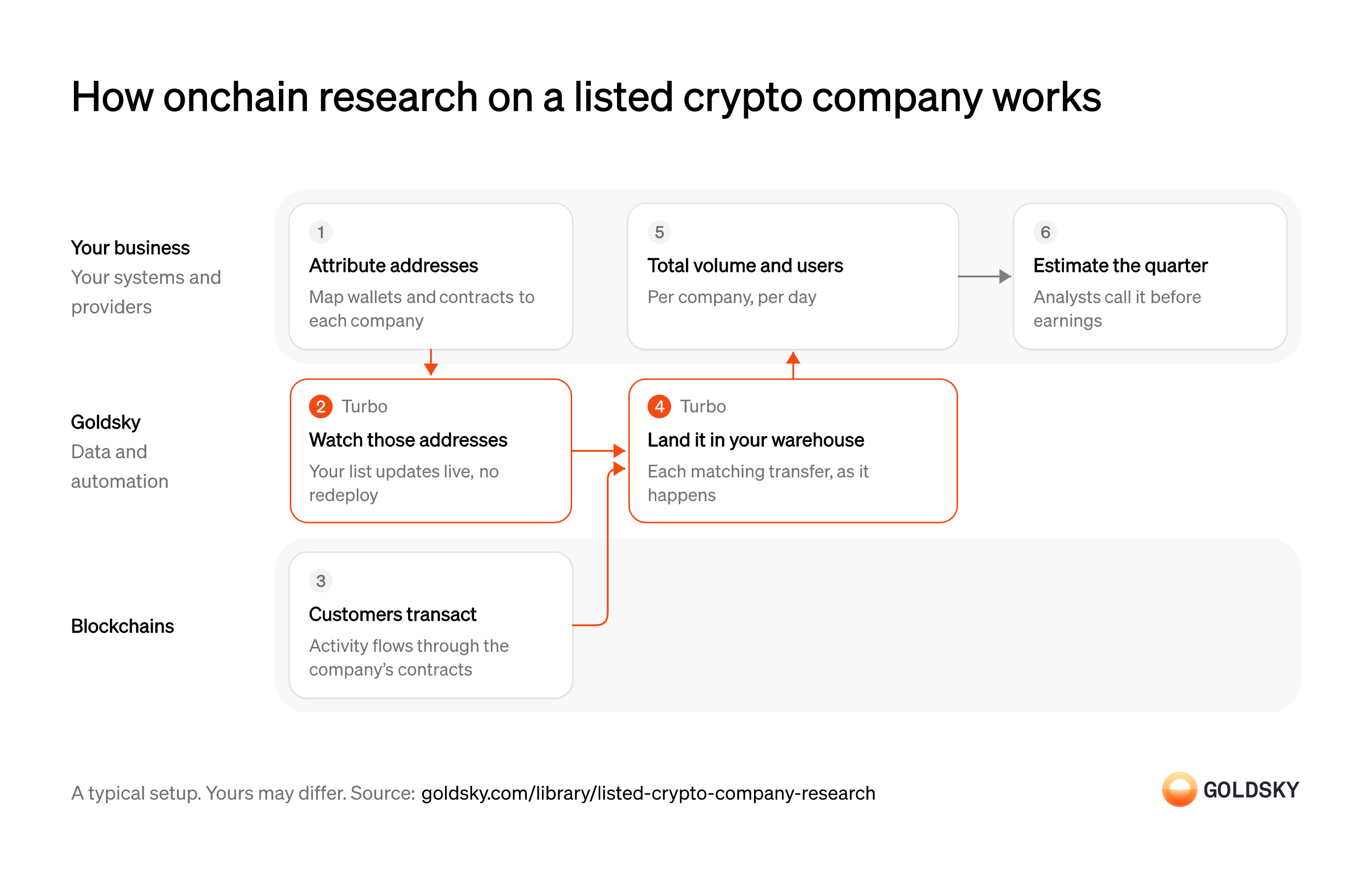
How onchain research on a listed crypto company works
The diagram follows one company from the addresses you attribute to it to the quarter your analysts estimate before earnings. Your setup may differ.
Attribute addresses to each company
A company’s onchain activity can only be measured once you know which wallets and contracts are its own.
Analysts map deposit wallets, treasury wallets and contracts to each company, using filings, public disclosures and transaction patterns. An address wrongly attributed adds someone else’s activity to the estimate, so record the evidence for each one.
Watch the attributed addresses
Handled by Goldsky TurboOnly activity at the company’s addresses counts, so the pipeline needs the current list.
The list changes as analysts find new addresses, and each change has to apply at once without restarting anything. An address added late misses the activity from the days before.
With Goldsky, the address list lives in a Turbo Pipelines dynamic table, which lives in a Postgres database, and
Learn about dynamic tables (opens in a new tab)dynamic_table_check()keeps only transfers to or from it. Add a row and the running pipeline picks it up with no redeploy.Customers transact with the company
The company’s customers deposit, withdraw, trade and pay fees through its wallets and contracts.
Each of those actions is a transfer recorded onchain, whether or not the company reports it separately. Activity that moves inside the company’s own systems and never touches the chain won’t show up.
Land each matching transfer in your warehouse
Handled by Goldsky TurboAnalysts need every matching transfer in one place they can query alongside their models.
Each transfer lands once, with its address, token, amount and time, and your warehouse joins it to the company through your address list. When the chain replaces recent blocks in a reorg, transfers from those blocks have to be corrected, or volume is counted that never settled.
Turbo Pipelines writes each match to your warehouse as it happens, and sinks with a
How reorgs reach your sinks (opens in a new tab)primary_key, such as ClickHouse, apply reorg corrections as updates and deletes to the same rows.Total volume and users per company
Daily totals turn raw transfers into the measures analysts track, such as volume, active users and fees.
Your warehouse adds up activity per company per day and counts distinct addresses as a stand-in for users. One user can hold several addresses, and exchanges often pool customers into shared wallets, so treat address counts as a trend.
Estimate the quarter before earnings
The point of the data is to see the quarter’s results before the company reports them.
Analysts fit the daily totals against past reported figures to estimate revenue and users. Check each estimate against the reported numbers once they’re out, to see how well onchain activity tracks that company.
What you control
- Your team
- Attribute addresses to each company
- Total volume and users per company
- Estimate the quarter before earnings
Security and deployment
- SOC 2 Type IIIndependently audited security controls.
- Dedicated infrastructureSingle-tenant options for production workloads.
- Data residencyCloud, on-premises or co-located.
More use cases that analyze onchain activity
- Stablecoin transaction volume and market share by chainMeasure real stablecoin or tokenized-asset volume by chain, with inorganic flows stripped out.
- Track stablecoin issuers and competitors onchainFollow competitors’ and issuers’ supply, mints, burns and holders.
- Protocol financial statements from chain dataBuild income statements (fees, revenue and costs) for chains and apps from their contracts.
- Digital asset treasury company holdings and mNAVTrack what listed treasury companies hold onchain, per share, and their mNAV.
- Grant and incentive impact trackingMeasure what grants and incentive programs did to users, volume and TVL, per grantee.
- DAO delegate dashboards and voting power analyticsTrack voting power, delegators and votes per delegate for a token-governed DAO.
- Blockchain ecosystem growth metricsTrack a chain’s active, new and returning addresses, transactions, fees and usage per app, compared with other chains.
- Stablecoin market data for analytics: market cap, supply and activityTrack stablecoin supply and market cap by token, chain and issuer, with holders, active addresses, transfer counts and velocity over time.
Use cases built the same way
- Stablecoin disbursements for public-sector programsTrack government benefit or grant payments made in stablecoins, from issue to spend.
- Daily stablecoin supply by chain for PS-01 reportsKeep the daily per-chain supply, issued, redeemed, issuer-held, frozen and lost figures that feed the weekly OCC PS-01 report.
- CFTC digital collateral reporting dataReport totals of BTC, ETH and USDC held as margin, per asset and account class, each week during an FCM’s first three months under the CFTC pilot.
- Onchain supervisory monitoring for regulatorsGive examiners one view of licensed firms’ onchain activity to test against what the firms report.
Research listed crypto companies with onchain data on Goldsky
We’ll map it to your systems and show you what Goldsky runs, so your team builds the product, not the pipelines underneath it.
 Robinhood
 HyperEVM
 Arc
 Solana
 Ethereum
 Polymarket
 Base
 Tempo
 Bitcoin