Onchain supervisory monitoring for regulators
What it is
Onchain supervisory monitoring gives a regulator’s examiners a view of the onchain activity of the crypto firms they license, so they can test it against what each firm reports.
Supervisors can use it to check reported balances, volumes and stablecoin reserves between examinations as well as during them (the BIS explored reserve supervision this way in Project Pyxtrial), and analytics vendors build it into the tools they sell to supervisors.
Goldsky watches each firm’s known addresses, writes their transfers to the supervisor’s warehouse and runs a task that compares reported balances with the chain; totals per firm, findings and any follow-up stay with the examiners.
Who it’s for
Financial regulators and supervisors of crypto firms, and the blockchain analytics vendors that build supervisory tools for them.
How onchain supervisory monitoring works
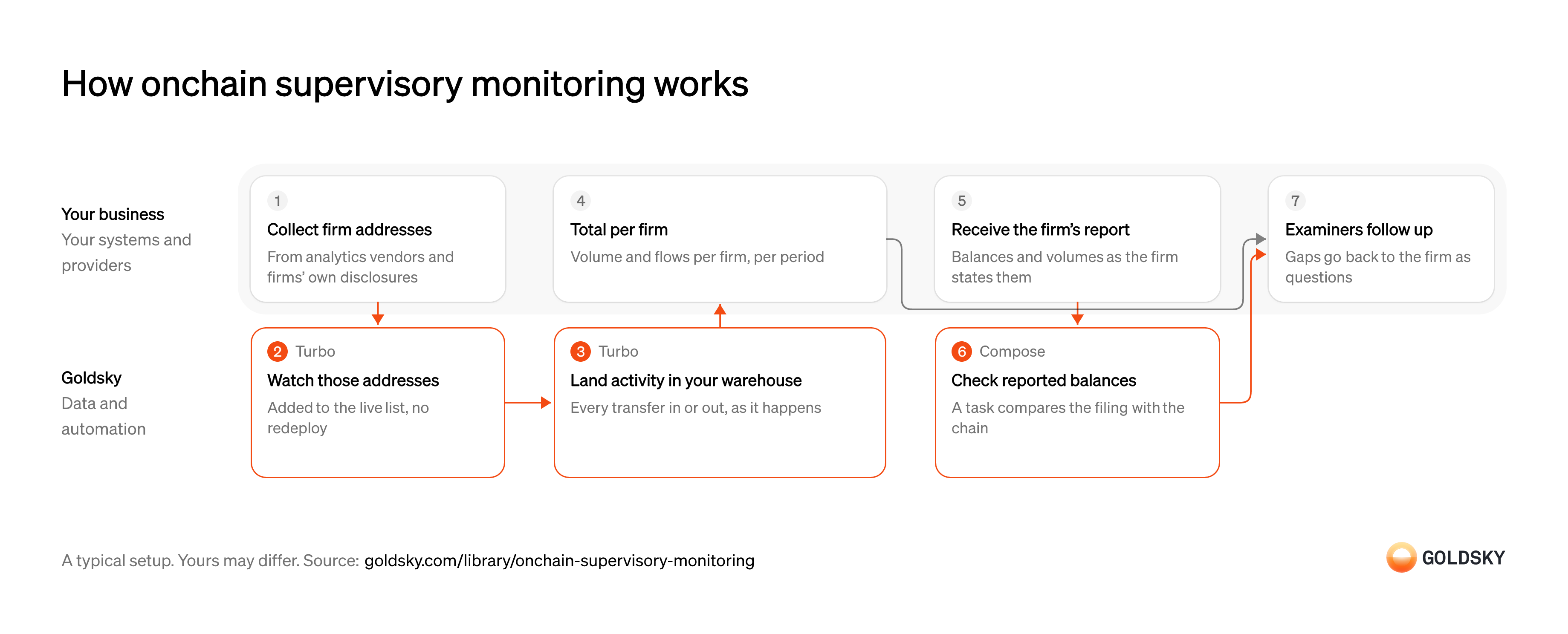
The diagram follows a licensed firm’s addresses from collection to the questions examiners send back, with the firm’s own report checked against the chain on the way. Your setup may differ.
Gather the addresses each firm runs
Onchain activity can only be tied to a firm once you know which wallets belong to it.
Supervisors draw these addresses from blockchain analytics vendors, whose attribution data tie address clusters to named firms, from the reserve addresses some firms publish, and from the firms themselves when asked. An address list that misses a firm’s hot wallets or client wallets gives totals that look like a shortfall.
Watch those addresses
Handled by Goldsky TurboFirms add and retire wallets, and the watch has to follow without a gap.
Each address goes on a list checked against every new transfer, and removing a retired address stops new matches. A list that changes only on a release leaves new wallets unwatched until then.
Turbo Pipelines keeps the list in a dynamic table, which lives in a Postgres database, and matches transfers against it with
Watch addresses with dynamic tables (opens in a new tab)dynamic_table_check(). Insert an address and the running pipeline starts matching it.Land every transfer in your warehouse
Handled by Goldsky TurboExaminers need each firm’s full activity in one place they can query.
Every transfer in and out of a watched address is written as a row with the firm, token, amount and transaction. When the chain rewrites recent blocks, the warehouse has to correct the same rows, or volumes drift from the chain.
With Goldsky, the same pipeline can write matches to a warehouse such as ClickHouse, whose sink deduplicates on the
Write to ClickHouse (opens in a new tab)primary_keyand applies reorg deletes to the same rows.Total activity per firm and period
Reports state balances and volumes per firm per period, so the chain data has to be summed the same way.
Examiners total inflows, outflows and volume per firm and reporting period in the warehouse. Periods have to end at the same moment the firm’s report uses, or the two will never match.
Receive the firm’s report
Licensed firms report their own balances and volumes, and that report is what you’re testing.
The firm files its figures through your usual reporting channel. Each figure needs the date it applies to and the addresses it covers, or it can’t be compared with the chain.
Check reported balances against the chain
Handled by Goldsky ComposeA difference between what a firm reports and what its wallets hold is what an examiner looks into.
For each report, the reported balance is compared with the balance the chain shows for the firm’s addresses, and every comparison is kept. A check that runs only during an examination finds a gap months after it opened.
Goldsky’s Compose can run a task on a cron trigger that fetches the reported figures, reads onchain balances with
Read contracts from a task (opens in a new tab)readContractand records both with the result, so each comparison can be audited.Follow up on the gaps
Findings are the supervisor’s, and so are the questions that go back to the firm.
Examiners review the differences and the totals, ask the firm to explain them and decide on any action. A gap can have an innocent cause, such as an address missing from the list, so the first question is often about the list.
What you control
- Your team
- Gather the addresses each firm runs
- Total activity per firm and period
- Receive the firm’s report
- Follow up on the gaps
Questions and answers
How are stablecoins regulated in the UK?
The FCA will regulate all UK-issued qualifying stablecoins, and issuers that HM Treasury recognizes as systemic will be regulated jointly by the Bank of England and the FCA. Issuing a stablecoin from the UK becomes an FCA-regulated activity from 25 October 2027. The Bank published its policy statement and draft rules for sterling-denominated systemic stablecoins on 22 June 2026; coins used mainly for buying and selling cryptoassets stay with the FCA alone. Either way, an issuer’s coins in issue sit on the chain, where examiners can check them against what the issuer reports.
Security and deployment
- SOC 2 Type IIIndependently audited security controls.
- Dedicated infrastructureSingle-tenant options for production workloads.
- Data residencyCloud, on-premises or co-located.
More use cases that monitor transactions
- Compliance monitoringScreen wallets and transfers, watch for misuse of your assets and feed your AML and surveillance tools.
- Securities surveillanceScreen wallets and transfers, watch for misuse of your assets and feed your AML and surveillance tools.
- Crypto wallet screening and sanctions dataFlag transfers that touch sanctioned or high-risk addresses.
- Secondary-market sanctions sweeps for token issuersScreen every holder and transfer of your stablecoin, not only your direct customers.
- Data for crypto AML transaction monitoringFeed complete transfer data to AML tools with lineage from the chain to the case.
- Unauthorized tokenization monitoringFind tokens that claim to represent your security without your consent.
- Smart contract and wallet monitoringWatch your contracts and wallets for attacks and unexpected changes.
- Blockchain forensics data feedGive investigators full history and traces across chains.
- VASP and counterparty due diligence dataProfile a VASP, issuer or counterparty by its onchain exposure before onboarding it and while the relationship lasts.
- Crypto source of funds and wealth checksTrace where a client’s onchain funds came from to document legitimate wealth at onboarding.
- Token listing due diligence for exchangesCheck a token’s supply, holders, liquidity and risky links before an exchange lists it, and after.
- Crypto scam and money mule detection dataFlag payments to scam-linked wallets and customer accounts that act as money mules.
- Crypto wallet monitoringGet an alert when a watched wallet makes a large transfer, crosses a balance limit, wakes after dormancy or pays an unknown counterparty.
- Address poisoning detectionFlag the zero-value, dust and fake-token transfers that lookalike addresses plant in a user’s history, and warn before anyone pays one.
Use cases built the same way
- Stablecoin disbursements for public-sector programsTrack government benefit or grant payments made in stablecoins, from issue to spend.
- Daily stablecoin supply by chain for PS-01 reportsKeep the daily per-chain supply, issued, redeemed, issuer-held, frozen and lost figures that feed the weekly OCC PS-01 report.
- CFTC digital collateral reporting dataReport totals of BTC, ETH and USDC held as margin, per asset and account class, each week during an FCM’s first three months under the CFTC pilot.
- Onchain research on listed crypto companiesTrack listed companies’ onchain revenue and users before they report earnings.
Run onchain supervisory monitoring with Goldsky
We’ll map it to your systems and show you what Goldsky runs, so your team builds the product, not the pipelines underneath it.
 Robinhood
 HyperEVM
 Arc
 Solana
 Ethereum
 Polymarket
 Base
 Tempo
 Bitcoin