Daily stablecoin supply by chain for PS-01 reports
What it is
A daily per-chain stablecoin supply ledger is the record of how much of a token is outstanding on each chain at each day’s close, split into issued, redeemed, held by the issuer, frozen and lost; teams also call it stablecoin supply by chain.
Payment stablecoin issuers supervised by the OCC need it for Schedule A of the weekly PS-01 report, which asks for those figures for every day of the week.
Goldsky decodes every mint, burn and freeze and reads the balances of the wallets you list into your warehouse, while the daily totals, the call on which wallets count as lost and the report itself stay with your team.
Who it’s for
Stablecoin issuers, the platforms that issue coins for other brands, and crypto-native banks with a payment stablecoin of their own.
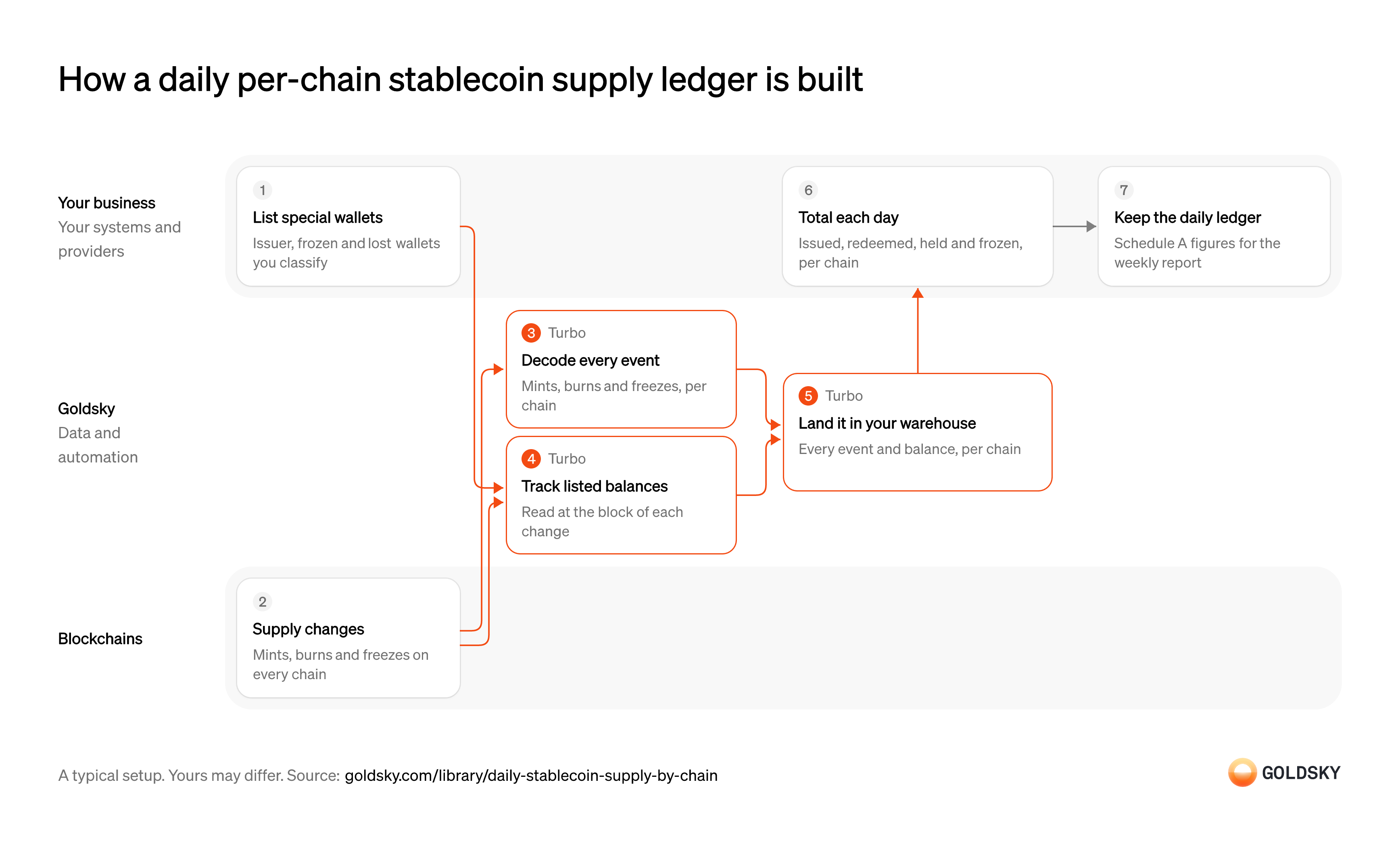
How a daily per-chain stablecoin supply ledger is built
The diagram follows one day’s supply changes on each chain, and your list of special wallets, through to the daily ledger behind the Schedule A figures. Your setup may differ.
Classify issuer, frozen and lost wallets
Some tokens in circulation are held by the issuer, frozen by order or lost for good, and the report counts them apart from the rest.
Your policy decides which wallets belong in each class, and the list has to change as soon as a wallet’s class does. A frozen wallet missing from the list is counted as ordinary supply until someone notices.
Record mints, burns and freezes on each chain
Supply moves when tokens are minted or burned, and a freeze takes tokens out of use without changing supply.
Each chain records only its own events, so a figure per chain needs each chain read separately. For a short time the newest blocks can still be rewritten, so the day’s close should be taken once its last blocks have settled.
Decode every mint, burn and freeze
Handled by Goldsky TurboThe daily figures are built from events, so each one has to become a record with its amount, wallet, chain and block.
Every chain, and every event type the contract emits, has to be covered from the contract’s first block. A freeze event the decoder ignores leaves the frozen line wrong in every report after it.
With Goldsky, one Turbo Pipelines pipeline can decode your contract’s events on each chain with
Decode events on several chains (opens in a new tab)_gs_log_decodeand combine them withUNION ALL, each row tagged with its chain and block.Track the listed wallets’ balances
Handled by Goldsky TurboThe issuer-held, frozen and lost figures are the balances of the wallets on your list, read whenever they change.
Each balance has to be read at the block where it changed, so the day’s figure is exact. Polling every listed wallet on a timer misses changes between polls and costs more as the list grows.
Your list can live in a Turbo Pipelines dynamic table, which lives in a Postgres database, and
Watch wallets with dynamic tables (opens in a new tab)dynamic_table_check()keeps only events that touch a listed wallet._gs_eth_callthen reads that wallet’sbalanceOfat the event’s block.Land the events and balances in your warehouse
Handled by Goldsky TurboThe daily figures are built with SQL, so the events and balances need to sit where your analysts query.
Rows carry chain, block, time and transaction, so each day’s figure can be traced to the events behind it. A reorg (the chain replacing its newest blocks) can undo a recorded event, so the daily query applies corrections before it totals.
Turbo Pipelines can write the rows to S3 as Parquet files, partitioned by chain and date with
Write Parquet files to S3 (opens in a new tab)partition_columns, for your warehouse to read. Reorg corrections arrive in the same stream as rows marked by the_gs_opcolumn.Total each day per chain
Schedule A asks for each figure at each day’s close, per chain.
Your SQL sums mints and burns up to the close and takes each listed wallet’s last balance before it, chain by chain. The close time and time zone have to be fixed in writing, because a figure cut at a different hour won’t match the reserve side.
Keep the daily ledger for the weekly report
The weekly report is filed from these daily figures, and every later supply number has to agree with them.
Store each day’s figures once they’re final, along with the query that produced them. If a figure changes after filing, record the change and its reason too.
What you control
- Your team
- Classify issuer, frozen and lost wallets
- Total each day per chain
- Keep the daily ledger for the weekly report
Security and deployment
- SOC 2 Type IIIndependently audited security controls.
- Dedicated infrastructureSingle-tenant options for production workloads.
- Data residencyCloud, on-premises or co-located.
More use cases that track supply and reserves
- Proof of reserves for stablecoinsKeep a per-chain record of mints, burns and supply, and check it against reserves.
- Stablecoin mint and redemption monitoringRecord every mint and redemption of a stablecoin as it happens, on every chain.
- Continuous proof of reservesCompare onchain supply with reported reserves on a schedule, then publish the ratio or alert on a gap.
- Month-end stablecoin supply for reserve reportsProduce the month-end supply across all chains that the monthly reserve report and its examination need.
- Stablecoin redemption spike alertsAlert when redemption requests in a single 24-hour period pass 10% of a brand’s outstanding issuance, the point at which the OCC must be told within 24 hours.
- MiCA daily usage cap for stablecoinsTrack the quarterly average of daily transactions and their value against the 1M transactions and €200M a day limits, and warn well before an issuer must stop issuing.
- Supply data for stablecoin issuance platformsGive an issuance platform one view of supply across every coin and chain it runs.
- Stablecoin depeg and manipulation alertsAlert the issuer when its coin trades off peg in its own pools or pool activity looks like manipulation, on every chain it runs on.
- Tokenized money market funds in stablecoin reservesTrack stablecoin reserves held as tokenized money market fund shares and check them against the reserve record.
Use cases built the same way
- GENIUS Act stablecoin reporting dataFile the weekly OCC PS-01 report from daily per-chain supply, freeze and holder data.
- CFTC digital collateral reporting dataReport totals of BTC, ETH and USDC held as margin, per asset and account class, each week during an FCM’s first three months under the CFTC pilot.
- NCUA stablecoin reporting dataReport supply, mint and burn, and holder figures for a stablecoin issued by a credit union subsidiary under the NCUA’s proposed rules.
- Sponsored gas spendTotal the gas you pay for your users per user, paymaster and day, watch the paymaster’s deposit and check the provider’s bill.
Keep a daily per-chain stablecoin supply ledger with Goldsky
We’ll map it to your systems and show you what Goldsky runs, so your team builds the product, not the pipelines underneath it.
 Robinhood
 HyperEVM
 Arc
 Solana
 Ethereum
 Polymarket
 Base
 Tempo
 Bitcoin