Stablecoin depeg and manipulation alerts
What it is
Stablecoin depeg alerts tell an issuer when its coin trades away from its peg on decentralized exchanges (DEXs), or when trading in its pools looks like an attempt to push the price.
Stablecoin issuers and issuance platforms watch for this because an off-peg price can lead holders to redeem, and the team needs time to check liquidity before that happens.
Goldsky decodes every swap in your coin’s pools, writes it to your database and sends a webhook for each trade outside your price band, while the rules about volume over time and the response stay with your team.
Who it’s for
Stablecoin issuers, banks and brands that issue their own stablecoin, and the issuance platforms that run coins for them.
How stablecoin depeg alerts work
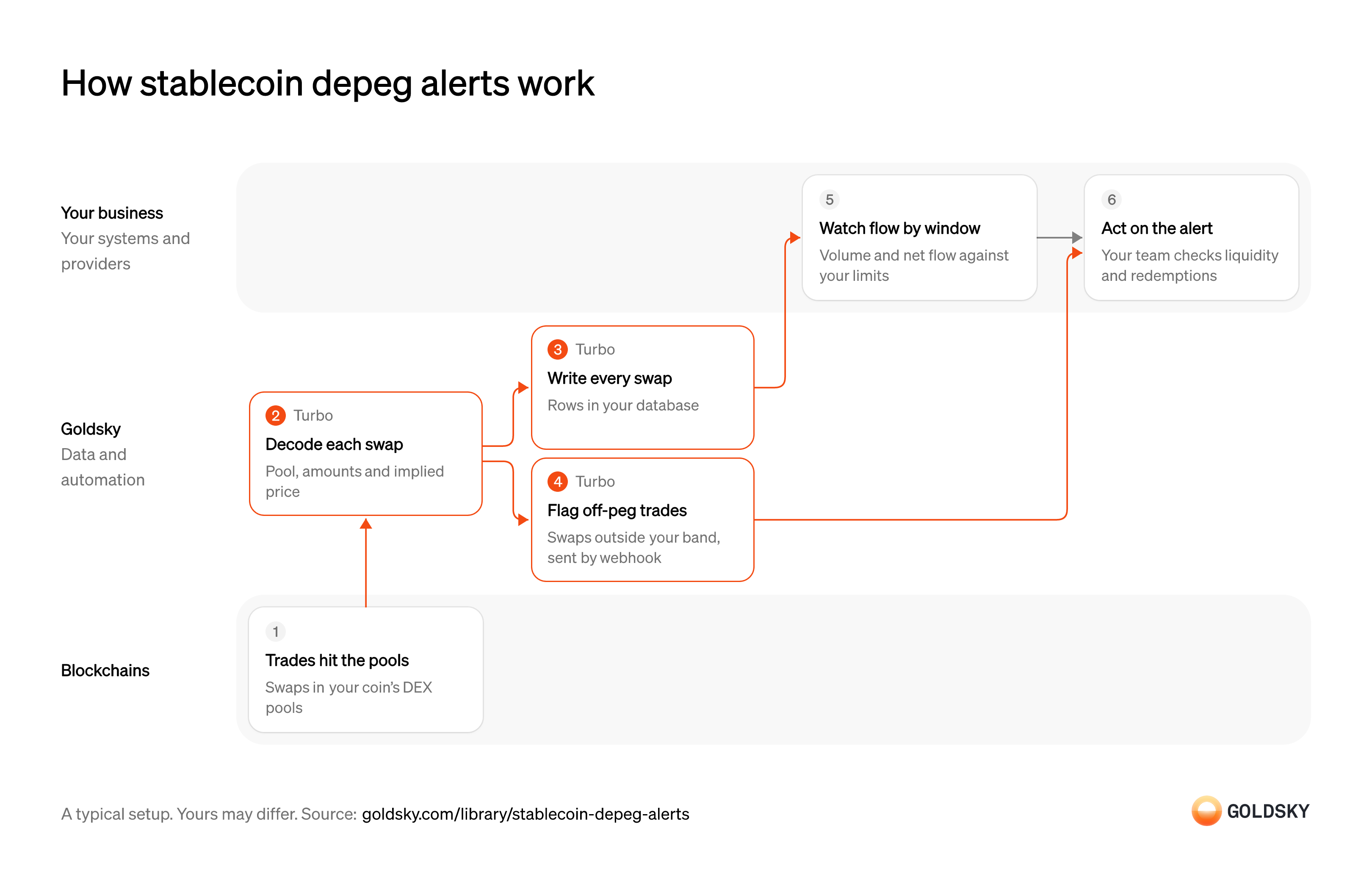
The diagram follows trades from your coin’s DEX pools to your team acting on an alert, and shows who does each step. Your setup may differ.
Trades hit your coin’s pools
A DEX pool sets the price of your coin by the trades made against it, so that’s where a depeg shows first.
Each trade is a swap recorded in a block on the chain. Some pools are small enough that one large swap moves the price a long way, which is why every pool that trades your coin belongs on the list.
Decode each swap
Handled by Goldsky TurboA raw swap record is encoded, so it has to be read into pool, amounts and price before anyone can judge it.
Each swap’s amounts in and out give the price it traded at. Pools built on different exchange designs record swaps differently, so each design needs its own decoding, and a pool you can’t decode is one you can’t watch.
In Turbo Pipelines,
Decode logs with an ABI (opens in a new tab)_gs_log_decode()readsSwapevents with the pool contract’s ABI, and the same SQL can work out the implied price from the decoded amounts.Write every swap to your database
Handled by Goldsky TurboPatterns over time, like heavy one-way selling, only show up when every swap is kept.
Each swap is stored once with pool, direction, amounts, price and block, and corrected if a reorg (the chain replacing its newest blocks) undoes it. Repeated rows inflate volume and can raise a false alarm.
Goldsky writes each swap to a database table keyed on its
How repeats and reorgs reach your sinks (opens in a new tab)id, so a repeated delivery overwrites the same row and reorg corrections update or delete it.Flag swaps outside your price band
Handled by Goldsky TurboA single trade far from the peg is the earliest sign something is wrong, so it should reach a person right away.
The rule looks at one swap at a time: is its price outside the band you set? The alert goes out when the swap is first seen, not once it’s final, so your endpoint has to handle a correction for a swap that a reorg undid.
A second SQL transform in Turbo Pipelines keeps only swaps whose implied price falls outside your band and sends each one to a webhook sink, which retries until your endpoint accepts it.
Set up the webhook sink (opens in a new tab)Watch volume and net flow over time
Manipulation often looks like steady pressure across many trades, which no single swap shows.
Your database sums volume and net flow per pool over a rolling window and compares them with your limits. These rules look across many rows and across time, so they run in your own scheduled queries.
Act on the alert
An alert is only useful if someone with authority looks at it and decides what to do.
Your team checks liquidity, redemptions and the pools involved, and follows the playbook you agreed in advance. Deciding who acts at night or on a weekend before the first alert saves the time it takes to find them.
What you control
- Your team
- Watch volume and net flow over time
- Act on the alert
Security and deployment
- SOC 2 Type IIIndependently audited security controls.
- Dedicated infrastructureSingle-tenant options for production workloads.
- Data residencyCloud, on-premises or co-located.
More use cases that track supply and reserves
- Proof of reserves for stablecoinsKeep a per-chain record of mints, burns and supply, and check it against reserves.
- Stablecoin mint and redemption monitoringRecord every mint and redemption of a stablecoin as it happens, on every chain.
- Continuous proof of reservesCompare onchain supply with reported reserves on a schedule, then publish the ratio or alert on a gap.
- Daily stablecoin supply by chain for PS-01 reportsKeep the daily per-chain supply, issued, redeemed, issuer-held, frozen and lost figures that feed the weekly OCC PS-01 report.
- Month-end stablecoin supply for reserve reportsProduce the month-end supply across all chains that the monthly reserve report and its examination need.
- Stablecoin redemption spike alertsAlert when redemption requests in a single 24-hour period pass 10% of a brand’s outstanding issuance, the point at which the OCC must be told within 24 hours.
- MiCA daily usage cap for stablecoinsTrack the quarterly average of daily transactions and their value against the 1M transactions and €200M a day limits, and warn well before an issuer must stop issuing.
- Supply data for stablecoin issuance platformsGive an issuance platform one view of supply across every coin and chain it runs.
- Tokenized money market funds in stablecoin reservesTrack stablecoin reserves held as tokenized money market fund shares and check them against the reserve record.
Use cases built the same way
- Confirm x402 and agent stablecoin paymentsConfirm stablecoin payments that AI agents make, often per request, and keep each agent within its spending limits.
- Sponsored gas spendTotal the gas you pay for your users per user, paymaster and day, watch the paymaster’s deposit and check the provider’s bill.
- Crypto fair-value pricing from DEX tradesFeed DEX trade prices into principal-market fair-value marks and the VWAPs used to check them.
- Keep tokenized stocks backed one to oneCheck token supply on every chain against the shares or fund units held in custody, and alert on any gap.
Set up stablecoin depeg alerts with Goldsky
We’ll map it to your systems and show you what Goldsky runs, so your team builds the product, not the pipelines underneath it.
 Robinhood
 HyperEVM
 Arc
 Solana
 Ethereum
 Polymarket
 Base
 Tempo
 Bitcoin