Keep tokenized stocks backed one to one
What it is
Keeping tokenized stocks backed one to one means checking that the tokens in circulation, on every chain they’re issued on, match the shares held in custody for them; issuers also call it proof of reserves for tokenized stocks.
Tokenized stock venues and tokenization platforms run the check because each token is a claim on one share, and a gap means some holders own tokens with no share behind them.
Goldsky records every mint and burn in your database, keeps the supply on each chain there and runs a scheduled task that compares supply with your custodian’s count, then alerts your team or pauses minting on a gap, while custody, the share count and resolving a break stay with you.
You can build it two ways: keep every mint and burn and the supply on each chain with Turbo Pipelines and check the totals with a scheduled Compose task, or have the Compose task read total supply on each chain over Edge RPC.
Who it’s for
Tokenized stock venues, brokers that issue stock tokens and tokenization platforms that hold the underlying shares with a custodian or broker.
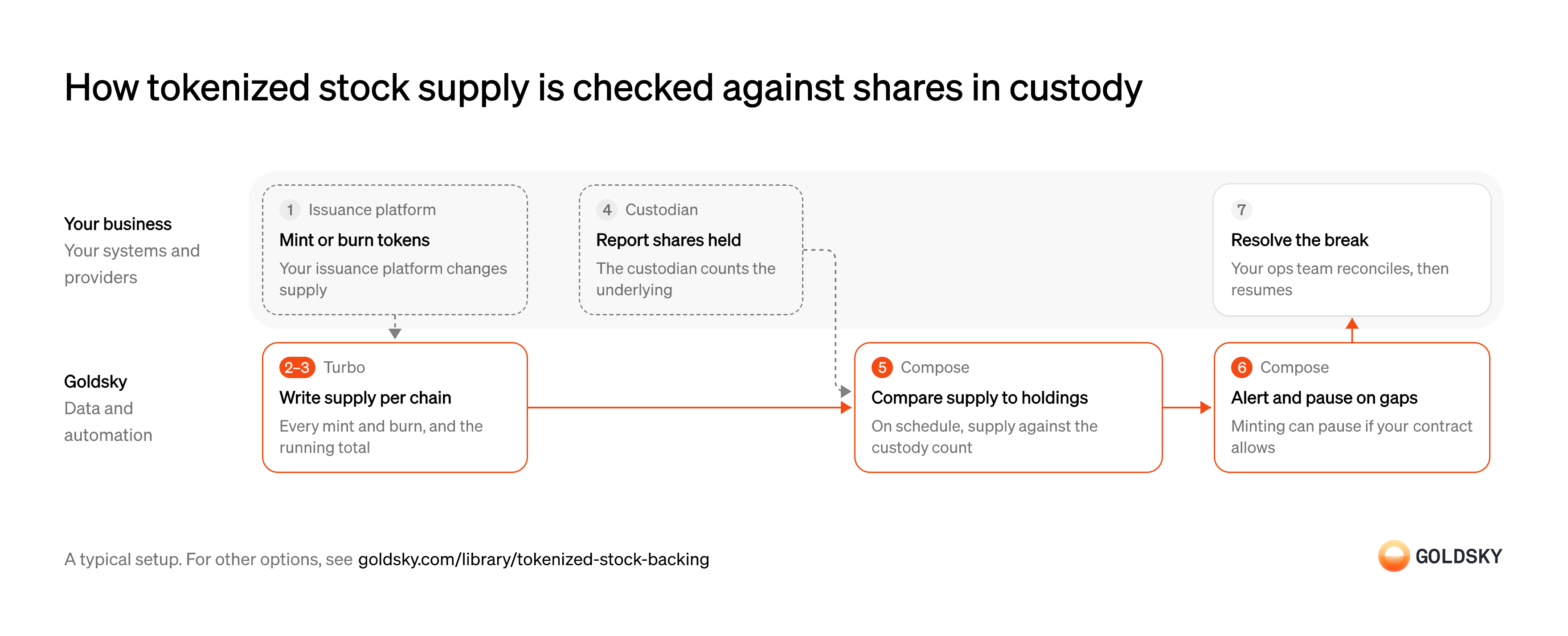
How tokenized stock supply is checked against shares in custody
The diagram follows supply from each mint or burn to the break your operations team resolves, with the custodian’s share count feeding the comparison, and shows who does each step. Your setup may differ.
Ways to check tokenized stock supply against custody
A ledger of every mint and burn lets you trace a gap to the change that opened it, while reading total supply gives one current figure per chain and nothing to run but the task.
- Best for
- Several chains, with every supply change on record
- Best for
- A few chains, with no pipeline or database
| Usual setupOption 1: Supply ledger and check | Option 2: Scheduled supply check | |
|---|---|---|
| Best for | Several chains, with every supply change on record | A few chains, with no pipeline or database |
| Products | TurboCompose | ComposeEdge |
Mint or burn tokens
Supply changes when your issuance platform mints tokens for a buyer or burns them on a redemption.
Each mint should follow shares arriving in custody, and each burn shares leaving. When the two happen at different times, supply and custody differ for a while, and the check has to allow for that window.
Record every mint and burn
Handled by Goldsky TurboA full record of supply changes on each chain shows which change opened a gap, as well as whether there is one.
Every mint and burn, on every chain the token is issued on, has to land once with its amount, chain and transaction. A chain left out makes supply look lower than it is, which can hide a real gap.
A Turbo Pipelines pipeline can pick mints and burns out of the token’s transfers (those from or to the zero address) and write each to your database keyed on its
Track supply from mints and burns (opens in a new tab)id, with reorg corrections applied to the same rows.Keep the supply on each chain
Handled by Goldsky TurboThe comparison needs one supply figure per chain, kept current between checks.
Each mint has to add to its chain’s supply and each burn take away, and a mint or burn a reorg removes has to come back out. A bridged token can be counted twice, once where it’s locked and once where it’s minted, so your rules have to say which side counts when the chains are added together.
The same pipeline can write mints as positive amounts and burns as negative ones to Turbo Pipelines’
Keep running totals in your database (opens in a new tab)postgres_aggregatesink, which keeps running totals in a Postgres database: group by token and chain withsumon the amount, and keep the_gs_opcolumn so a mint or burn a reorg deletes comes off the total.Report the shares held
The other side of the check is how many shares the custodian holds for token holders.
Your custodian or broker reports the share count for each stock, usually over an API, with the time it applies to. A count with no time can’t be compared fairly with supply that changed since.
Compare supply with the shares held
Handled by Goldsky ComposeThe check answers one question on a timer: does every token have a share behind it?
Add the chains together and compare the total with the custodian’s count for each stock, allowing for mints and burns still in transit under your rules. Figures taken at different moments produce false breaks, which teach the team to ignore alerts.
A Compose task on a cron trigger can fetch the supply totals from your database’s API and the custodian’s count with
Set up cron triggers (opens in a new tab)fetch, compare them, and log every input with the result.Alert and pause on a gap
Handled by Goldsky ComposeA gap needs a person straight away, and minting more tokens while it’s open can make it bigger.
Send an alert with the stock, both figures and the difference, and stop new minting until someone has checked. A pause works only if the token contract has one and the checking wallet is allowed to use it.
Goldsky Compose can post the alert to your endpoint and, when the token gives the task’s wallet a pause role, call the pause function in the same run. Durable execution carries the pause through a restart.
Learn about task wallets (opens in a new tab)Resolve the break
Someone has to find out why supply and custody differ and fix it before minting resumes.
Your operations team traces the gap to a mint, burn or custody movement, corrects the side that’s wrong and lifts the pause. Keep each break and its cause on record, because auditors and the custodian will ask for that history.
What to know about a supply ledger with a scheduled check
- The ledger holds each mint and burn with its transaction, so a break can be traced to the change that caused it.
- Supply is kept per chain as mints and burns arrive, and corrected when a reorg removes one.
- The check runs on a timer, so a gap shows at the next run, and the custodian’s count is as fresh as its last report.
- A pause happens only if the token contract has one and the task’s wallet holds the role.
Mint or burn tokens
Supply changes when your issuance platform mints tokens for a buyer or burns them on a redemption.
Each mint should follow shares arriving in custody, and each burn shares leaving. When the two happen at different times, supply and custody differ for a while, and the check has to allow for that window.
Run the check on a schedule
Handled by Goldsky ComposeA timer makes sure supply is checked even when nobody is looking.
Choose an interval that fits how often tokens are minted and burned and how often the custodian reports. Checking far more often than the custodian reports compares new supply with an old count.
With Goldsky, the check is a Compose task on a cron trigger, and every read, comparison and alert in a run is logged together.
Set up cron triggers (opens in a new tab)Read total supply on each chain
Handled by Goldsky EdgeThe token contract’s total supply is the number of tokens in circulation on that chain.
Read it at a stated block on each chain, so the figure can be repeated and compared. A read from a node that has fallen behind returns an old supply without any error.
Edge RPC serves
Read contract state with eth_call (opens in a new tab)eth_callfortotalSupply()at a block number or tag, and checks responses across providers so a lagging one doesn’t return stale data.Report the shares held
The other side of the check is how many shares the custodian holds for token holders.
Your custodian or broker reports the share count for each stock, usually over an API, with the time it applies to. A count with no time can’t be compared fairly with supply that changed since.
Compare supply with the shares held
Handled by Goldsky ComposeThe check answers one question on a timer: does every token have a share behind it?
Add the chains together and compare the total with the custodian’s count for each stock, allowing for mints and burns in transit under your rules. Figures taken at different moments produce false breaks.
The Compose task fetches the custodian’s count with
Make logged HTTP requests (opens in a new tab)fetch, which retries failed reads, and keeps both figures in the run’s log beside the result.Alert and pause on a gap
Handled by Goldsky ComposeA gap needs a person straight away, and minting more tokens while it’s open can make it bigger.
Send an alert with the stock, both figures and the difference, and stop new minting until someone has checked. A pause works only if the token contract has one and the checking wallet is allowed to use it.
Goldsky Compose can post the alert to your endpoint and, when the token gives the task’s wallet a pause role, call the pause function in the same run. Durable execution carries the pause through a restart.
Learn about task wallets (opens in a new tab)Resolve the break
Someone has to find out why supply and custody differ and fix it before minting resumes.
Your operations team traces the gap to a mint, burn or custody movement, corrects the side that’s wrong and lifts the pause. Keep each break and its cause on record, because auditors and the custodian will ask for that history.
What to know about checking total supply on a schedule
- Each run sees one supply figure per chain, with no history of the mints and burns behind it.
- There’s no database to keep; the timer and the task are all that run.
- Tracing a break to its cause needs another source, such as your issuance platform’s records.
What you control
- Your team
- Resolve the break
- Your providers
- Issuance platform
- Custodian
Questions and answers
Are tokenized stocks backed by real shares?
Some are and some aren’t; it depends on how the issuer builds the token. A backed token is issued against a share that a custodian or broker holds, one token per share, while other products give exposure to the price with no share held for each token. For a backed token, the test is whether supply on every chain matches the shares in custody, which the issuer can check on a schedule and publish or alert on.
Security and deployment
- SOC 2 Type IIIndependently audited security controls.
- Dedicated infrastructureSingle-tenant options for production workloads.
- Data residencyCloud, on-premises or co-located.
More use cases that tokenize securities
- Tokenized fund subscriptions and redemptions across chainsTrack subscriptions and redemptions of a tokenized fund as mints and burns across every chain it’s on.
- Tokenized stock mint and redeem against ordersTrigger mints and redemptions when a customer buys or sells, and record every step for the books.
- Keep gold and commodity tokens backedKeep gold and other commodity tokens matched to vaulted holdings, and alert on any gap.
- Wrapped bitcoin reserve monitoringCheck a wrapped bitcoin token’s supply on every chain against the BTC at its custodian’s reserve addresses, and alert on any gap.
Use cases built the same way
- Continuous proof of reservesCompare onchain supply with reported reserves on a schedule, then publish the ratio or alert on a gap.
- Tokenized securities venue disclosuresPublish trading notices, enforce volume caps and sync halts with the listing exchange.
- Confirm x402 and agent stablecoin paymentsConfirm stablecoin payments that AI agents make, often per request, and keep each agent within its spending limits.
- Cross-chain transfer trackingSee every cross-chain stablecoin transfer as settled, in flight or stalled, and catch the stuck ones.
Keep tokenized stocks backed one to one with Goldsky
We’ll map it to your systems and show you what Goldsky runs, so your team builds the product, not the pipelines underneath it.
 Robinhood
 HyperEVM
 Arc
 Solana
 Ethereum
 Polymarket
 Base
 Tempo
 Bitcoin