Tokenized fund subscriptions and redemptions across chains
What are tokenized fund subscriptions and redemptions across chains?
Tokenized fund subscriptions and redemptions across chains are the money moving into and out of a fund whose shares are tokens, such as a tokenized money market or Treasury fund, recorded as share mints and burns on every chain the fund is issued on; asset managers call them tokenized fund flows.
Asset managers, transfer agents and tokenization platforms track them so fund accounting can reconcile net flows and shares outstanding for the whole fund, which no single chain can show.
With Goldsky, you can stream every chain’s share mints and burns into your database with Turbo Pipelines, or index them in a hosted subgraph on each chain and query it over GraphQL.
Who tracks tokenized fund subscriptions and redemptions across chains?
Asset managers with tokenized funds, the transfer agents that keep their share registers, and the tokenization platforms that issue the shares.
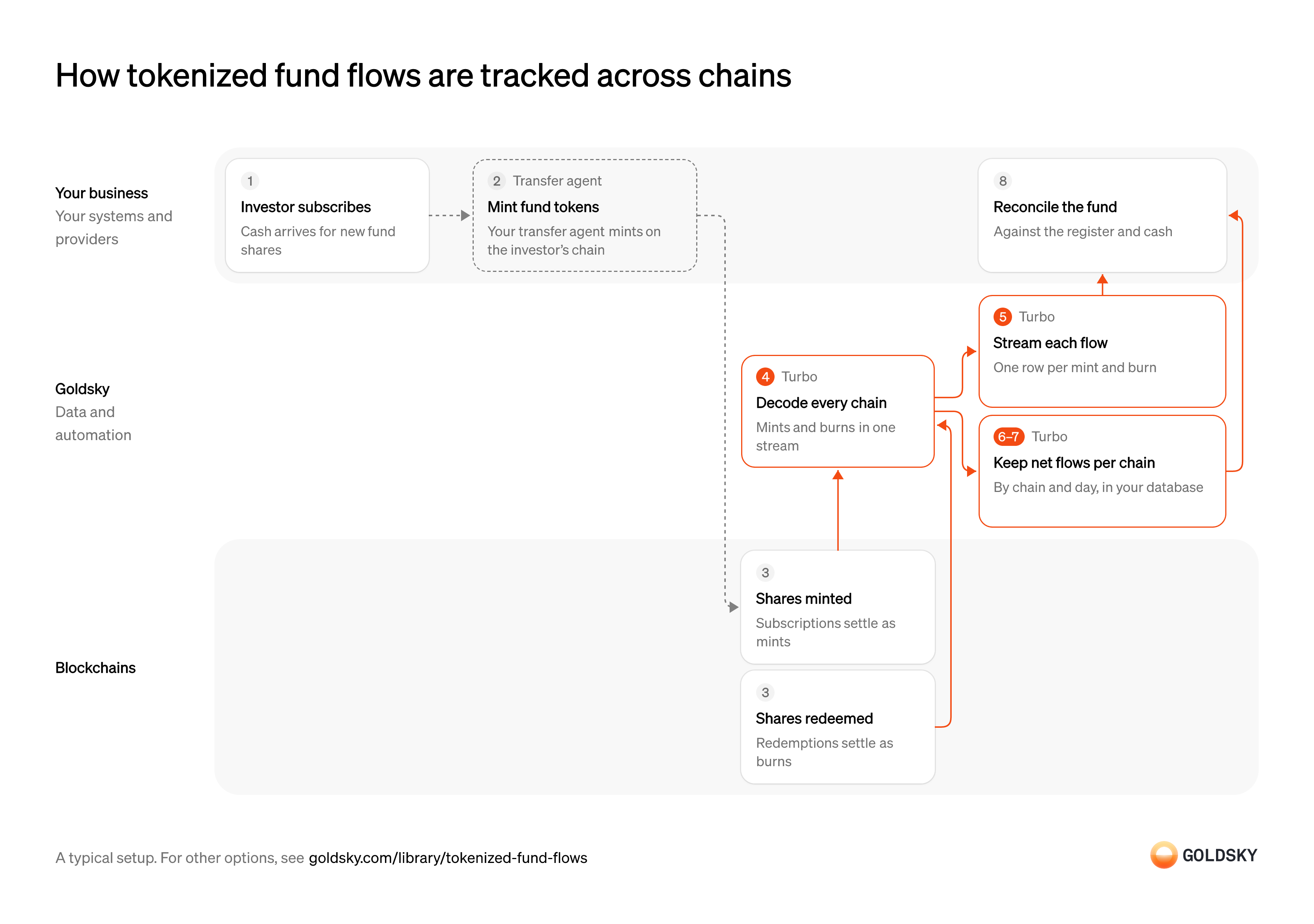
How tokenized fund flows are tracked across chains
The diagram follows an investor’s subscription, and a later redemption, to the reconciliation of the fund’s flows and shares on each chain. Your setup may differ.
Ways to track tokenized fund flows across chains
Streaming puts every chain’s share mints and burns, and running net flows per chain, in your database next to fund accounting; a subgraph keeps each chain’s flows in a hosted index that your systems query and combine.
- Best for
- Many chains, every flow next to fund accounting
- Products
- Turbo
- What you run
- The destination: your database, queue or bucket, or a Postgres database Goldsky hosts
- What you write
- Pipeline YAML and SQL; TypeScript transforms when needed
- Where your data lives
- In your own database or systems
- How results reach you
- Pushed to you
- Best for
- A few EVM chains, read from a hosted API
- Products
- Subgraphs
- What you run
- Nothing; Goldsky runs indexing, storage and the API
- What you write
- A schema and mapping handlers, or a no-code or low-code config for simple contracts
- Where your data lives
- Hosted by Goldsky
- How results reach you
- You query; changes are pushed
| Usual setupOption 1: Stream to your database | Option 2: Hosted subgraph | |
|---|---|---|
| Best for | Many chains, every flow next to fund accounting | A few EVM chains, read from a hosted API |
| Products | Turbo | Subgraphs |
| What you run | The destination: your database, queue or bucket, or a Postgres database Goldsky hosts | Nothing; Goldsky runs indexing, storage and the API |
| What you write | Pipeline YAML and SQL; TypeScript transforms when needed | A schema and mapping handlers, or a no-code or low-code config for simple contracts |
| Where your data lives | In your own database or systems | Hosted by Goldsky |
| How results reach you | Pushed to you | You query; changes are pushed |
Take the investor’s subscription
An investor buys into the fund by sending cash, and the shares come afterwards.
The subscription is accepted under the fund’s rules, such as cut-off times and eligibility, before any shares exist. Shares minted for cash that hasn’t settled leave the fund owed money by an investor who already holds shares.
Mint the fund’s shares
The transfer agent creates the investor’s shares as tokens on the chain the investor uses.
The mint has to carry a reference the transfer agent can tie to the subscription. Without one, fund accounting sees shares appear but can’t say whose cash paid for them.
Settle subscriptions and redemptions on the chain
Subscriptions settle as share mints and redemptions as burns, on whichever chain each investor holds shares.
Each chain shows only its own part of the fund. For a short time the newest blocks can still be rewritten, so a mint seen once isn’t final yet.
Decode mints and burns on every chain
Handled by Goldsky TurboEach mint and burn has to become a record with its amount, wallet, chain and transaction before it can be reconciled.
Every chain the fund is on has to be covered, and a new chain added before shares are issued there. A chain left out shows up as shares outstanding that don’t add up to the register.
With Goldsky, one Turbo Pipelines pipeline can read each chain as its own source and combine their mints and burns with
Merge chains in one pipeline (opens in a new tab)UNION ALL, tagging each row with its chain.Stream each flow to your database
Handled by Goldsky TurboFund accounting works from tables, so every flow has to land as a row it can query.
Rows need a stable ID, because delivery can repeat after a restart and a flow counted twice overstates net subscriptions.
Turbo Pipelines writes each mint and burn to a database table keyed on
Set up the Postgres sink (opens in a new tab)id, so a repeated delivery overwrites the same row.Keep net flows per chain and day
Handled by Goldsky TurboFund accounting reconciles net subscriptions per chain and day, and shares outstanding per chain.
Redemptions count as negative amounts, and the day has to follow the fund’s cut-off rather than midnight on the chain, or a late flow lands in the wrong day.
With Goldsky, the Turbo Pipelines
Keep running totals in your database (opens in a new tab)postgres_aggregatesink keeps a runningsumper chain and day in your database, with the day set in the pipeline’s SQL, updated as each flow arrives; keep the_gs_opcolumn in that SQL so a flow a reorg deletes comes off the total.Correct flows undone by a reorg
Handled by Goldsky TurboSometimes a chain replaces its newest blocks (a reorg), and a mint or burn you recorded can disappear.
Your tables have to follow the chain when that happens. Otherwise shares outstanding include a mint that no longer exists, and the register and the chain disagree.
Reorg corrections come through Turbo Pipelines as updates and deletes. A database sink with a
How reorgs reach your sinks (opens in a new tab)primary_keyapplies them to the same rows, and the running flows take a removed row back out.Reconcile the fund
The fund’s books, the transfer agent’s register and the chain have to agree on net flows and shares outstanding.
Your team compares net flows per chain and day, and shares outstanding per chain and in total, with the register and the cash movements. A difference means a missed chain, a late mint or a booking error, and it has to be explained before the fund’s next valuation.
What to know about streaming fund flows to your database
- Goldsky runs the pipeline and keeps the running flows; the database, the reconciliation and the fund’s books are yours.
- Rows arrive as blocks are produced, so fund accounting can see the day’s flows before the close.
- Tables keyed on the row ID take reorg corrections as updates and deletes, and the running flows drop a mint or burn a reorg removes.
- Tying a mint to an investor’s subscription is a join in your database against the transfer agent’s records.
Take the investor’s subscription
An investor buys into the fund by sending cash, and the shares come afterwards.
The subscription is accepted under the fund’s rules, such as cut-off times and eligibility, before any shares exist. Shares minted for cash that hasn’t settled leave the fund owed money by an investor who already holds shares.
Mint the fund’s shares
The transfer agent creates the investor’s shares as tokens on the chain the investor uses.
The mint has to carry a reference the transfer agent can tie to the subscription. Without one, fund accounting sees shares appear but can’t say whose cash paid for them.
Settle subscriptions and redemptions on the chain
Subscriptions settle as share mints and redemptions as burns, on whichever chain each investor holds shares.
Each chain shows only its own part of the fund. For a short time the newest blocks can still be rewritten, so a mint seen once isn’t final yet.
Define the flow records
The subgraph needs to know which events are subscriptions and redemptions, and what to keep for each.
A record per mint and burn, plus running totals per day, lets fund accounting read flows without summing every event. Daily totals kept in mappings use the chain’s block time, so the day boundary has to match the fund’s cut-off.
Index every share mint and burn
Handled by Goldsky SubgraphsFlows and shares outstanding come from every mint and burn since the fund token was deployed.
Indexing starts at the token’s deployment block on each chain and then keeps up with new blocks. A start block set too late leaves early subscriptions out with no error.
You deploy the subgraph to Goldsky Subgraphs with
Deploy a subgraph to Goldsky (opens in a new tab)goldsky subgraph deploy, once per chain, and it indexes from the start block you set.Query each chain’s flows
Handled by Goldsky SubgraphsFund accounting reads the records by querying each chain’s endpoint.
Fund flow data isn’t meant for the public, so the endpoint should require a key. Each query should note the block it was answered at, so figures from different chains can be lined up.
Each subgraph in Subgraphs has a hosted GraphQL endpoint, which you can make private so every request needs an API token.
Set up private endpoints (opens in a new tab)Reconcile the fund
The fund’s books, the transfer agent’s register and the chain have to agree on net flows and shares outstanding.
Your systems add up each chain’s net flows and shares outstanding, then compare them with the register and the cash movements. A reorg (the chain replacing its newest blocks) can change recent figures, so reconcile against blocks that have settled.
What to know about tracking fund flows with a subgraph
- Each chain is its own subgraph, so a fund-wide figure means querying each one and adding them up.
- Your mapping code decides what’s stored, such as daily flow totals, and changing it means deploying and indexing again.
- Your systems pull from the endpoint, and webhooks can push each change if you need them.
- Goldsky hosts the index; the reconciliation and the fund’s books stay with your team.
What you control
- Your team
- Take the investor’s subscription
- Reconcile the fund
- Your providers
- Transfer agent
Questions and answers
What is a tokenized fund?
A tokenized fund is an investment fund whose shares are issued as tokens on a blockchain instead of only as entries in a transfer agent’s register. Investors subscribe and redeem much as they would with any fund, and their shares are minted to or burned from their wallets. The fund’s assets, valuation and legal structure work as usual; the token changes how shares are held, moved and recorded.
What is a tokenized money market fund?
A tokenized money market fund is a money market fund, investing in short-term government debt and similar assets, whose shares are issued as tokens. Investors can hold the shares in a wallet and move them onchain. Some stablecoin issuers hold these shares as part of their reserves, which is one reason the funds often run on several chains at once. Each share mint and burn on those chains is a subscription or redemption the fund has to reconcile.
What are tokenized treasuries?
Tokenized treasuries are US Treasury bills and bonds, or shares in a fund that holds them, issued as tokens on a blockchain. Many are shares in a tokenized Treasury or government money market fund: investors subscribe and the fund mints shares to their wallets, then burns them when the investor redeems. Because these funds often run on several chains, each chain’s mints and burns are part of the flows the fund reconciles.
Security and deployment
- SOC 2 Type IIIndependently audited security controls.
- Dedicated infrastructureSingle-tenant options for production workloads.
- Data residencyCloud, on-premises or co-located.
More use cases that tokenize securities
- Keep tokenized stocks backed one to oneCheck token supply on every chain against the shares or fund units held in custody, and alert on any gap.
- Tokenized stock mint and redeem against ordersTrigger mints and redemptions when a customer buys or sells, and record every step for the books.
- Keep gold and commodity tokens backedKeep gold and other commodity tokens matched to vaulted holdings, and alert on any gap.
- Wrapped bitcoin reserve monitoringCheck a wrapped bitcoin token’s supply on every chain against the BTC at its custodian’s reserve addresses, and alert on any gap.
Use cases built the same way
- Stablecoin distributor revenue shareAttribute holdings, mints and burns to each distributor across wallets and chains.
- Tokenized fund register across chainsCombine holdings of one fund issued on many chains into a single register.
- Cross-chain transfer trackingSee every cross-chain stablecoin transfer as settled, in flight or stalled, and catch the stuck ones.
- Stablecoin mint and redemption monitoringRecord every mint and redemption of a stablecoin as it happens, on every chain.
Track tokenized fund subscriptions and redemptions across chains with Goldsky
We’ll map it to your systems and show you what Goldsky runs, so your team builds the product, not the pipelines underneath it.
 Robinhood
 HyperEVM
 Arc
 Solana
 Ethereum
 Polymarket
 Base
 Tempo
 Bitcoin