Tokenized fund register across chains
What is a tokenized fund register?
A tokenized fund register, also called a unitholder register, is one list of everyone who holds a fund’s units when the fund is issued as a token on several chains.
Transfer agents and asset managers need it because each chain only knows its own holders, while the fund reports one total, one set of investors and one NAV per unit.
Goldsky decodes the fund’s transfers on every chain into one schema in your database and keeps each holder’s balance per chain; your team pairs units moved between chains and reports the fund total.
Who keeps a tokenized fund register?
Asset managers, transfer agents and tokenization platforms that issue one fund on several chains and report it as a single fund.
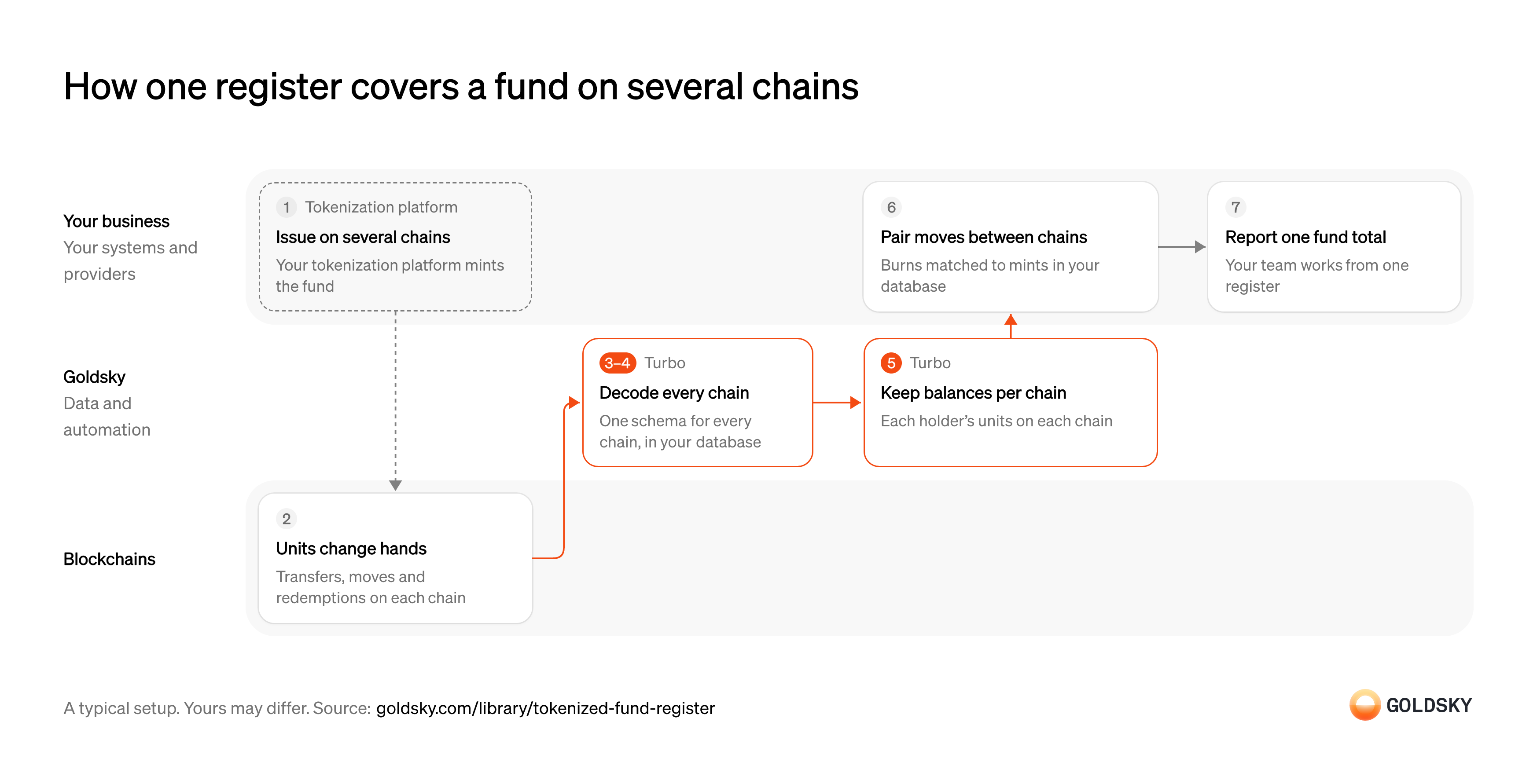
How one register covers a fund on several chains
The diagram follows the fund’s units from issuance on each chain to one fund total your team reports from, and shows who does each step. Your setup may differ.
Issue the fund on each chain
Investors hold the fund on the chains they use, so the same fund is issued as a separate token on each one.
Your tokenization platform deploys the fund’s token on each chain and mints units there. Every deployment has its own contract address, and the register has to know all of them, or a whole chain’s holders are missing.
Record units changing hands on each chain
Each chain records only the transfers, mints and redemptions of its own token.
Units are minted, redeemed and transferred on each chain separately, and some are moved between chains by burning them on one and minting them on another. The newest blocks on any chain can still be rewritten, so a move seen once isn’t settled yet.
Decode every chain into one schema
Handled by Goldsky TurboThe register reads one table, so transfers from every chain need the same columns and a field saying which chain they came from.
Each chain’s events are decoded with the same contract definition and given the same columns plus a chain name. If one chain’s rows come out in a different shape, every report has to treat that chain as a special case.
With Goldsky, one Turbo Pipelines pipeline can read each chain as its own source, decode the logs with
Combine several chains in one pipeline (opens in a new tab)_gs_log_decode, add a column for the chain and combine them withUNION ALL.Write every transfer to one register table
Handled by Goldsky TurboEvery transfer changes two balances, and every row has to stay correct when a chain rewrites its newest blocks.
Write each transfer as a credit to the recipient and a debit from the sender, each with an ID that’s unique across chains. When a reorg on one chain undoes a transfer, only that chain’s rows should change.
Turbo Pipelines writes to a database table with a
How reorgs reach your database (opens in a new tab)primary_key, so reorg corrections arrive as deletes and updates to the same rows, and a repeated delivery overwrites the row it already wrote.Keep balances per holder and chain
Handled by Goldsky TurboThe fund needs each investor’s holding on each chain, and their total across all of them.
Each credit and debit has to change the balance for its holder, token and chain as it arrives. The same investor may use different wallets on different chains, so the total per investor comes from your own record of which wallets are theirs.
Turbo Pipelines’
Keep running totals in your database (opens in a new tab)postgres_aggregatesink keeps running totals in a Postgres database: group by holder, token and chain withsumon the amount, and each balance updates as rows land and drops a row a reorg deletes, provided the rows keep the_gs_opcolumn.Pair moves between chains
A unit moved from one chain to another is burned on the first and minted on the second, and it’s still one unit.
Match each burn on the source chain to its mint on the destination chain, in your database. A burn with no mint yet is in transit, and counting it on neither chain, or on both, puts the fund total out by that amount.
Report one fund total
The fund reports one number of units in issue, whatever chains they sit on.
Add the units on every chain and the units in transit, and check the sum against the units the fund has issued. A difference is a break to explain before the register or the NAV per unit is reported.
What you control
- Your team
- Pair moves between chains
- Report one fund total
- Your providers
- Tokenization platform
Questions and answers
What is a tokenized fund?
A tokenized fund is an investment fund whose shares or units are issued as tokens on a blockchain. The fund keeps its usual legal structure, manager and administrator. The token records who holds the units and lets them move between approved wallets, and the transfer agent keeps the official register in step with those moves.
What is a tokenized money market fund?
A tokenized money market fund is a money market fund whose units are issued as tokens on a blockchain. It holds the same short-term assets as any money market fund, such as Treasury bills and repo. Holders can transfer units between approved wallets, and the fund’s NAV and holder register are kept in step with those transfers.
Who owns the underlying asset in a tokenized fund?
The fund owns the underlying assets, and investors own units of the fund. The token is a record of those units, so holding it means holding a share of the fund on the terms of its documents. The assets themselves are usually held by the fund’s custodian, and the transfer agent’s register is the legal record of who the investors are.
How do you launch a tokenized fund?
You set up the fund with its legal structure, manager, administrator and transfer agent, then a tokenization platform issues its units as tokens on the chains you choose. Before launch you decide who can hold the token, how investors are verified, how the NAV reaches each chain and how the register follows transfers. Your legal counsel decides what the fund’s documents and filings need to say.
Security and deployment
- SOC 2 Type IIIndependently audited security controls.
- Dedicated infrastructureSingle-tenant options for production workloads.
- Data residencyCloud, on-premises or co-located.
More use cases that keep a holder register
- Onchain shareholder register for transfer agentsKeep a transfer agent’s official register of a tokenized fund or stock in step with onchain transfers.
- Investor statements from a tokenized registerProduce investor statements and holdings reports straight from the onchain register.
- Onchain primary issuance and allocationsRecord shares issued onchain at issuance or IPO straight into the register.
- Security token recovery for lost walletsRecord when an issuer reissues a lost security token to a new wallet after identity checks.
Use cases built the same way
- Tokenized fund subscriptions and redemptions across chainsTrack subscriptions and redemptions of a tokenized fund as mints and burns across every chain it’s on.
- Stablecoin distributor revenue shareAttribute holdings, mints and burns to each distributor across wallets and chains.
- Cross-chain transfer trackingSee every cross-chain stablecoin transfer as settled, in flight or stalled, and catch the stuck ones.
- Stablecoin mint and redemption monitoringRecord every mint and redemption of a stablecoin as it happens, on every chain.
Keep a tokenized fund register across chains with Goldsky
We’ll map it to your systems and show you what Goldsky runs, so your team builds the product, not the pipelines underneath it.
 Robinhood
 HyperEVM
 Arc
 Solana
 Ethereum
 Polymarket
 Base
 Tempo
 Bitcoin