Onchain primary issuance and allocations
What is onchain primary issuance?
Onchain primary issuance is selling new shares, fund units or bonds by minting them as tokens straight to investors’ wallets, at launch or in a tokenized IPO.
Transfer agents and tokenization platforms track it because every mint creates a holder in the register, and the units minted have to match the allocations set when the book closed.
Goldsky records each mint with its wallet and amount in your database; verifying investors, setting allocations and minting stay with you and your issuance platform.
You can record onchain primary issuance two ways: stream every mint into your database with Turbo Pipelines, or have a Goldsky subgraph index the mints and serve them over GraphQL.
Who runs onchain primary issuance?
Transfer agents, tokenization platforms and issuers that sell new shares, fund units or bonds by minting them to investors.
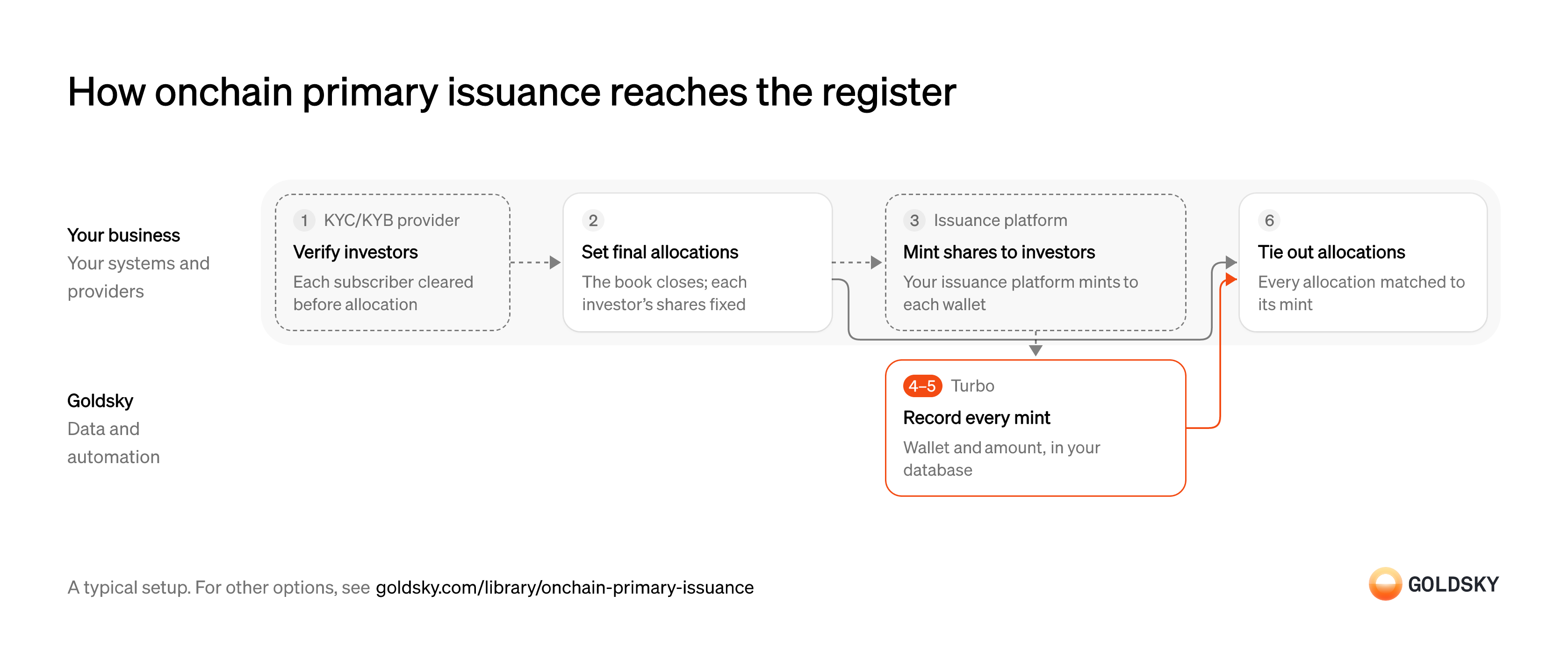
How onchain primary issuance reaches the register
The diagram follows one offering from the investor checks to the tie-out of every allocation against its mint, and shows who does each step. Your setup may differ.
Ways to record onchain primary issuance
Mint records from the pipeline land in your database next to the allocation list, so the tie-out is a query; the subgraph keeps the mints and holders behind a GraphQL endpoint your tie-out job calls.
- Best for
- Allocations tied out in your own database, on any number of chains
- Products
- Turbo
- What you run
- The destination: your database, queue or bucket, or a Postgres database Goldsky hosts
- What you write
- Pipeline YAML and SQL; TypeScript transforms when needed
- Where your data lives
- In your own database or systems
- How results reach you
- Pushed to you
- Best for
- One chain, mints and holders queried from an API
- Products
- Subgraphs
- What you run
- Nothing; Goldsky runs indexing, storage and the API
- What you write
- A schema and mapping handlers, or a no-code or low-code config for simple contracts
- Where your data lives
- Hosted by Goldsky
- How results reach you
- You query; changes are pushed
| Usual setupOption 1: Stream to your database | Option 2: Hosted holder index | |
|---|---|---|
| Best for | Allocations tied out in your own database, on any number of chains | One chain, mints and holders queried from an API |
| Products | Turbo | Subgraphs |
| What you run | The destination: your database, queue or bucket, or a Postgres database Goldsky hosts | Nothing; Goldsky runs indexing, storage and the API |
| What you write | Pipeline YAML and SQL; TypeScript transforms when needed | A schema and mapping handlers, or a no-code or low-code config for simple contracts |
| Where your data lives | In your own database or systems | Hosted by Goldsky |
| How results reach you | Pushed to you | You query; changes are pushed |
Verify investors
Only investors the issuer has checked can be allocated shares, so every subscriber is verified before the book closes.
Your identity verification provider checks each subscriber, and the wallet they’ll receive shares in is recorded against their identity. A wallet added after allocation, or one that was never checked, means a mint to someone the register can’t name.
Set final allocations
When the book closes, each investor’s number of shares is fixed, and that list is what the mints must match.
The allocation list names each investor, their wallet and the units they get. It has to be final before minting starts, or the tie-out compares the chain against a moving target.
Mint shares to investors
Minting creates the new shares and puts them in each investor’s wallet, which is the moment the issue happens on the chain.
Your issuance platform mints each allocation to its investor’s wallet. A mint that fails, or goes to the wrong wallet, leaves the register and the allocation list out of step until someone fixes it.
Record every mint
Handled by Goldsky TurboEach mint is the record that an investor received their shares, so it has to reach the register with its wallet and amount.
A mint is a transfer from the empty (zero) address, so every one of them has to be decoded and written with the receiving wallet, the amount and the transaction. A mint that’s missed leaves an allocation looking unfilled.
With Goldsky, a Turbo Pipelines SQL transform keeps the token’s transfers whose sender is the zero address and writes each one to a database table with a
Filter transfers with SQL (opens in a new tab)primary_key.Correct mint records after a reorg
Handled by Goldsky TurboWhen the chain replaces its newest blocks, a mint you recorded can disappear and be sent again.
The records have to follow the chain, removing a mint the reorg undid and adding it back when it’s included again. If they don’t, the tie-out passes an allocation the chain no longer shows.
Turbo Pipelines passes reorg corrections through as deletes and updates, and a database sink with a
How reorgs reach your database (opens in a new tab)primary_keyapplies them to the same rows.Tie out allocations against mints
The issue is complete when every allocation has a matching mint and every mint has an allocation.
Match each mint to one allocation by wallet and amount, in your database. An allocation with no mint, or a mint with no allocation, is a break that has to be explained before the register is booked.
What to know about streaming mints into your database
- Goldsky runs the pipeline; you own the database and the tie-out query.
- Mints land next to the allocation list, so matching them is a join in your database.
- Tables with a primary key take reorg corrections as updates and deletes.
- The same pipeline keeps recording transfers after the offering, so the register stays current.
Verify investors
Only investors the issuer has checked can be allocated shares, so every subscriber is verified before the book closes.
Your identity verification provider checks each subscriber, and the wallet they’ll receive shares in is recorded against their identity. A wallet added after allocation, or one that was never checked, means a mint to someone the register can’t name.
Set final allocations
When the book closes, each investor’s number of shares is fixed, and that list is what the mints must match.
The allocation list names each investor, their wallet and the units they get. It has to be final before minting starts, or the tie-out compares the chain against a moving target.
Mint shares to investors
Minting creates the new shares and puts them in each investor’s wallet, which is the moment the issue happens on the chain.
Your issuance platform mints each allocation to its investor’s wallet. A mint that fails, or goes to the wrong wallet, leaves the register and the allocation list out of step until someone fixes it.
Index every mint and holder
Handled by Goldsky SubgraphsThe tie-out needs each mint with its wallet and amount, and the register needs each holder’s balance after the offering.
Your mapping code records a mint for every transfer from the zero address and updates the holder it went to. Indexing has to start at the token’s deployment block, or the first mints are missing.
Goldsky Subgraphs runs your mapping code from the start block you set and keeps the records current as new blocks arrive. If you deploy with the no-code wizard, it looks up the start block when it can.
Deploy a subgraph to Goldsky (opens in a new tab)Roll back holdings undone by a reorg
Handled by Goldsky SubgraphsWhen the chain replaces its newest blocks, a transfer the index already counted can disappear.
The index has to drop the changes those blocks made, so each holder’s balance goes back to what it was. If it doesn’t, the register can show shares in a wallet that never received them.
Subgraphs stores every version of a record with a
How record versions track reorgs (opens in a new tab)block_rangeshowing the blocks it’s valid for, and rows are removed only when a reorg rolls them back. Webhooks on the record carry the sameblock_range, so your systems can tell a rollback from an ordinary change.Query the mints for the offering
Handled by Goldsky SubgraphsYour tie-out job reads the mints from the index to compare them with the allocation list.
The job queries every mint of the token since the offering opened. Allocation and holder data isn’t public, so the endpoint should require a key on every request.
Every subgraph gets a GraphQL endpoint in Subgraphs. Turn on the private endpoint and each request needs an API token in the
Set up a private endpoint (opens in a new tab)Authorizationheader.Tie out allocations against mints
The issue is complete when every allocation has a matching mint and every mint has an allocation.
Match each mint to one allocation by wallet and amount, in your database. An allocation with no mint, or a mint with no allocation, is a break that has to be explained before the register is booked.
What to know about recording an offering in a hosted index
- Goldsky runs the index and its endpoint; your tie-out job pulls the mints when it runs.
- The allocation list stays in your systems, so the match runs in your code after each query.
- Each index follows one chain, so an offering on several chains needs one per chain.
What you control
- Your team
- Set final allocations
- Tie out allocations against mints
- Your providers
- KYC/KYB provider
- Issuance platform
Questions and answers
What is a digital bond?
A digital bond is a bond issued and settled as a record on a distributed ledger instead of only through a traditional securities depository; it’s also called a tokenized bond. Supranational issuers have issued them in live tests and governments are piloting them, on ledgers run by securities depositories and banks, in some cases settling in central bank money. Recording each mint from chain data works only where the bond’s tokens are issued on a chain you can read.
Security and deployment
- SOC 2 Type IIIndependently audited security controls.
- Dedicated infrastructureSingle-tenant options for production workloads.
- Data residencyCloud, on-premises or co-located.
More use cases that keep a holder register
- Onchain shareholder register for transfer agentsKeep a transfer agent’s official register of a tokenized fund or stock in step with onchain transfers.
- Tokenized fund register across chainsCombine holdings of one fund issued on many chains into a single register.
- Investor statements from a tokenized registerProduce investor statements and holdings reports straight from the onchain register.
- Security token recovery for lost walletsRecord when an issuer reissues a lost security token to a new wallet after identity checks.
Use cases built the same way
- Stablecoin mint and redemption monitoringRecord every mint and redemption of a stablecoin as it happens, on every chain.
- Tokenized fund subscriptions and redemptions across chainsTrack subscriptions and redemptions of a tokenized fund as mints and burns across every chain it’s on.
- Stablecoin distributor revenue shareAttribute holdings, mints and burns to each distributor across wallets and chains.
- Sponsored gas spendTotal the gas you pay for your users per user, paymaster and day, watch the paymaster’s deposit and check the provider’s bill.
Record onchain primary issuance in the register with Goldsky
We’ll map it to your systems and show you what Goldsky runs, so your team builds the product, not the pipelines underneath it.
 Robinhood
 HyperEVM
 Arc
 Solana
 Ethereum
 Polymarket
 Base
 Tempo
 Bitcoin