Crypto scam and money mule detection data
What is crypto scam and money mule detection?
Crypto scam and money mule detection is flagging customer payments to wallets linked to scams, and customer accounts that receive stolen funds and pass them on (money mules).
Neobanks, payment companies and banks that let customers send crypto run it because a scammed customer rarely gets the money back and a mule account keeps moving the proceeds; FinCEN tied about $12.7 billion in reports filed from September 2023 to December 2025 to digital asset investment scams, also called pig butchering.
Goldsky matches your customers’ payments against a scam list you can change while it runs, then records your risk provider’s verdict on each match; holding a payment or closing an account is your fraud team’s decision.
Who uses crypto scam and money mule detection?
Neobanks and consumer finance apps, payment service providers, banks and the fraud and transaction monitoring vendors that serve them.
How crypto scam and money mule detection works
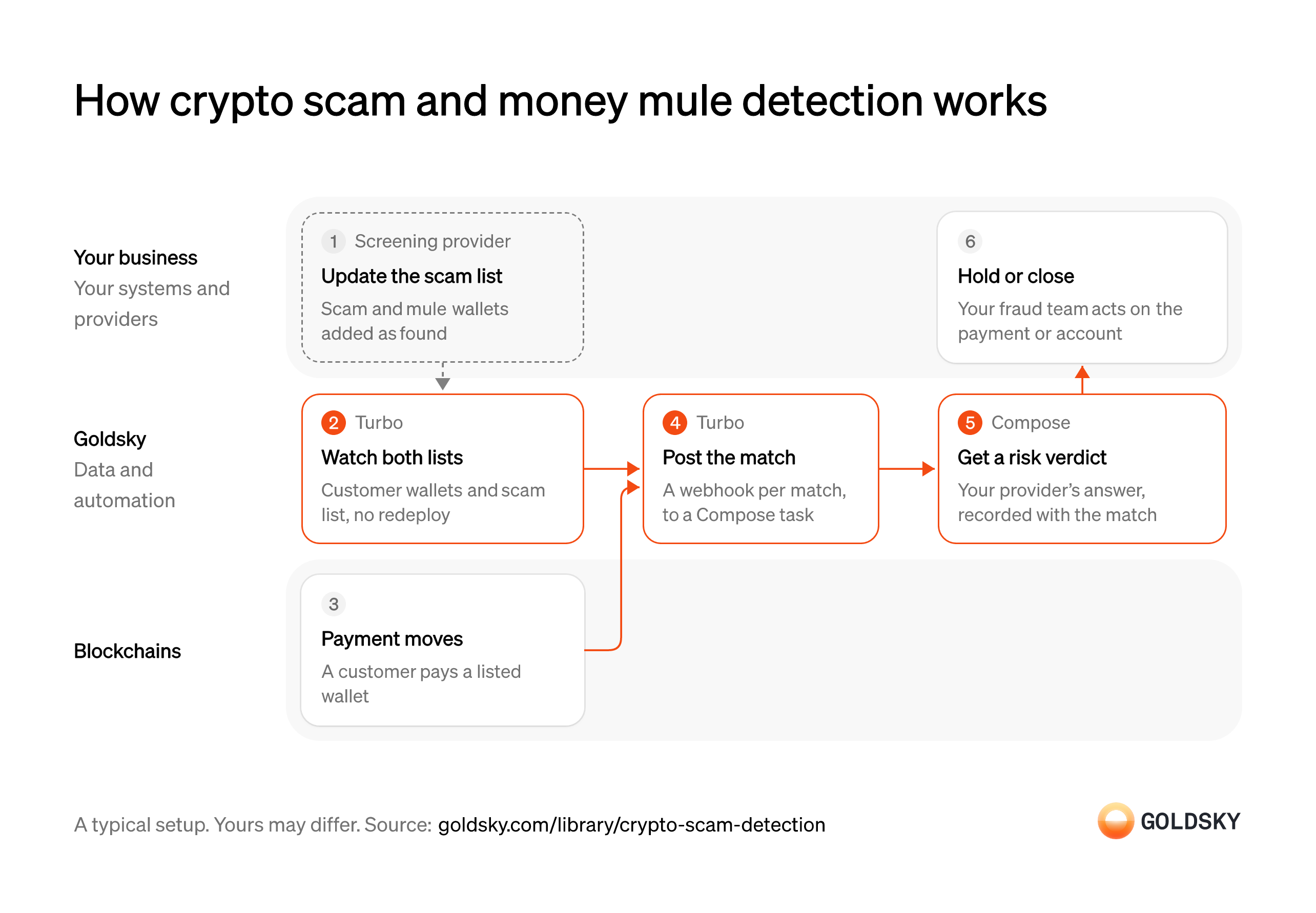
The diagram follows a payment from the moment a wallet joins your scam list to your fraud team’s decision to hold the payment or close the account. Your setup may differ.
Keep the scam list current
Scammers open new wallets all the time, so a list from last month misses this week’s scams.
Your intelligence provider, your fraud team and customer reports add wallets linked to scams as they’re found. Each entry needs its source and date, because a wallet wrongly listed blocks payments to an innocent party.
Watch customer wallets against the scam list
Handled by Goldsky TurboYou care about the transfers where one of your customers pays a scam wallet, or receives from one.
Both lists have to change while the check runs: a new customer wallet or a new scam wallet counts from the moment it’s added. A check that needs a release to pick up a new scam wallet misses the payments in between.
With Goldsky, each list can be a Turbo Pipelines dynamic table, and one SQL filter keeps transfers where
Filter transfers with dynamic tables (opens in a new tab)dynamic_table_check()finds a customer wallet on one side and a scam wallet on the other. New rows apply without a redeploy.The customer’s payment moves onchain
The customer sends funds from their wallet, often believing the recipient is genuine.
The transfer is recorded in a block on the chain. Once it’s there, it can’t be pulled back, so speed matters most for the payments that are still pending in your own app.
Post each match to your fraud workflow
Handled by Goldsky TurboA match is only useful if it reaches someone who can act on it while the account is still open.
Each match goes out with the wallets, token, amount and transaction, and delivery can repeat after an error, so the receiver checks the transfer’s ID first. A match is sent when the transfer is seen, before it’s final, so the receiver also has to handle the rare correction when the chain rewrites recent blocks.
Turbo Pipelines’ webhook sink can send each match as its own request with
Set up the webhook sink (opens in a new tab)one_row_per_request: true, retrying failed deliveries, to an HTTP-triggered task or your own endpoint.Get a risk verdict on the match
Handled by Goldsky ComposeA list match says two wallets met; your provider can say how strong the scam link is and what else the wallet has done.
The match is sent to your risk provider, and its answer is stored with the match before anyone acts on it. If the provider is down, the request has to be retried, and a match that still fails needs to reach someone instead of disappearing.
A Compose task calls your provider through
Call your provider with fetch (opens in a new tab)ctx.fetchwith the retry rules you set, and every run is traced with its inputs and outputs for later review.Hold the payment or close the account
Stopping a scam payment or a mule account is a decision your fraud team owns.
Your team holds pending payments to the wallet, contacts the customer or closes the account. Mule behavior, where an account receives stolen funds and passes them on within a short time, spans several transfers, so your fraud system checks that pattern across the matches it holds.
What you control
- Your team
- Hold the payment or close the account
- Your providers
- Screening provider
Security and deployment
- SOC 2 Type IIIndependently audited security controls.
- Dedicated infrastructureSingle-tenant options for production workloads.
- Data residencyCloud, on-premises or co-located.
More use cases that monitor transactions
- Compliance monitoringScreen wallets and transfers, watch for misuse of your assets and feed your AML and surveillance tools.
- Securities surveillanceScreen wallets and transfers, watch for misuse of your assets and feed your AML and surveillance tools.
- Crypto wallet screening and sanctions dataFlag transfers that touch sanctioned or high-risk addresses.
- Secondary-market sanctions sweeps for token issuersScreen every holder and transfer of your stablecoin, not only your direct customers.
- Data for crypto AML transaction monitoringFeed complete transfer data to AML tools with lineage from the chain to the case.
- Unauthorized tokenization monitoringFind tokens that claim to represent your security without your consent.
- Smart contract and wallet monitoringWatch your contracts and wallets for attacks and unexpected changes.
- Blockchain forensics data feedGive investigators full history and traces across chains.
- VASP and counterparty due diligence dataProfile a VASP, issuer or counterparty by its onchain exposure before onboarding it and while the relationship lasts.
- Crypto source of funds and wealth checksTrace where a client’s onchain funds came from to document legitimate wealth at onboarding.
- Token listing due diligence for exchangesCheck a token’s supply, holders, liquidity and risky links before an exchange lists it, and after.
- Crypto wallet monitoringGet an alert when a watched wallet makes a large transfer, crosses a balance limit, wakes after dormancy or pays an unknown counterparty.
- Address poisoning detectionFlag the zero-value, dust and fake-token transfers that lookalike addresses plant in a user’s history, and warn before anyone pays one.
- Onchain supervisory monitoring for regulatorsGive examiners one view of licensed firms’ onchain activity to test against what the firms report.
Detect crypto scams and money mules with Goldsky
We’ll map it to your systems and show you what Goldsky runs, so your team builds the product, not the pipelines underneath it.
 Robinhood
 HyperEVM
 Arc
 Solana
 Ethereum
 Polymarket
 Base
 Tempo
 Bitcoin