Staking rewards data for institutions
What is staking rewards data for institutions?
Staking rewards data for institutions is the record of every reward a fund’s validators earn, per validator and per period, also called validator rewards.
Asset managers and exchanges that stake client or fund assets have to book that income and report it, which means separating what’s earned from stake that’s returned to them.
Goldsky writes each validator’s withdrawals from the Beacon chain (Ethereum’s staking layer) and every transfer to its fee addresses to your warehouse, while the totals, the split between principal and rewards and the books stay with your team.
Who uses staking rewards data for institutions?
Asset managers running staking funds and crypto exchanges that stake on behalf of their clients.
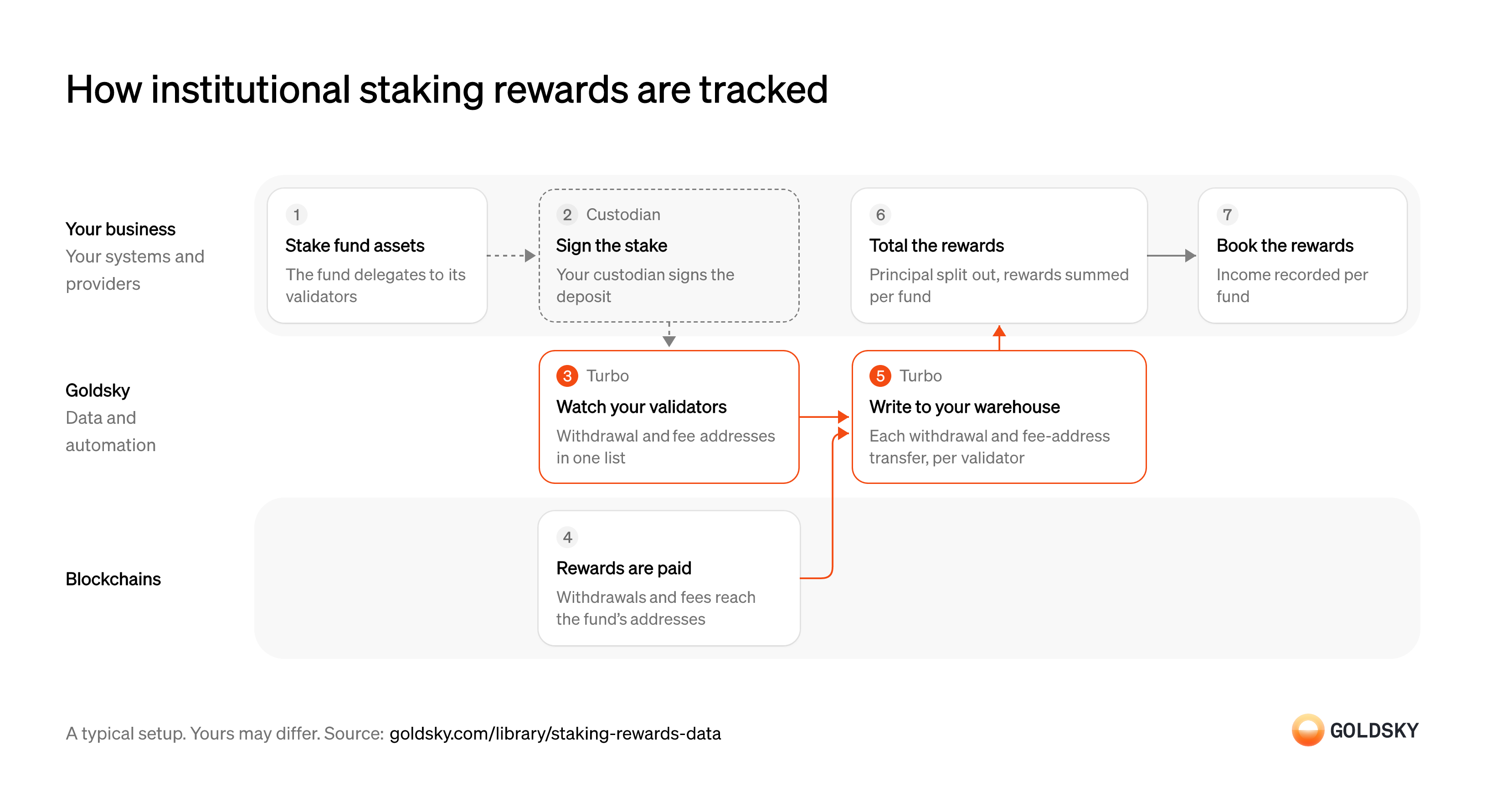
How institutional staking rewards are tracked
The diagram follows one fund from staking its assets to booking the rewards as income, and shows who does each step. Your setup may differ.
Stake fund assets with your validators
Staking puts the fund’s tokens to work securing the chain, and the chain pays rewards in return.
The fund decides how much to stake and with which validators (the machines that propose and check blocks), and records each validator against the fund that owns it. A validator with no fund in your records earns rewards nobody can book.
Sign the stake deposit
Staking moves fund assets, so the deposit has to be signed by the key that controls them.
Your custodian signs the deposit under the fund’s approval policy, with the withdrawal address set to an address the fund controls. The withdrawal address decides where rewards and principal go, and it’s hard to change once the validator is running.
Watch the validators’ payout addresses
Handled by Goldsky TurboRewards arrive at the addresses each validator pays out to, so those are the ones to follow.
Every validator’s withdrawal address and fee address goes on one list, updated as validators are added or retired. A validator missing from the list earns rewards that never reach the fund’s books.
With Goldsky, you can keep the addresses in a Turbo Pipelines dynamic table, which lives in a Postgres database, and add a validator’s addresses as a row without redeploying the pipeline.
Learn about dynamic tables (opens in a new tab)Receive rewards and fees
The chain pays validators for their work in two ways: protocol rewards and the fees from the blocks they propose.
Protocol rewards reach the withdrawal address as withdrawals, and block fees reach the fee address. A full withdrawal also returns the stake itself, so not every payment to the withdrawal address is income.
Land each payment in your warehouse
Handled by Goldsky TurboFinance needs every reward payment, tied to its validator, in the system where the fund’s books are kept.
Each withdrawal and fee payment has to arrive with its validator, address, amount and time. A payment recorded without its validator can’t be assigned to a fund, and a missed one understates income. Block fees the chain credits straight to a fee address arrive without a transfer, so they show up only in that address’s balance.
Goldsky indexes Beacon chain withdrawals with their
See the Beacon withdrawal fields (opens in a new tab)validator_index,addressandamount, and a pipeline can write those, plus native transfers to your fee addresses, to a warehouse sink such as ClickHouse keyed on each row’sid.Split principal from rewards and total them
Only the rewards are income, and the fund reports them per validator and per period.
Your team separates returned stake from earned rewards, then sums rewards per validator, per fund and per period in your warehouse. Treating a full withdrawal as income overstates the fund’s yield by the whole stake.
Book the rewards as income
Rewards have to appear in each fund’s accounts and net asset value.
Your fund accounting records each period’s rewards at the value your policy sets, against the right fund. Booking from totals nobody tied back to individual payments leaves the auditor nothing to trace.
Related jobs
Stake clients’ assets with your validators
Clients who opt in hand their tokens to your platform to stake, and the chain pays rewards for the validators’ work.
Your staking provider runs the validators, or stakes with them, and signs the deposits, with the withdrawal address set to one your platform controls. That address decides where rewards and returned stake go, and it’s hard to change once a validator is running.
Keep each client’s staked balance
Rewards are shared in proportion to how much each client staked, and for how long.
Your ledger records each client’s stake as it’s added or withdrawn, against the validators that hold it. A stake change left out of the ledger shifts rewards from one client to another.
Record every reward paid to your validators
Handled by Goldsky TurboRewards reach your validators’ withdrawal and fee addresses, so every payment there has to be counted.
Each withdrawal and fee payment arrives with its validator, address, amount and time. A full withdrawal also returns stake, so not every payment is a reward.
Goldsky indexes Beacon chain withdrawals with their
See the Beacon withdrawal fields (opens in a new tab)validator_index,addressandamount, and a pipeline can write those, plus native transfers to your fee addresses, to your warehouse keyed on each row’sid.Split rewards across clients
Each client is owed the share of rewards their stake earned.
Your team separates returned stake from rewards, then divides each period’s rewards by each client’s share of the stake over that period. Shares worked out on today’s balances instead of the period’s overpay clients who staked late.
Take your commission and credit each client
Platforms usually keep a commission on staking rewards and pass on the rest.
Your ledger deducts your commission before crediting each client’s rewards to their balance, on the payout schedule you publish for each asset, and shows each payout in their history. Any reward rate you display is worked out from what clients were actually paid.
Report rewards for tax
Clients may owe tax on staking rewards, and platforms often have to report them.
At year end your platform totals each client’s rewards and issues the tax forms required where you operate. Totals that can’t be traced back to individual payouts are hard to defend if a client disputes them.
What you control
- Your team
- Stake fund assets with your validators
- Split principal from rewards and total them
- Book the rewards as income
- Your providers
- Custodian
Security and deployment
- SOC 2 Type IIIndependently audited security controls.
- Dedicated infrastructureSingle-tenant options for production workloads.
- Data residencyCloud, on-premises or co-located.
More use cases that track staking and lending
Track staking rewards for institutions with Goldsky
We’ll map it to your systems and show you what Goldsky runs, so your team builds the product, not the pipelines underneath it.
 Robinhood
 HyperEVM
 Arc
 Solana
 Ethereum
 Polymarket
 Base
 Tempo
 Bitcoin