Crypto-backed lending collateral monitoring
What is crypto-backed lending collateral monitoring?
Crypto-backed lending collateral monitoring is tracking each loan a client takes against their crypto on a lending protocol: the collateral, the debt and how close the loan is to liquidation.
Exchanges and consumer apps offering these loans have to warn a client before the protocol sells their collateral, and prices can move that far between two loan events.
Goldsky records the protocol’s loan events and positions for your clients, or checks health on a schedule, while the margin limits and the call to the client stay with you.
You can build it two ways: stream the lending protocol’s events and positions into your database with Turbo Pipelines, or index the protocol with Subgraphs and recheck loan health on a schedule with a Compose task.
Who uses crypto-backed lending collateral monitoring?
Crypto exchanges, neobanks and consumer finance apps that let clients borrow stablecoins against the crypto they hold.
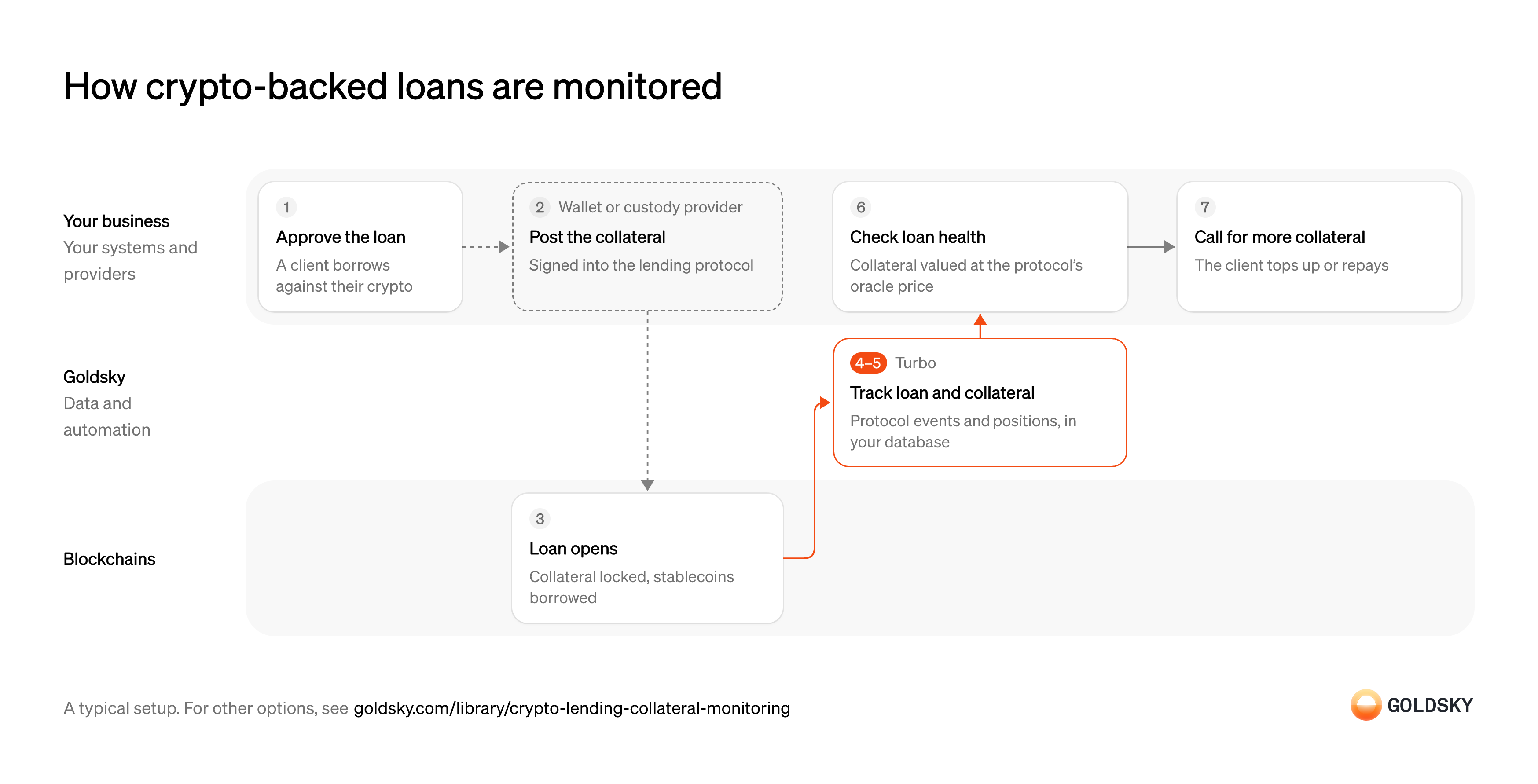
How crypto-backed loans are monitored
The diagram follows one loan from its approval to a call for more collateral, and shows who does each step. Your setup may differ.
Ways to monitor crypto-backed loan collateral
Your risk system checks loan health from your database with the pipeline, while the subgraph and scheduled task read health from the protocol and send an alert when a loan crosses your limit.
- Best for
- Loan events and positions beside your risk system
- Products
- Turbo
- What you run
- The destination: your database, queue or bucket, or a Postgres database Goldsky hosts
- What you write
- Pipeline YAML and SQL; TypeScript transforms when needed
- Where your data lives
- In your own database or systems
- How results reach you
- Pushed to you
- Best for
- One protocol deployment, with scheduled alerts
- What you run
- Nothing; Goldsky runs indexing, storage and the API
- What you write
- A schema and mapping handlers, or a no-code or low-code config for simple contracts
- Where your data lives
- Hosted by Goldsky
- How results reach you
- You query; changes are pushed
| Usual setupOption 1: Stream to your database | Option 2: Index and scheduled check | |
|---|---|---|
| Best for | Loan events and positions beside your risk system | One protocol deployment, with scheduled alerts |
| Products | Turbo | SubgraphsCompose |
| What you run | The destination: your database, queue or bucket, or a Postgres database Goldsky hosts | Nothing; Goldsky runs indexing, storage and the API |
| What you write | Pipeline YAML and SQL; TypeScript transforms when needed | A schema and mapping handlers, or a no-code or low-code config for simple contracts |
| Where your data lives | In your own database or systems | Hosted by Goldsky |
| How results reach you | Pushed to you | You query; changes are pushed |
Approve the loan
A client borrows against their crypto, so the terms are set before any collateral moves.
Your credit team sets how much the client can borrow against each asset and the point at which you’ll ask for more collateral. Those limits are tighter than the protocol’s own liquidation point, or the protocol sells the collateral before you’ve had a chance to warn the client.
Post the collateral to the lending protocol
The loan runs on a lending protocol (a set of contracts that lend against deposits), so the collateral has to be deposited there.
Your custodian signs the deposit and the borrow from the address you hold for the client. Use one address per client if you can; collateral from many clients in one position can’t be told apart on the chain.
Open the loan on the chain
The protocol locks the collateral and sends the borrowed stablecoins to the client’s address.
The protocol records the deposit and the borrow as events, and from then on it can sell the collateral if its value falls below the protocol’s threshold. That sale happens on the chain whether or not your systems noticed the price move.
Record every loan event
Handled by Goldsky TurboDeposits, borrows, repayments and liquidations each change a loan, and your records need all of them.
Every event for your clients’ addresses is decoded into a row with the client, asset, amount and block. A missed repayment overstates the debt; a missed liquidation leaves you calling a client about collateral that’s already gone.
In Turbo Pipelines,
Decode contract events (opens in a new tab)_gs_log_decodewith the ABI from_gs_fetch_abidecodes the protocol’s raw logs in SQL, and a dynamic table of client addresses keeps only your clients’ events.Read the position after each event
Handled by Goldsky TurboEvents say what changed; the protocol’s own record says where the loan stands afterwards.
After each event, the client’s collateral and debt are read from the protocol at that block. Adding up events yourself misses interest that builds up between them.
With Goldsky, the same pipeline can call the protocol’s position view at the event’s block with
Call contracts from SQL (opens in a new tab)_gs_eth_calland write the result to your database next to the event.Check each loan’s health
A loan is healthy while the collateral is worth enough more than the debt, and that changes every time prices move.
Your risk system compares collateral and debt at the price the protocol uses, from its oracle (the contract that feeds it prices), against your own margin limit. Prices move without any loan event, so the check has to rerun on a schedule as well as after each event.
Call for more collateral
Before the protocol liquidates, you give the client the chance to add collateral or repay.
The client is told how much to add and by when, and the loan is watched until they act. If nobody acts, the protocol can sell the collateral, often with a penalty, and the client loses more than the top-up would have cost.
What to know about streaming lending events
- The pipeline sees loan events, so positions update when a client acts, not when prices move.
- Health checks between events are your scheduled job, against the protocol’s oracle price.
- Tables keyed on a primary key take reorg corrections as updates and deletes.
- Goldsky runs the pipeline; you own the risk rules and the margin calls.
Approve the loan
A client borrows against their crypto, so the terms are set before any collateral moves.
Your credit team sets how much the client can borrow against each asset and the point at which you’ll ask for more collateral. Those limits are tighter than the protocol’s own liquidation point, or the protocol sells the collateral before you’ve had a chance to warn the client.
Post the collateral to the lending protocol
The loan runs on a lending protocol (a set of contracts that lend against deposits), so the collateral has to be deposited there.
Your custodian signs the deposit and the borrow from the address you hold for the client. Use one address per client if you can; collateral from many clients in one position can’t be told apart on the chain.
Open the loan on the chain
The protocol locks the collateral and sends the borrowed stablecoins to the client’s address.
The protocol records the deposit and the borrow as events, and from then on it can sell the collateral if its value falls below the protocol’s threshold. That sale happens on the chain whether or not your systems noticed the price move.
Index the protocol’s loans
Handled by Goldsky SubgraphsYour team and your task need one place to ask which loans exist and what each one holds.
The protocol’s events are turned into loan records, from the contract’s first block to now, and served for queries. Records that skip early history show loans with no opening deposit.
Goldsky Subgraphs runs subgraph mappings over the protocol’s events and serves the resulting loan records at a hosted GraphQL endpoint, with webhooks if you want changes pushed.
Index a protocol with Subgraphs (opens in a new tab)Recheck loan health on a schedule
Handled by Goldsky ComposeCollateral values move with the market, so health has to be read again even when nothing happens on the loan.
For each open loan, the check reads the protocol’s own health figure, which uses its oracle price. A check that only runs after loan events misses the price drop that matters most.
A Compose task with a
Schedule a task with cron (opens in a new tab)crontrigger can read each loan’s health from the protocol contract through Edge RPC, using typed classes generated from the protocol’s ABI.Alert your team when a loan crosses your limit
Handled by Goldsky ComposeThe point of watching is to reach the client before the protocol liquidates.
An alert names the loan, the client, the health figure and the limit it crossed, and goes where your team will act on it. Alerts that repeat every run for the same loan get ignored, so record which ones you’ve already sent.
With Goldsky Compose, the task can post the alert to your endpoint with
Send requests from a task (opens in a new tab)fetch, and each call and its response are recorded in the run’s log.Call for more collateral
Before the protocol liquidates, you give the client the chance to add collateral or repay.
The client is told how much to add and by when, and the loan is watched until they act. If nobody acts, the protocol can sell the collateral, often with a penalty, and the client loses more than the top-up would have cost.
What to know about indexing the protocol and checking on a schedule
- The subgraph answers queries about loans; it doesn’t check health on its own.
- The task checks health at the times you schedule, so the interval sets how soon you hear about a drop.
- The rule for an alert lives in the task’s code, so changing it is a deploy.
- Goldsky hosts the subgraph and runs the task; you own the limits and the margin calls.
What you control
- Your team
- Approve the loan
- Check each loan’s health
- Call for more collateral
- Your providers
- Wallet or custody provider
Security and deployment
- SOC 2 Type IIIndependently audited security controls.
- Dedicated infrastructureSingle-tenant options for production workloads.
- Data residencyCloud, on-premises or co-located.
More use cases that track staking and lending
Monitor crypto-backed loan collateral with Goldsky
We’ll map it to your systems and show you what Goldsky runs, so your team builds the product, not the pipelines underneath it.
 Robinhood
 HyperEVM
 Arc
 Solana
 Ethereum
 Polymarket
 Base
 Tempo
 Bitcoin