Deposit detection for wallet providers: native deposits that arrive by internal call
On 5 chains, 7% to 34% of wallets with a native-token deposit received it only through internal calls. The data, the method, and how to detect these deposits.

Product Manager
On Base, 34.2% of the wallets that received native tokens from another sender received them only through internal calls. On Ethereum, the share was 26.3%. A deposit watcher that reads ERC-20 logs and top-level transactions reports no native deposit for those wallets. An internal transfer has no log and no transaction of its own. The largest source on Ethereum is an exchange contract that pays many recipients in one transaction. The data covers 5 chains from October 17 to November 15, 2026.
Why an internal transfer has no log and no transaction
An ERC-20 deposit emits a Transfer log. A native-token deposit emits no log. The chain records it in one of two places: the value field of a transaction, or a call inside the trace of a transaction. The second case is an internal transfer. A contract sends native tokens to an address while it runs.
One example from the data is Ethereum transaction 0xeb989fc9…5716612a. The transaction calls batchTransferETH on a Coinbase wallet contract, and its own value is 0. Etherscan labels that contract "Coinbase 10". The number is part of the label that Etherscan gives to each Coinbase address. Inside the call, the contract sends 0.587 ETH to another address. Etherscan shows that transfer only in its list of internal transactions.
Native deposits from other senders, by chain
The table counts native-token transfers that a wallet received and did not send to itself. A wallet is an address that sent one or more transactions in the window.
| Chain | Wallets with a deposit | Wallets with only internal deposits | Internal share of deposits, by count | Internal share of deposits, by value |
|---|---|---|---|---|
| Ethereum | 5.81M | 26.3% | 31.9% | 13.9% |
| Base | 2.70M | 34.2% | 30.5% | 31.5% |
| Arbitrum One | 1.09M | 20.0% | 12.1% | 13.5% |
| Optimism | 0.29M | 7.0% | 15.5% | 12.5% |
| Polygon | 2.72M | 21.4% | 14.8% | 8.9% |
Window: 2026-10-17 to 2026-11-15, in UTC days. A deposit here is a transfer whose recipient is not the sender of the transaction. Payments from ERC-4337 EntryPoint contracts are not in the table.
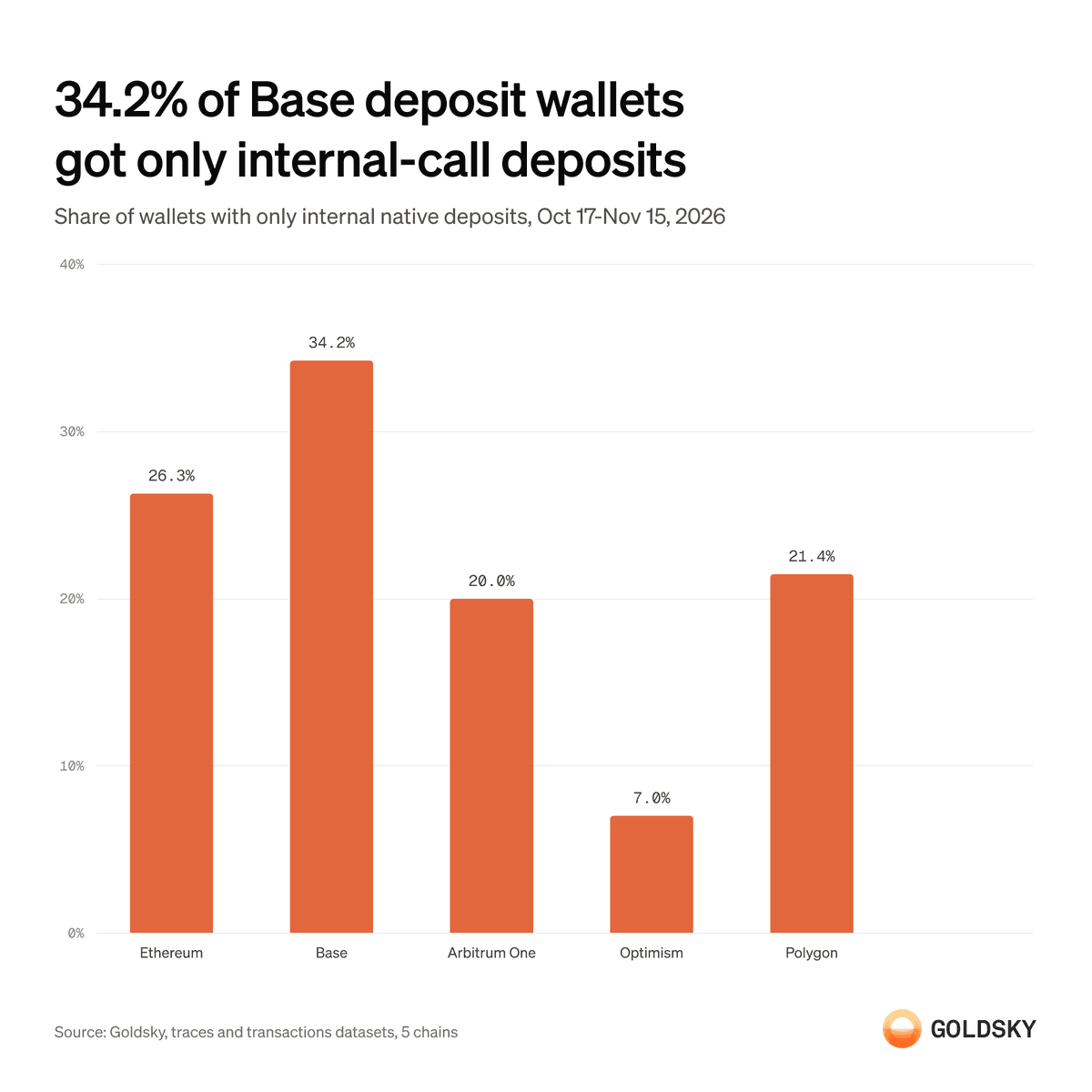
For a wallet in the third column, a watcher of logs and top-level transactions shows no native deposit in the 30 days. On 4 of the 5 chains, the share is between 20% and 34%.
The value share depends on a few large senders. On Base, one contract with a market maker label on Blockscout sent 41% of the internal value to 4 addresses.
Two kinds of internal transfer that are not deposits
A count of all internal transfers to wallets is larger than the numbers above. Two groups are in that count, and neither one is a deposit from another party.
The first group is bundler payments. An ERC-4337 EntryPoint contract pays the bundler for gas when the bundler submits handleOps. More than 98% of these transfers on each chain go to the sender of the transaction.
The second group is transfers that the wallet started. A wallet signs a swap, and a router sends the native token back in an internal call. A deposit watcher does not need these for detection, but a balance or a history screen does.
| Chain | Bundler payments | Started by the wallet | From another sender |
|---|---|---|---|
| Ethereum | 0.69M | 1.29M | 7.70M |
| Base | 6.06M | 3.82M | 4.53M |
| Arbitrum One | 0.37M | 0.42M | 0.74M |
| Optimism | 0.15M | 0.42M | 0.39M |
| Polygon | 6.05M | 0.37M | 1.56M |
The table shows the number of internal transfers to wallets in the window. On Base and Polygon, bundler payments are the largest group by count. A provider that runs a bundler sees these transfers in its own gas wallets.
Where internal deposits come from
Each sender below has a public label, and the Method section has the addresses.
| Chain | Sender | Share of internal deposit value |
|---|---|---|
| Ethereum | A Coinbase wallet contract (Etherscan label: Coinbase 10), through batchTransferETH | 41% |
| Base | L2StandardBridge, the OP Stack bridge contract | 21% |
| Optimism | L2StandardBridge, the OP Stack bridge contract | 61% |
| Polygon | POL token contract 0x…1010 (Polygonscan label) | 24% |
On Ethereum, that Coinbase contract sent 837,000 internal transfers to 354,000 wallets. A transfer from an exchange to a customer wallet is a deposit that a wallet provider's customers wait for. In this data, the largest exchange source pays it through an internal call.
On Base and Optimism, the OP Stack specification (opens in a new tab) lists the sender as the L2StandardBridge. It pays out ETH that a user moved from Ethereum through the standard bridge. A wallet that a user funds from Ethereum gets its first deposit this way.
What a deposit watcher must read
A watcher needs ERC-20 Transfer logs for token deposits, traces for native deposits, and the corrections after a reorg. Three approaches give it the traces.
| Approach | What the team runs | Internal transfers |
|---|---|---|
| Poll trace methods on an RPC node, for example Goldsky Edge RPC (opens in a new tab) | A poller that calls trace_block or debug_traceBlockByNumber, decodes every call, and keeps a cursor. The team writes the reorg logic and the backfill. | In each block trace. The team extracts them. |
| Run a pipeline over traces with Turbo Pipelines | A pipeline definition and a destination. We run ingestion and reorg correction. | In the ready-made <chain>.native_transfers dataset. |
| Use Feeds (opens in a new tab) | No pipeline and no poller. A request to the Transfers API, or a data sync to a webhook or a database. | In the Transfers feed, as native rows. |
Feeds returns internal deposits with no pipeline
Feeds reads the traces, so the provider does not. The Transfers feed has the native and ERC-20 transfers of a wallet on Ethereum, Base, Arbitrum One, Optimism, Polygon, and 4 more EVM chains. A native transfer from an internal call is a row in that feed, the same as a transfer from a top-level transaction. With include_position=true, each native row has a trace_address. An empty value is a top-level transaction, and a value such as 0,2 is an internal call. Each row also has the counterparty and the USD value at transfer time.
A provider uses the feed in 2 ways:
- A request. The Transfers API (opens in a new tab) returns the transfers of one wallet, or of up to 10 EVM wallets, newest first.
- A push. Feeds data sync (opens in a new tab) sends each new transfer row to a webhook or to the provider's own database as the row lands. The provider adds and removes the wallets that a sync covers. Data sync is in early access.
Feeds fits a provider that wants each deposit and does not want to run a pipeline. The next section is for a provider that wants its own filter logic, another destination, or a chain that Feeds does not cover.
Build a watcher with Turbo Pipelines
Our native transfers guide (opens in a new tab) builds the stream from a chain's raw traces dataset. Its transform marks each row as Internal TX or EOA TX and removes delegatecall traces and failed traces. We publish the result as the <chain>.native_transfers dataset for each chain with traces.
A provider watches a list of addresses, not the full chain. A dynamic table (opens in a new tab) holds the list in Postgres, and the running pipeline matches each new row with no redeploy. Our Elysium wallet activity guide (opens in a new tab) shows the full pattern on one chain, with ERC-20 transfers and native transfers in one table.
The webhook sink (opens in a new tab) sends each match to the provider's endpoint, with at-least-once delivery and retries on 429 and 5xx responses. The endpoint deduplicates on the row id. A reorg sends delete and update records through the pipeline, and a webhook consumer applies those corrections itself. Our delivery guarantees page (opens in a new tab) explains both rules. Turbo also writes to Postgres, ClickHouse, Kafka, and the other destinations in our list of supported sinks (opens in a new tab).
Privy built its deposit webhooks this way, as our case study with Privy describes. Its Turbo pipelines stream transactions and token transfers to webhook endpoints, one pipeline per chain. Our deposit detection playbook covers the rest of the build, such as one credit per account and reconciliation. Our post on wallet-as-a-service infrastructure covers balances, history, and data sync for the same reader.
Method
Window and chains. 2026-10-17 00:00 to 2026-11-16 00:00 UTC, on Ethereum, Base, Arbitrum One, Optimism, and Polygon. Values are in native units.
Rules. A top-level transfer is the value of a successful transaction. An internal transfer is a trace with call_type = 'call', a non-empty trace_address, value > 0, and no error, in a successful transaction. The rules exclude delegatecall, staticcall, and callcode traces. A wallet is an address that is the from of a transaction in the window.
Split. A bundler payment is an internal transfer from an EntryPoint contract (versions 0.6.0, 0.7.0, and 0.8.0). A transfer started by the wallet has a recipient that is the from of the same transaction. All other internal transfers are deposits from another sender. The 3 groups add up to the total of internal transfers on each chain.
Example query. This is the part of queries/ethereum-split.sql that assigns each internal transfer to a group.
internal_rows AS (
  SELECT
    t.to_address AS recipient,
    toFloat64(t.value) / 1e18 AS amt,
    hf.tx_from AS tx_from,
    multiIf(
      t.from_address IN ('0x5ff137d4b0fdcd49dca30c7cf57e578a026d2789','0x0000000071727de22e5e9d8baf0edac6f37da032','0x4337084d9e255ff0702461cf8895ce9e3b5ff108'), 'A',
      hf.tx_from = t.to_address, 'B',
      'C'
    ) AS cat
  FROM mainnet_raw_traces_v4 AS t
  INNER JOIN hash_from AS hf ON t.transaction_hash = hf.hash
  WHERE t.block_number BETWEEN 26203240 AND 26429160
    AND t.block_timestamp >= toDateTime('2026-10-17 00:00:00') AND t.block_timestamp < toDateTime('2026-11-16 00:00:00')
    AND t.call_type = 'call' AND t.trace_address != '' AND t.value > 0
    AND t.error = '' AND t.status = 1
    AND t.to_address IN (SELECT addr FROM wallets)
),Senders. The Coinbase contract on Ethereum, which Etherscan labels Coinbase 10: 0xa9d1e08c7793af67e9d92fe308d5697fb81d3e43. L2StandardBridge on Base and Optimism: 0x4200000000000000000000000000000000000010. POL token contract on Polygon: 0x0000000000000000000000000000000000001010. The Base contract with the market maker label: 0x51c72848c68a965f66fa7a88855f9f7784502a7f.
Checks. We compared 15 sample transfers on the 5 chains, and 2 more examples, with public block explorers. All 17 matched on sender, recipient, and value.
Limits. The data covers one 30-day window on 5 chains. A smart-contract wallet that never sends a transaction, such as an ERC-4337 account, is not a wallet under this rule. Its deposits are not in the tables. Withdrawals from the Ethereum beacon chain are not in the data. They credit an address with no transaction and no trace.
FAQ
Why does a watcher of logs miss a native-token deposit?
A native transfer emits no log. A top-level transfer is in the transaction value field. An internal transfer is only in the trace of the transaction.
Is a payment from an ERC-4337 EntryPoint a deposit?
No. The EntryPoint pays the bundler for gas. In this data, more than 98% of these payments on each chain go to the sender of the transaction.
Does the data include smart-contract wallets?
No. The wallet rule needs one sent transaction in the window. An ERC-4337 account that only acts through a bundler is not in the tables.
How does a wallet provider get native transfers from Goldsky?
The shortest route is Feeds: call the Transfers API, or turn on a data sync that pushes each transfer to a webhook or a database. A provider that wants its own pipeline uses the <chain>.native_transfers dataset in Turbo Pipelines, with a dynamic table of wallet addresses and a webhook sink.
 Robinhood
 HyperEVM
 Arc
 Solana
 Ethereum
 Polymarket
 Base
 Tempo
 Bitcoin
