Wallet-as-a-service infrastructure: the full stack, from keys to reconciliation
A map of the full wallet-as-a-service stack: identity, keys, transactions, ramps, wallet data, compliance, and ledger. Who provides each part, and where Goldsky fits.

A wallet-as-a-service provider does more than hold keys. It verifies customers, signs and sends transactions, moves money in and out, detects deposits, shows balances, screens for risk, and keeps a ledger. No single vendor covers all of it. At Goldsky, we run the chain data and the automation in that stack, with Turbo Pipelines, Feeds, Compose, and Edge RPC. This guide maps every part of the stack, names who provides each one, and then goes through the parts that need chain data.
The full stack
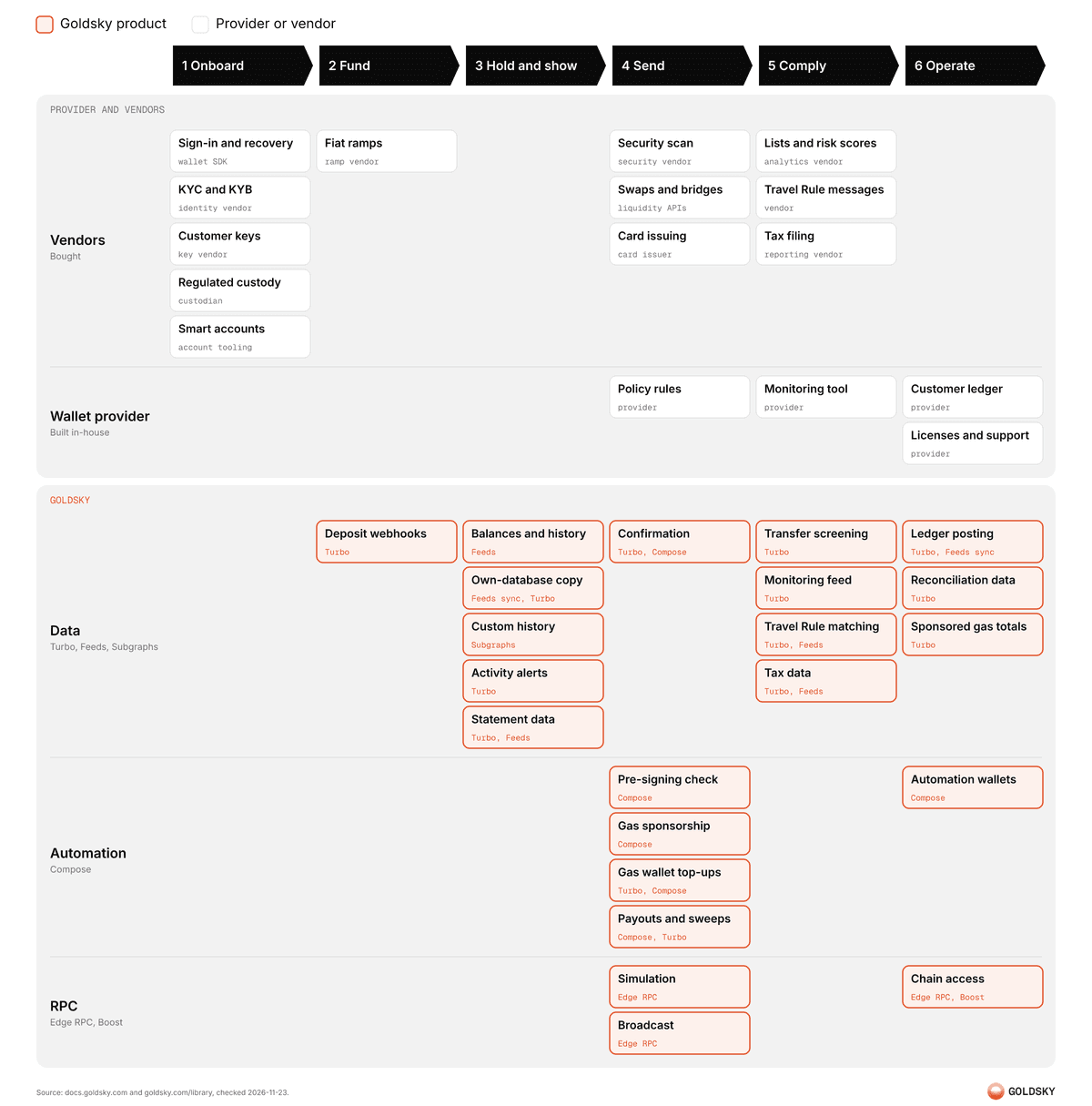
The map lists what a team needs to bring a white-label wallet product to market. Each table is one layer. The last column names a Goldsky product only where that product does the work in the row. The vendor names are examples, not a complete list.
Customers and identity
| Capability | Who provides it | Example vendors | Goldsky product |
|---|---|---|---|
| Sign-in and account recovery | The provider's app or a wallet SDK | Privy (opens in a new tab), Fireblocks Dynamic (opens in a new tab) | None |
| KYC and KYB checks | An identity vendor | Sumsub (opens in a new tab), Alloy (opens in a new tab) | None |
Keys and custody
| Capability | Who provides it | Example vendors | Goldsky product |
|---|---|---|---|
| Key generation, storage, and signing for customer wallets | A key-management vendor, or the provider's own MPC or HSM system | Fireblocks (opens in a new tab), Turnkey (opens in a new tab), Dfns (opens in a new tab) | None. We are not a custodian, and we do not hold customer keys or customer funds. |
| Regulated custody | A chartered custodian, or the provider's own license | Anchorage Digital (opens in a new tab), BitGo (opens in a new tab) | None |
| Smart accounts for customers | Account contracts and their tooling | Safe (opens in a new tab), ZeroDev (opens in a new tab) | None |
| Wallets for the provider's own automation | The provider | Compose: a smart wallet, a stored key, or a webhook wallet |
Transaction path
| Capability | Who provides it | Example vendors | Goldsky product |
|---|---|---|---|
| Policy rules and approvals | The provider's policy engine, often part of the key system | None | |
| A check task before each signature: list lookup and risk vendor call | A service behind the provider's handler | Compose | |
| Transaction simulation | An RPC provider | Edge RPC | |
| Transaction security scan | A security vendor | Blockaid (opens in a new tab) | None |
| Gas sponsorship: bundler and paymaster | The automation layer, or a gas vendor | Compose, for the transactions that it sends | |
| Gas wallet balances and top-ups | The provider's treasury | Turbo Pipelines and Compose. The provider's signer signs. | |
| Fee estimates and broadcast | An RPC provider | Edge RPC | |
| Confirmation and reorg corrections | A data pipeline | Turbo Pipelines. Compose, for the transactions that it sends. |
Money movement
| Capability | Who provides it | Example vendors | Goldsky product |
|---|---|---|---|
| Fiat on-ramp and off-ramp | A ramp vendor | MoonPay (opens in a new tab), Transak (opens in a new tab), Bridge (opens in a new tab), Zero Hash (opens in a new tab) | None |
| Swaps and cross-chain transfers | Liquidity and bridge APIs | 0x (opens in a new tab), LI.FI (opens in a new tab), Circle CCTP (opens in a new tab) | None |
| Card issuing | A card issuer | Rain (opens in a new tab) | None |
| Payout runs and treasury sweeps | The provider's treasury | Compose and Turbo Pipelines, to run payouts and sweeps. The provider's signer signs. |
We do not convert fiat, swap tokens, or issue cards. Those vendors move the money. The chain side of each one is a transfer or a balance, and the wallet data layer below reads it:
- The deposit that an on-ramp sends to a wallet
- The deposit at an off-ramp cash-out address
- A CCTP transfer in transit
- The balance of a card-backing wallet
Wallet data
| Capability | Who provides it | Example vendors | Goldsky product |
|---|---|---|---|
| Deposit detection and webhooks | A data pipeline | Turbo Pipelines | |
| Balances, history, and USD values | A wallet data API | Feeds | |
| Wallet data in the provider's own database | A sync or a pipeline | Feeds data sync and Turbo Pipelines | |
| Custom history for one contract or protocol | An indexer | Subgraphs | |
| Alerts on wallet activity | A monitoring pipeline | Turbo Pipelines, for wallet monitoring | |
| Statement data: holdings at a cutoff date and transfers in a period | A data pipeline | Turbo Pipelines, Feeds, and Edge RPC, for custody statements |
Risk and compliance
| Capability | Who provides it | Example vendors | Goldsky product |
|---|---|---|---|
| Sanctions lists and risk scores | A blockchain analytics vendor | Chainalysis (opens in a new tab), TRM Labs (opens in a new tab), Elliptic (opens in a new tab) | None |
| A check of each transfer against the provider's list | A screening pipeline | Turbo Pipelines | |
| Monitoring tool and case review | The provider's compliance team | None | |
| A feed of every transfer to the monitoring tool | A data pipeline | Turbo Pipelines | |
| Travel Rule messages | A Travel Rule vendor | Notabene (opens in a new tab) | None |
| A match of each outgoing transfer to its Travel Rule message | A data pipeline or an API | Turbo Pipelines or Feeds, as in our Travel Rule guide | |
| Tax forms and filing | A reporting vendor | Taxbit (opens in a new tab) | None |
| Transfer history with USD values for tax forms | A data pipeline or an API | Turbo Pipelines and Feeds, for Form 1099-DA data |
Finance and operations
| Capability | Who provides it | Example vendors | Goldsky product |
|---|---|---|---|
| Customer ledger | The provider, or a ledger API | Fragment (opens in a new tab) | None |
| A post of each transfer to the ledger | A data pipeline or a sync | Turbo Pipelines or Feeds data sync | |
| Chain data for reconciliation and proof of reserves | A data pipeline | Turbo Pipelines | |
| Sponsored gas totals for each user | A data pipeline | Turbo Pipelines, for sponsored gas spend | |
| Chain access and new chains | An RPC provider and a data pipeline | Edge RPC, Boost (opens in a new tab), and Turbo Pipelines | |
| Licenses, audits, and customer support | The provider | None |
Vendors and the provider run identity, customer keys, policy, ramps, cards, risk scores, filings, and the ledger. We run the chain data and the automation next to them. The rest of this guide covers the main rows with a Goldsky product.
Keys, policy, and signing
A signed transfer cannot be called back, so the policy check comes before the signature. The provider's key system holds each transfer and calls a handler that the provider hosts. Our guide to pre-signing policy checks runs the check as a Compose task behind that handler. The task checks the destination against the provider's list, calls the provider's risk vendor, and returns allow or deny. Compose logs every call with its inputs and outputs, so each decision has a record.
The policy, the list, and the signature stay with the provider. For its own transactions, such as a treasury transfer, the provider can use a Compose webhook wallet (opens in a new tab). Compose builds the transaction, posts it to a signing URL that the provider hosts, and submits the signed result. Compose never sees that key.
Broadcast, gas, and confirmation
The provider sends each signed transaction to a node. Edge RPC (opens in a new tab) serves eth_estimateGas, eth_call, and eth_sendRawTransaction over a multi-region CDN, with automatic failover across providers. The price is $5 per million requests, and all methods have the same price.
Compose sponsors gas for the transactions that it sends. It builds each one as an ERC-4337 UserOperation with paymaster data and submits it through a bundler, so the wallet holds no native token. Sponsoring works for a Compose smart wallet, for a key in Compose secrets with sponsorGas: true, and for a webhook wallet whose key stays with the provider. If the main bundler for a chain is down, Compose uses a backup bundler on the chains that have one. The price (opens in a new tab) is a 10% surcharge on the gas spent, on the monthly Goldsky bill.
A provider that pays network fees from its own wallets keeps a gas wallet on each chain. An empty gas wallet stops every transfer on that chain. Our gas wallet monitoring guide reads each wallet's balance after every transaction with Turbo Pipelines. Below the floor that the provider sets, a webhook starts a Compose task that sends the top-up. The provider's custody policy decides if its key system signs the refill.
The customer then needs to know that the transfer settled. The pipeline in the next section matches a watched wallet as the sender or the recipient, so the same pipeline confirms outgoing transfers. For a transaction that Compose sends, Compose waits for the confirmations that the task sets and can send the transaction again after a reorg.
Deposit webhooks on an address list that grows
A provider's customers create wallets through an API and then wait for funds. Adam Inglehart, a founding engineer at Privy, states the requirement in our case study with Privy. "Our customers spin up thousands of server wallets and need to know exactly when funds hit." A watcher with a fixed address list fails this requirement. A new wallet receives its first deposit before the watcher has the address, and no webhook goes out.
Turbo Pipelines handle the growing list with dynamic tables (opens in a new tab). A dynamic table is a lookup table in Postgres that a running pipeline filters against with dynamic_table_check(). The provider inserts each new wallet address as a row, and the pipeline starts to match it with no redeploy. With the in-memory cache on, the pipeline loads new rows once per second by default. A deleted row needs a pipeline restart, because the cache does not load deletes.
This is the config for a cached wallet table:
transforms:
  tracked_wallets:
    type: dynamic_table
    backend_type: Postgres
    backend_entity_name: tracked_wallets
    secret_name: MY_POSTGRES
    time_column: updated_at         # Required to enable caching, even when it's the default
    cache: true                     # Required to enable caching
cache_refresh_debounce_ms: 1000 # Optional. Only set when cache is trueMatched events go to the provider through the webhook sink (opens in a new tab). The sink sends batches as JSON POST requests, and the endpoint returns a 2xx status to acknowledge a batch. The sink retries network errors, timeouts, 429, and 5xx responses with exponential backoff and no retry limit. Any other 4xx response fails the pipeline.
sinks:
  my_webhook_sink:
    type: webhook
    from: my_transform
    url: https://api.example.com/endpoint
    secret_name: MY_WEBHOOK_SECRET
    one_row_per_request: true # or false (default)
    headers:
X-Custom-Header: my-valueThe provider's webhook handler must follow two rules, and our delivery guarantees page (opens in a new tab) explains both. Turbo delivers each record at least once, so the handler deduplicates on a stable key such as the record id. A chain reorg sends delete and update records through the pipeline, and a webhook consumer applies those corrections itself. A handler that follows both rules credits each deposit one time and reverses a deposit that a reorg removed.
Privy built its deposit webhooks on Turbo Pipelines. It set up pipelines that stream transactions and token transfers to its webhook endpoints, one pipeline per chain. Privy then filters the events against its own wallet addresses and the contracts that its customers subscribe to. The case study reports 100M+ wallets monitored and 99.99%+ uptime on webhook delivery. A provider can keep the wallet filter in its own system, as Privy did. A dynamic table moves that filter into the pipeline.
Our deposit detection playbook covers the rest of the build: the detection method, one credit per account, wrong-network deposits, and reconciliation.
Native-token deposits from internal calls
An ERC-20 deposit emits a Transfer log. A native-token deposit emits no log, and a contract can send native tokens in an internal call, for example when a swap pays out. A watcher that reads only logs and top-level transactions does not see that deposit.
Our native transfers guide (opens in a new tab) builds the full stream from the raw traces dataset, which holds top-level transactions and internal calls. We also publish the result as a ready-made <chain>.native_transfers dataset for each chain with traces. The Elysium wallet activity guide (opens in a new tab) shows the complete pattern on one chain. It filters ERC-20 transfers and native transfers against a cached dynamic table of wallets and writes both to one Postgres table.
Balances and transfer history for customer screens
A provider's customers show balances and activity in their apps. The provider's dashboard and support tools need the same data. Feeds (opens in a new tab) returns both over REST. Balances returns what a wallet holds, with USD values. Transfers returns the wallet's transfers, with the USD value at transfer time. Our worked example of the wallet balance and transfer history API shows both requests and responses for one wallet.
| Topic | Detail |
|---|---|
| Chains | 9 EVM chains and Solana |
| Wallets per request | One wallet, or up to 10 EVM wallets separated by commas. A Solana address goes alone. |
| Price | $0.35 per 1,000 requests. Each wallet in a request counts as one request. |
| Rate limit | Per project. 5 requests per second on Starter, 50 on Scale, and up to 500 on the paid tiers. |
The Feeds API overview (opens in a new tab) has the request parameters. The Feeds section of our pricing page (opens in a new tab) has the price and the rate limits.
The API fits reads on demand: a customer opens a wallet screen, or a support agent looks up one address. Our guide to embedded wallet balances covers that case for one app. A provider that reads every wallet on a schedule has a different problem, and the next section measures it.
What polling costs at provider scale
A provider that polls for balance changes sends requests in proportion to wallets, chains, and polls per day. The example below uses round numbers. It is not a measurement of any provider.
| Input | Example value |
|---|---|
| Wallets | 2,000,000 |
| Chains | 5 |
| Polls per wallet per day (one per minute) | 1,440 |
| Requests per day | 14,400,000,000 |
On an RPC node, that count covers the native token only. Each ERC-20 token adds one balanceOf call per wallet, per chain, per poll. A Feeds Balances request covers every supported chain, so the chain factor goes away. The same schedule is still 2.88 billion requests per day.
Most polls also return a balance that did not change. We measured this on 6 chains with USDC and USDT. The cohort is every address that received USDC or USDT between 2026-10-10 and 2026-11-08. The table shows how much of the cohort had a USDC or USDT transfer in the next week.
| Chain | Wallets in the cohort | Median share with a transfer per day | Share with a transfer in 7 days |
|---|---|---|---|
| Ethereum | 6.10M | 4.2% | 15.3% |
| Base | 3.84M | 4.8% | 18.7% |
| Arbitrum One | 1.61M | 4.6% | 15.2% |
| Optimism | 0.16M | 6.5% | 23.6% |
| Polygon | 2.56M | 4.0% | 14.7% |
| BNB Smart Chain | 20.32M | 6.6% | 18.6% |
Window: 2026-11-09 to 2026-11-15, in UTC days. The counts come from Transfer logs of the main USDC and USDT contracts on each chain, which include bridged and Binance-Peg tokens. The cohort includes contracts and exchange addresses.
On the median day, 4.0% to 6.6% of these wallets had a stablecoin transfer. A poll of every wallet reads the other wallets and finds no stablecoin change. A provider at this scale needs data that arrives when a wallet changes, not a poll of every wallet.
A copy of the data in the provider's own database
Feeds data sync (opens in a new tab) pushes feed rows to a destination that the provider owns, as the rows land. No job polls the API. Data sync is in early access. To request access, email [email protected] with the feed and the destination.
| Topic | Detail |
|---|---|
| Destinations | ClickHouse, Postgres, MySQL, and a webhook. More are available on request. |
| Feeds | Wallet Balances and wallet Transfers |
| History | With backfill on, the sync loads the history of each wallet, including wallets added later |
| Changes | The team adds and removes the wallets, tokens, and chains that a sync covers |
The Create a sync reference (opens in a new tab) has the full request.
With the rows in its own database, the provider joins balances and transfers to its customer and account tables in SQL. The read path of the provider's API then has no external rate limit.
A provider that needs another destination, or its own transform logic, builds the pipeline from the deposit section. Turbo Pipelines write to Kafka, S3, SQS, Pub/Sub, data warehouses, and the other destinations in our list of supported sinks (opens in a new tab).
Screening, monitoring, and reconciliation
A provider's compliance team must see each transfer that touches a listed address. Our wallet screening guide streams the transfers through a Turbo pipeline. The provider loads the list from its sanctions data vendor. The pipeline checks the sender and the recipient against the list and sends each hit to a queue or a case tool. The list, the review, and each decision stay with the provider.
The same transfer rows feed the provider's ledger. Our ledger reconciliation playbook covers the steps: post each transfer to the ledger, match it, and close the period.
New chains
A provider's customers ask for chains that the provider does not support yet. We support 149 chains and 269 networks, and our chains page has the full list. Privy set up one pipeline per chain, and a new network was one new YAML file. Turbo normalizes data across chains, so Privy added networks without new handler logic.
FAQ
Does Goldsky hold keys or customer funds?
No. We are not a custodian. Key generation, custody, and signing for customer wallets stay with the wallet provider or its key vendor. Compose can hold a key for the provider's own automation as an encrypted secret, or call the provider's signer and never see the key.
How does a wallet provider start on Goldsky?
Install the Goldsky CLI and run goldsky login. Then deploy a Turbo pipeline with a webhook sink, or create a Feeds API key in the dashboard for Balances and Transfers.
How does a team request Feeds data sync?
Email [email protected] with the feed (Balances or Transfers) and the destination. Data sync is in early access.
Does a webhook arrive exactly one time?
No. Turbo delivers each record at least once. The endpoint deduplicates on a stable key.
Can one pipeline cover several chains?
Yes. One pipeline can read sources from several chains. When the same logic runs on every chain, we recommend one pipeline file per chain.
 Robinhood
 HyperEVM
 Arc
 Solana
 Ethereum
 Polymarket
 Base
 Tempo
 Bitcoin
