Pre-signing policy checks for custodians
What it is
Pre-signing policy checks, also called pre-transaction screening or a transaction policy engine, test each outgoing withdrawal from a custody account against your rules and a risk verdict on the destination wallet before the custodian signs it.
Custody platforms and custodian banks run them because a transfer can’t be called back once it’s signed, so a withdrawal to a listed or high-risk wallet has to be stopped before the signature.
Your custody platform calls a callback handler you host, which runs a task on Goldsky Compose that checks the destination against your list, calls your risk provider for a verdict and returns allow or deny, with each decision recorded; the policy, the provider, the handler and the signature stay yours.
Who it’s for
Custody and wallet infrastructure providers and custodian banks that check each outgoing transfer before they sign it.
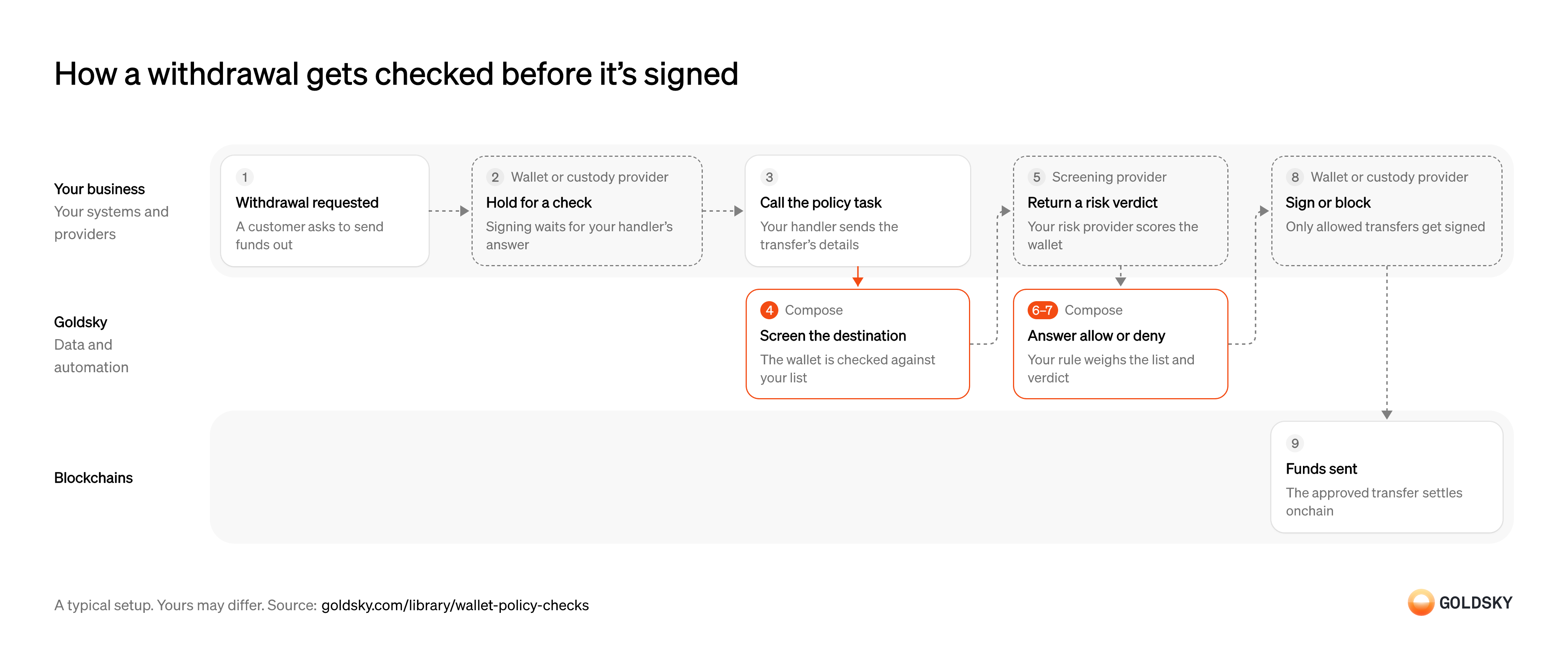
How a withdrawal gets checked before it’s signed
The diagram follows one withdrawal from the customer’s request to the approved transfer settling onchain, and shows who does each step. Your setup may differ.
Take the withdrawal request
Every check starts with a customer asking to send funds out.
Your app records who asked, the amount, the asset, the chain and the destination wallet, and passes the request to your custody platform. A request without a destination or chain can’t be checked, so reject it before it goes further.
Hold the transfer for a check
The check has to happen before the signature, because a signed transfer can’t be called back.
Your custody platform holds the transfer and calls a callback handler you host with its details before any key signs. Check how your platform treats a late answer: a callback that fails closed, the safe default, blocks the transfer on a deny or on no answer within its time limit, so the whole check has to finish in time.
Pass the request to your policy task
The custody platform expects an authenticated answer in its own format, from a server it trusts.
Your handler checks that the request really came from the platform, sends the transfer’s details to the task and turns the decision into the response the platform expects. Keep it thin, since any delay in the handler eats into the platform’s time limit.
Check the destination against your list
Handled by Goldsky ComposeA wallet on your own blocklist or a sanctions list should be stopped without waiting on anyone else.
The destination is compared with your list in one address format, and a match is enough to deny. The list has to be the current one, so a newly added wallet is blocked from the next request on.
With Goldsky, your handler calls a Compose task’s HTTP trigger, which takes any JSON payload. The task can look the wallet up in a Compose collection that holds your list, which another task keeps current.
Keep your list in a collection (opens in a new tab)Get a risk verdict on the wallet
A wallet that isn’t on any list can still have links to stolen funds or other risk your provider tracks.
Your risk provider returns a score or verdict and the reasons behind it. If the provider doesn’t answer, your policy needs an agreed outcome, or the check stalls.
Answer allow or deny
Handled by Goldsky ComposeThe custody platform needs one clear response it can act on.
Your rule weighs the list check and the verdict, for example denying on any list match or on a score above your threshold, and returns allow or deny with the reason. A reason on every deny lets your team explain the decision to the customer and to an examiner.
The Compose task calls your risk provider with
Return a response over HTTP (opens in a new tab)fetch, applies your threshold in TypeScript and returns its decision and reason as the HTTP response, which your handler passes back to the custody platform.Keep a record of every decision
Handled by Goldsky ComposeAuditors and customers may ask later why a transfer was allowed or blocked.
Each decision is tied to the request, the list entry checked, the verdict and the rule that applied. A decision with no saved inputs can only be explained from memory.
Goldsky Compose logs every call a task makes with its inputs and outputs, and the task can also write a decision record to a collection keyed on the request ID.
How Compose logs each call (opens in a new tab)Sign or block the transfer
Only an allowed transfer should get a signature.
Your custody platform signs allowed transfers under its approval policy and blocks denied ones, telling your app which happened. Send each denied transfer to a reviewer, so the customer gets an answer instead of a withdrawal that silently never arrives.
The approved transfer settles onchain
The withdrawal is done once the chain has accepted the transfer and enough blocks sit on top of it.
Once it’s included, the funds are in the destination wallet and the transfer can’t be reversed. If it fails or is dropped, the request needs a fresh check before it’s sent again, because the list may have changed.
What you control
- Your team
- Take the withdrawal request
- Pass the request to your policy task
- Your providers
- Wallet or custody provider
- Screening provider
Security and deployment
- SOC 2 Type IIIndependently audited security controls.
- Dedicated infrastructureSingle-tenant options for production workloads.
- Data residencyCloud, on-premises or co-located.
More use cases that enforce transaction policies
Use cases built the same way
- Stablecoin payroll and contractor payoutsPay contractors and staff in stablecoins and confirm each payout settled.
- Stablecoin payouts for marketplaces and creatorsPay sellers, gig workers and creators in stablecoins from a marketplace balance.
- B2B cross-border payments in stablecoinsPay suppliers abroad in stablecoins and track each payment from send to off-ramp.
Run policy checks before signing with Goldsky
We’ll map it to your systems and show you what Goldsky runs, so your team builds the product, not the pipelines underneath it.
 Robinhood
 HyperEVM
 Arc
 Solana
 Ethereum
 Polymarket
 Base
 Tempo
 Bitcoin