Why indexing onchain data is hard: reorgs, log volume, and backfill size
Measured on 6 chains: replaced blocks and the longest reorg, event logs per day, and the rows in a full-history backfill. With the data for each chain.

Head of Operations
Indexing onchain data gets harder as a chain grows, and it gets harder in three specific ways: you have to undo the blocks that a reorg replaces, keep up with each day's event logs, and load the full history once. We measured all three on Ethereum, Base, Arbitrum One, Optimism, Polygon PoS, and BNB Smart Chain, and it turns out that each chain presents its own nuanced challenges. Polygon PoS is hard for reorgs, with one run of 136 replaced blocks in a row. BNB Smart Chain is hard for raw volume, and Base is hard because it changes so fast (it produced 6 times more blocks in the first 22 days of November 2026 than in all of October).
Reorgs: the blocks an indexer has to correct
A reorg replaces the block at one height with a different block, so an indexer that already wrote the first block has to remove its rows and write the rows of the second. How often you have to do that depends almost entirely on the chain you're on. We counted the block numbers that have a replaced block in our data, and Polygon PoS has more than 4 times as many as Ethereum, while Arbitrum One and Optimism have none at all.
| Chain | Replaced blocks | Records start | Longest run of replaced blocks |
|---|---|---|---|
| Ethereum | 14,253 | 2023 | 2 |
| Base | 1 | 2024 | 1 |
| Arbitrum One | 0 | ||
| Optimism | 0 | ||
| Polygon PoS | 65,241 | 2023 | 136, on 2025-07-30 |
| BNB Smart Chain | 1,486 | March 2024 | 16, on 2025-10-28 |
Counts run to November 22, 2026. Our block data keeps replaced blocks from 2023 for Ethereum and Polygon PoS, and from March 2024 for BNB Smart Chain. An earlier month has no data, which isn't the same as zero reorgs.
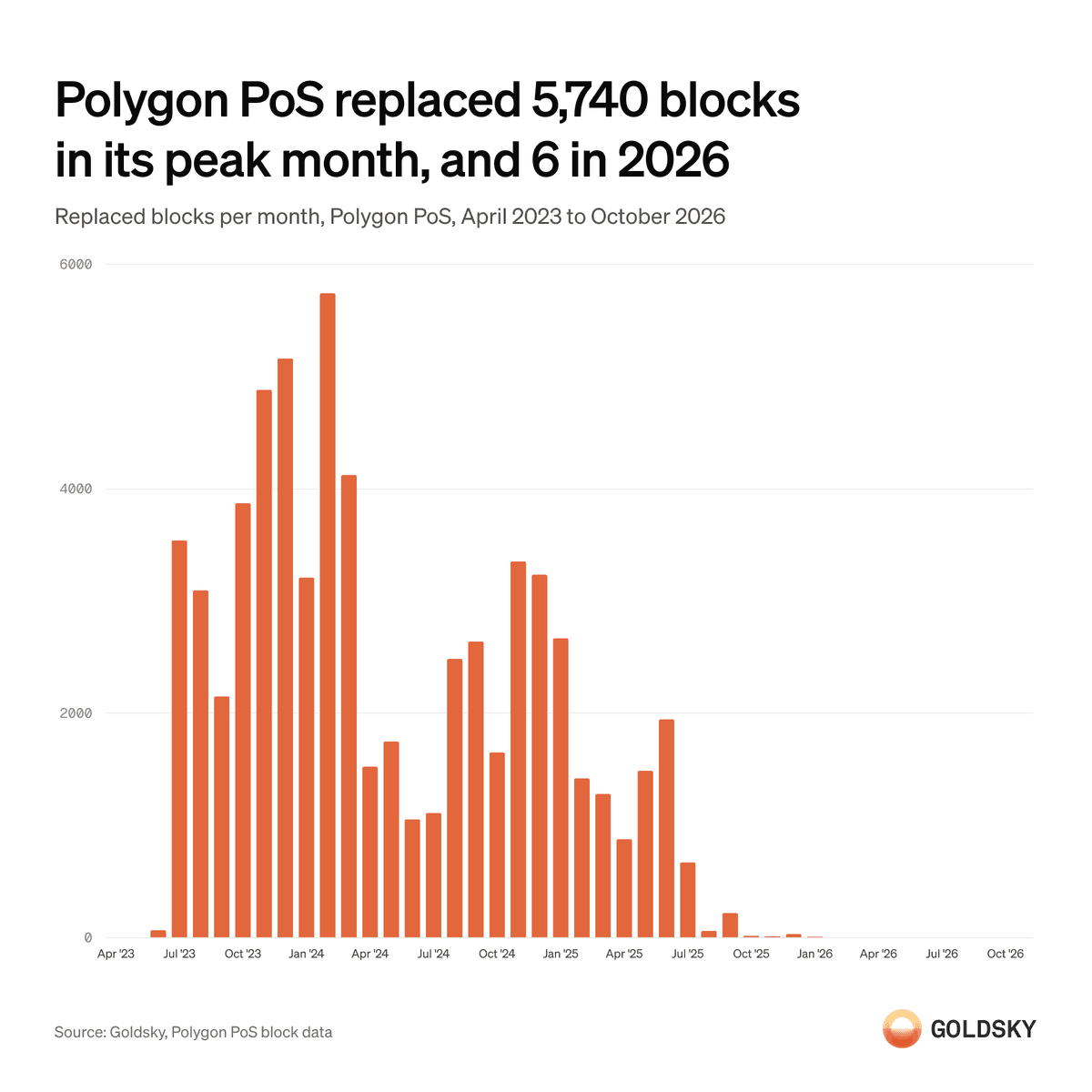
The good news is that Polygon PoS is a much quieter chain than it used to be. Its worst month was February 2024, with 5,740 replaced blocks, and all of 2026 so far has just 6.
That drop followed two upgrades. The count went from 668 in July 2025 to 58 in August, after the Heimdall v2 upgrade of July 10, which Polygon says reduces the chance and the depth of reorgs (opens in a new tab). The Rio upgrade (opens in a new tab) came next, in October 2025. Our post on historical blockchain datasets has the rate for each chain and year.
The bad news is that the depth of a reorg matters as much as the count. If your indexer waits a fixed number of blocks before it writes, that number has to be higher than the longest run of replaced blocks, and on Polygon PoS that run was 136 blocks.
Turbo Pipelines handle this for you at ingestion. When a block doesn't connect to the block before it, we send delete and update records for the replaced blocks. A sink with a primary key applies them, so your table matches the canonical chain. Our delivery guarantees page (opens in a new tab) explains how it works.
Event logs per day: the volume to keep up with
Over the last 30 days, BNB Smart Chain emitted about 104 million event logs a day, which is 16 times more than Ethereum.
| Chain | Mean per day | Peak day | Mean per month, 12 months |
|---|---|---|---|
| Ethereum | 6.5M | 8.2M | 182.7M |
| Base | 35.5M | 50.5M | 1,231.5M |
| Arbitrum One | 4.6M | 6.2M | 177.6M |
| Optimism | 12.8M | 35.9M | 431.0M |
| Polygon PoS | 51.6M | 63.5M | 2,487.9M |
| BNB Smart Chain | 104.2M | 120.4M | 2,482.9M |
The daily columns cover the 30 UTC days from October 24 to November 22, 2026, and the monthly column covers November 2025 to October 2026.
For capacity, the peak day matters more than the average day. Optimism's busiest day had 2.8 times its mean, and we couldn't find a published cause for it. If you size an indexer for the average day, it falls behind on a day like that one.
A Turbo pipeline has a resource_size from xs to xxl. Our pipeline configuration page (opens in a new tab) describes what each size is typically used for, and our advice is to start small and move up if the pipeline lags.
Full history: the rows that a backfill moves
Block count tells you very little about the size of a backfill. Arbitrum One has the most blocks of the six chains, about 4 times as many as BNB Smart Chain, but BNB Smart Chain has about 8 times as many logs. A backfill moves rows, so for event data the log count is the number that sets its size.
| Chain | Blocks | Transactions | Logs |
|---|---|---|---|
| Ethereum | 26.5M | 3.87B | 7.94B |
| Base | 61.0M | 8.12B | 30.95B |
| Arbitrum One | 526.6M | 2.96B | 8.28B |
| Optimism | 159.9M | 1.48B | 10.86B |
| Polygon PoS | 97.8M | ||
| BNB Smart Chain | 135.2M | 15.93B | 68.13B |
Counts run from the first block to November 22, 2026, and each one is exact, with no duplicate rows. Our count of Polygon PoS transactions and logs doesn't cover every month, so the table doesn't show a total for them.
Block count isn't a fixed number either. Base produced 1.34 million blocks in October 2026 and 8.11 million in the first 22 days of November, and a public Base RPC now returns a block every 0.2 seconds. If your indexer makes one request per block, it now makes 10 times more requests on Base than it did in October.
How long a backfill takes then comes down to the read rate. Our post on faster historical backfills has the rates from our benchmark: about 50,000 rows per second through Kafka, and about 600,000 rows per second with Apache Arrow. A source filter also turns on fast scan (opens in a new tab), which skips the blocks that your pipeline doesn't need.
Method
The counts come from our block, transaction, and log data for each chain. A block number is a reorg when it has more than one block hash and one of those blocks is marked as replaced. Log counts are distinct pairs of transaction hash and log index, and transaction counts are distinct hashes. Where one query over the full history was too large, we counted each month and added the months.
SELECT
  toStartOfMonth(ts) AS month,
  countDistinct(number) AS blocks,
  countDistinctIf(number, hashes > 1 AND has_deleted = 1) AS replaced_blocks
FROM (
  SELECT number, max(timestamp) AS ts,
    countDistinct(if(hash != repeat('\0', 66), hash, NULL)) AS hashes,
    max(is_deleted) AS has_deleted
  FROM mainnet_blocks
  WHERE hash != repeat('\0', 66)
  GROUP BY number
)
GROUP BY month
ORDER BY monthWe checked the log count of 13 blocks against eth_getLogs on public RPCs: 3 blocks each on Ethereum, Base, Arbitrum One, and Optimism, and 1 on Polygon PoS. All 13 matched. Public endpoints for Polygon PoS and BNB Smart Chain didn't serve the other calls, so we checked 5 more blocks on those chains by transaction count, and all 5 matched. For 3 replaced Ethereum blocks, a public RPC returned the hash that our data keeps, not the hash that it marks as replaced.
Limits: the reorg counts start in 2023 or 2024, as the table shows. The post doesn't cover Solana, which has no event logs of this type.
FAQ
Why do Arbitrum One and Optimism show no replaced blocks?
Our block data for those chains has no block number with 2 block hashes. Each chain has one sequencer that orders its blocks.
How deep can a reorg go?
The longest run in our data was 136 blocks in a row on Polygon PoS, on July 30, 2025. On Ethereum the longest was 2 blocks, and on BNB Smart Chain it was 16.
Which number sets the size of a backfill?
The row count of the datasets that your pipeline reads. For event data, that's the log count, not the block count.
How do I get this data with the reorg corrections applied?
Deploy a Turbo pipeline (opens in a new tab) that reads a chain's logs dataset from start_at: earliest and writes to Postgres, ClickHouse, or MySQL with a primary key. Our post on contract indexing for data engineers has a full example.
 Robinhood
 HyperEVM
 Arc
 Solana
 Ethereum
 Polymarket
 Base
 Tempo
 Bitcoin
