Trading rewards and builder fee attribution
What is trading rewards and builder fee attribution?
Trading rewards and builder fee attribution is working out, from every filled order, which app, builder or trader drove the volume and fees, so incentive programs and fee shares are paid to the right party.
Prediction markets and trading apps run it to pay builder fees and trader rewards they can back up line by line when someone asks how a payout was reached.
Goldsky streams each fill with its builder, fee and the trader’s position into your warehouse, kept current as the chain changes; the totals for each reward period, the program’s rules and the payouts stay with your team.
Who runs trading rewards and builder fee attribution?
Prediction markets, trading apps that route orders through shared order books, and the builders and front ends paid a share of fees.
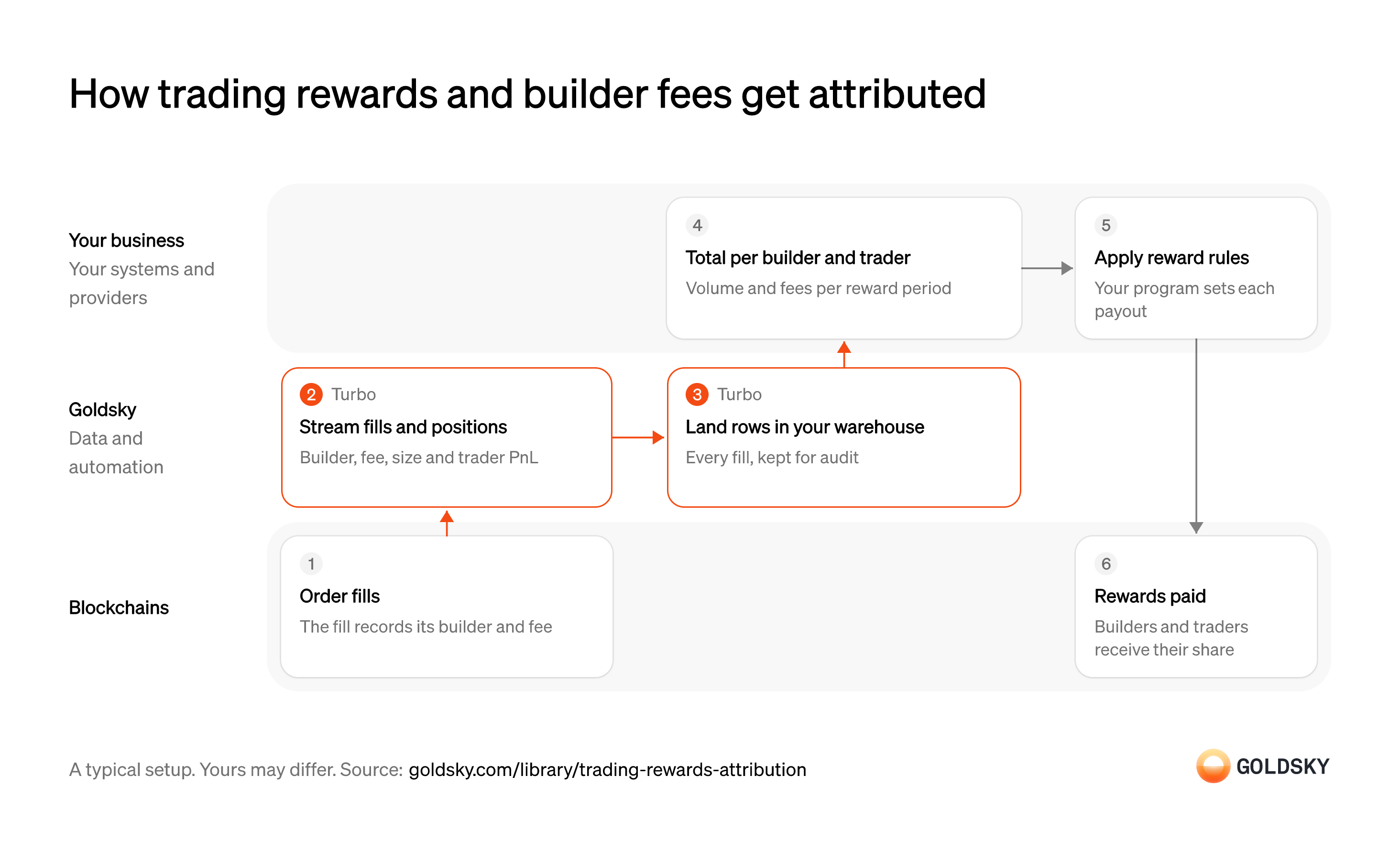
How trading rewards and builder fees get attributed
The diagram follows one order from the fill that records its builder and fee to the reward paid to that builder or trader. Your setup may differ.
Fill the order onchain
A fill is the moment a trade happens, and it’s the record rewards and fees are worked out from.
On venues that credit builders, each fill records the builder who routed the order and the fee paid alongside the trader, price and size. If the venue doesn’t record the builder in the fill, attribution has to come from your own order logs instead.
Capture every fill and position
Handled by Goldsky TurboRewards depend on volume, fees and sometimes profit, so you need each fill and each trader’s position.
Every fill has to be captured with its builder, fee, size, price and side, along with each trader’s position and realized profit and loss (PnL), from the program’s start. A fill missed here is volume someone wasn’t paid for.
For Polymarket, Goldsky’s Polymarket datasets do the decoding:
Stream prediction market datasets (opens in a new tab)polymarket.order_filledcarries each fill’sbuilderandfee, and the user positions dataset carries average price and realized PnL, with all of their history.Land every fill in your warehouse
Handled by Goldsky TurboYour rewards team needs all fills in one place they can query and audit later.
Each fill has to land once, keyed on its event ID, so a repeated delivery doesn’t count twice. When the chain replaces recent blocks in a reorg, fills from those blocks have to be removed or updated, or the totals pay for trades that never happened.
A Turbo Pipelines ClickHouse sink with a
Write fills to ClickHouse (opens in a new tab)primary_keywrites each fill to aReplacingMergeTreetable, so repeats collapse and reorg deletes are marked in anis_deletedcolumn.Total volume and fees per builder and trader
Rewards are paid per period, so fills have to be added up for each builder and trader over that period.
Your warehouse groups fills by builder or trader and period, leaving out rows marked as deleted. The period cutoff has to be the same block time your program publishes, or two people working from the same data get different totals.
Apply the reward rules
Your program decides who earns what, such as a share of fees per builder or rewards tiered by volume.
The rules run against the period totals to set each payout, with any exclusions written down, such as wash trading between linked accounts. Keep the inputs and the result for every payout so you can answer a builder who disputes it.
Pay the rewards
Builders and traders receive their share as a transfer they can see onchain.
Your payout process sends each reward from the rewards wallet. Matching each payment back to its line in the period’s results closes the period and shows anyone left unpaid.
What you control
- Your team
- Total volume and fees per builder and trader
- Apply the reward rules
Security and deployment
- SOC 2 Type IIIndependently audited security controls.
- Dedicated infrastructureSingle-tenant options for production workloads.
- Data residencyCloud, on-premises or co-located.
More use cases that distribute market data
- Prediction market dataPackage onchain trades, prices and flows into data products for exchanges, vendors and funds.
- Prediction market dataPackage prediction-market trades and positions into datasets for exchanges and funds.
- 24/7 tokenized stock prices and flowsStream round-the-clock prices, transfers and flows for tokenized stocks.
- Perpetuals and DEX market dataStream onchain perp and DEX trades, funding rates and candles to trading and research systems.
Use cases built the same way
- Daily stablecoin supply by chain for PS-01 reportsKeep the daily per-chain supply, issued, redeemed, issuer-held, frozen and lost figures that feed the weekly OCC PS-01 report.
- Supply data for stablecoin issuance platformsGive an issuance platform one view of supply across every coin and chain it runs.
- GENIUS Act stablecoin reporting dataFile the weekly OCC PS-01 report from daily per-chain supply, freeze and holder data.
- Stablecoin holder concentration reportingList every wallet holding over 2% of supply and the top 20 redemption wallets each day, for the weekly PS-01 report.
Attribute trading rewards and builder fees with Goldsky
We’ll map it to your systems and show you what Goldsky runs, so your team builds the product, not the pipelines underneath it.
 Robinhood
 HyperEVM
 Arc
 Solana
 Ethereum
 Polymarket
 Base
 Tempo
 Bitcoin