24/7 tokenized stock prices and flows
What are 24/7 tokenized stock prices and flows?
24/7 tokenized stock prices and flows are the prices, volume, transfers and net flows of tokenized stocks, measured from onchain trading at every hour, including nights and weekends when the stock’s home exchange is shut; data teams also call it a tokenized stock price feed.
Tokenized-stock venues, index providers and market data firms publish them because clients who hold or value these tokens want a price while the exchange is closed.
Goldsky’s Turbo Pipelines capture venue trades and every transfer and load them into your warehouse as they land; building the bars and flows, and publishing them, stays with your team.
Who uses 24/7 tokenized stock prices and flows?
Tokenized-stock venues, index providers and market data firms that publish prices for stocks traded onchain.
How onchain trades become 24/7 tokenized stock prices
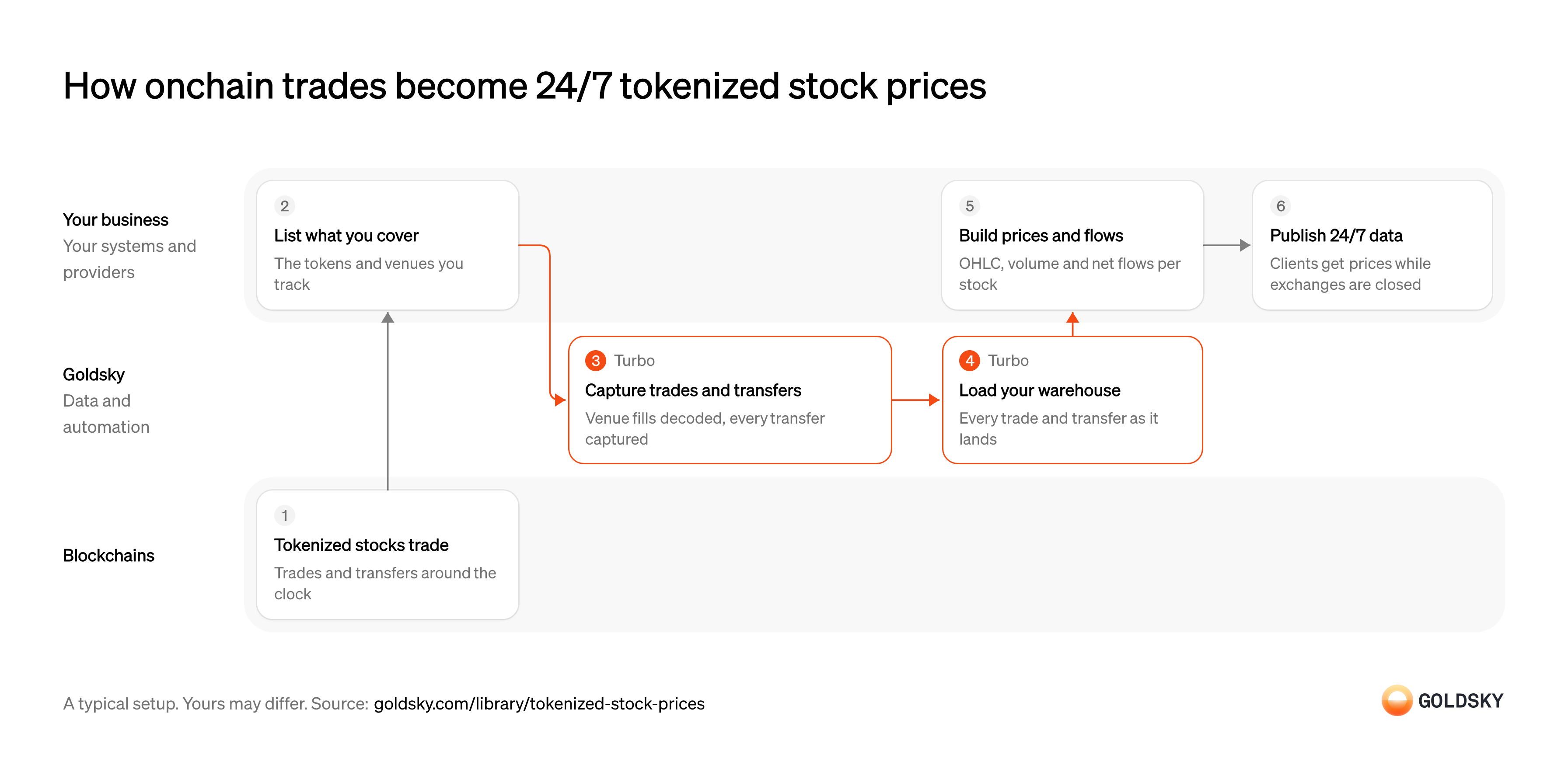
The diagram follows tokenized stocks from trading onchain to the round-the-clock data your clients receive, and shows who does each step. Your setup may differ.
Trade tokenized stocks onchain
A tokenized stock is a token, so it can be traded or moved at any hour, including when the stock’s exchange is closed.
Trades happen on venues such as decentralized exchange pools or a chain’s own matching contracts, and every move between wallets is a transfer. The newest blocks can still be replaced for a short time, so a trade seen once isn’t final yet.
List the tokens and venues you cover
Each tokenized stock has its own contract on each chain, and it trades only on certain venues.
Keep a reference list that maps each token address to the stock it stands for and each venue contract to its trading pair. A token missing from the list never shows up in your prices; a wrongly mapped one shows another stock’s price.
Capture trades and transfers
Handled by Goldsky TurboPrices come from trades and flows come from transfers, so you need both.
Every venue fill needs its price, size and time, and every transfer its sender, recipient and amount. Missing a venue biases the price toward the venues you did capture.
In Turbo Pipelines, a SQL transform decodes venue swap events with
Decode event logs in SQL (opens in a new tab)_gs_log_decode, the way the DEX trades guide does, and a ready-made ERC-20 transfers dataset supplies every transfer of the token.Load your warehouse as trades land
Handled by Goldsky TurboClients want the data current at any hour, weekends included.
Rows have to arrive continuously and survive repeats and reorgs (the chain replacing its newest blocks). A trade written twice inflates volume, and one from a replaced block shows a price that never happened.
Goldsky writes each row keyed on its
How reorgs reach your sinks (opens in a new tab)id, and sinks with aprimary_keyapply reorg corrections as updates and deletes, so the stored trades follow the chain.Build prices and flows
Clients want bars and totals for each stock, not individual fills.
Your warehouse builds open, high, low and close prices (OHLC), volume and net flows per stock and period, for example with a query grouped by token and minute. Thin overnight trading can move a bar on one trade, so decide how you flag bars with little volume.
Publish prices around the clock
The point is a price clients can use while the home exchange is shut.
Label onchain prices as such, with the venues and period they cover, so clients don’t mistake them for the exchange’s own close. A feed that stops at weekends loses the reason clients wanted it.
What you control
- Your team
- List the tokens and venues you cover
- Build prices and flows
- Publish prices around the clock
Questions and answers
Do tokenized stocks trade 24/7?
Onchain, they can: a tokenized stock is a token, so it can be transferred or traded at any hour, including weekends. The share behind it still trades only during its exchange’s hours, and whether a given venue offers round-the-clock trading is that venue’s choice. Trades made while the exchange is closed are what give the stock a price in those hours.
Security and deployment
- SOC 2 Type IIIndependently audited security controls.
- Dedicated infrastructureSingle-tenant options for production workloads.
- Data residencyCloud, on-premises or co-located.
More use cases that distribute market data
- Prediction market dataPackage onchain trades, prices and flows into data products for exchanges, vendors and funds.
- Prediction market dataPackage prediction-market trades and positions into datasets for exchanges and funds.
- Trading rewards and builder fee attributionCredit fills, fees and incentive rewards to the app, builder or trader that drove them.
- Perpetuals and DEX market dataStream onchain perp and DEX trades, funding rates and candles to trading and research systems.
Use cases built the same way
- Confirm x402 and agent stablecoin paymentsConfirm stablecoin payments that AI agents make, often per request, and keep each agent within its spending limits.
- Stablecoin disbursements for public-sector programsTrack government benefit or grant payments made in stablecoins, from issue to spend.
- Stablecoin credit lines for card issuersTrack the stablecoin draws and repayments on a card issuer’s credit line so the lender’s book matches the chain.
- Daily stablecoin supply by chain for PS-01 reportsKeep the daily per-chain supply, issued, redeemed, issuer-held, frozen and lost figures that feed the weekly OCC PS-01 report.
Build 24/7 tokenized stock prices and flows with Goldsky
We’ll map it to your systems and show you what Goldsky runs, so your team builds the product, not the pipelines underneath it.
 Robinhood
 HyperEVM
 Arc
 Solana
 Ethereum
 Polymarket
 Base
 Tempo
 Bitcoin