Stablecoin credit lines for card issuers
What it is
Stablecoin credit lines for card issuers lend an issuer stablecoins through a lending contract, which it draws on to settle with the card network and repays from what it collects from cardholders, a form of settlement financing.
Lenders, card issuers and their processors need the loan book to match what moved on the chain, so each line’s outstanding balance is known and any gap is chased early.
Goldsky decodes every draw and repayment from the lending contract’s events into your database beside the loan book and keeps each line’s drawn, repaid and outstanding totals there, while tying it out stays with your team.
Who it’s for
Private credit funds, card issuers, issuer processors and card networks that finance card settlement in stablecoins.
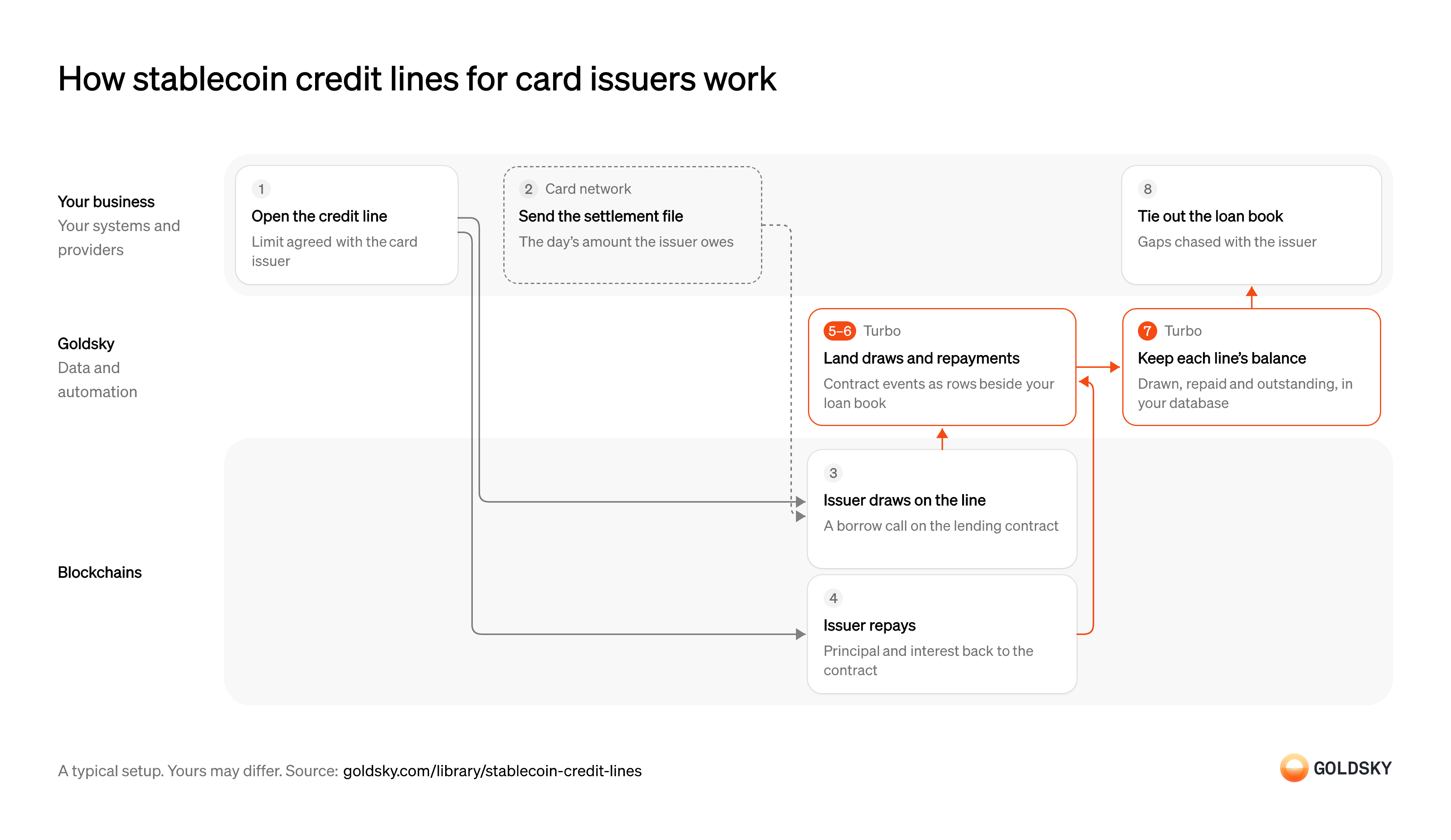
How stablecoin credit lines for card issuers work
The diagram follows one credit line from the agreed limit to the tie-out of your loan book, and shows who does each step. Your setup may differ.
Open the credit line
Every draw and repayment is checked against the terms, so the line is set up before any money moves.
You agree the limit, the pricing and the wallets each side uses with the card issuer, and record them in the loan book with the lending contract the line runs through. A draw on a line that isn’t on record can’t be booked to the right line.
Get the day’s settlement amount
The issuer draws on the line to pay what it owes the card network each day, so the network’s settlement figure is what each draw should match.
With the issuer’s permission, the lender can receive the network’s daily settlement files and size and check draws and repayments against them. A draw with no settlement behind it is money lent for something other than card spend.
Issuer draws on the line
The issuer draws on the line when it has to settle card spending with the network.
The issuer calls the lending contract to borrow stablecoins, up to the committed amount, and can repay and draw again. For a short time the newest blocks can still be rewritten, so a draw seen once isn’t final yet.
Issuer repays
Repayments come in as the issuer collects from cardholders, and each one lowers what’s outstanding.
Principal and interest go back into the lending contract. In some setups the issuer doesn’t send them: the program’s settlement receivables pass through a contract the lender controls, which takes the repayment automatically before the rest reaches the issuer. Partial repayments are common, so each one has to be recorded on its own.
Land draws and repayments beside the loan book
Handled by Goldsky TurboThe loan book can only be tied out against a complete record of what moved.
Every draw and repayment has to arrive as a row with line, direction, amount and transaction. Each one is an event on the lending contract that has to be decoded from the raw logs; watching the issuer’s wallet alone misses repayments the contract takes from incoming receivables.
Turbo Pipelines can decode the lending contract’s events in SQL with
Decode logs with an ABI (opens in a new tab)_gs_log_decode()and the contract’s ABI, and write each row to your database.Keep the rows in step with the chain
Handled by Goldsky TurboSometimes the chain replaces its newest blocks (a reorg), and a draw you recorded can disappear.
Your table has to drop or change the row when that happens. A draw that stays in the table after the chain dropped it shows money owed that was never lent.
With Goldsky, a database sink with a
How reorgs reach your sinks (opens in a new tab)primary_keyapplies reorg corrections as updates and deletes to the same rows, so the table follows the chain.Keep each line’s balance
Handled by Goldsky TurboThe loan book tracks drawn, repaid and outstanding amounts for each line, not single transfers.
Add each draw and repayment to its line’s totals as it lands, and take it off again when a reorg removes the row. Interest accrues between events, so interest owed comes from the line’s terms, not from the rows alone.
Turbo Pipelines can keep running sums per key in your database with its
Keep running totals in your database (opens in a new tab)postgres_aggregatesink. Set draw and repayment amounts as columns in SQL and group by line, and it keeps drawn, repaid and outstanding for each line as rows arrive; keep the_gs_opcolumn in the SQL so an event a reorg deletes comes off the totals.Tie out the loan book
The lender needs its book to match the chain before it reports or bills interest.
Your team compares each line’s onchain totals with the loan book and chases any difference with the issuer. A gap left open until month end is harder to trace to the transfer that caused it.
What you control
- Your team
- Open the credit line
- Tie out the loan book
- Your providers
- Card network
Security and deployment
- SOC 2 Type IIIndependently audited security controls.
- Dedicated infrastructureSingle-tenant options for production workloads.
- Data residencyCloud, on-premises or co-located.
More use cases that run stablecoin accounts and cards
- Stablecoin card programsDetect stablecoin top-ups to the wallets that back a card program so spend limits update.
- Stablecoin dollar accountsOffer dollar accounts held in stablecoins, with balances and history kept in step with the chain.
- Stablecoin card program operationsWatch card-backing wallets and read balances at authorization time for stablecoin-linked cards.
- Rewards on stablecoin balancesCalculate and pay rewards on customers’ stablecoin balances.
Use cases built the same way
- Confirm x402 and agent stablecoin paymentsConfirm stablecoin payments that AI agents make, often per request, and keep each agent within its spending limits.
- Tokenized deposits for interbank settlementSettle payments between banks in tokenized deposits and tie each one to the core.
- Continuous proof of reservesCompare onchain supply with reported reserves on a schedule, then publish the ratio or alert on a gap.
- Keep tokenized stocks backed one to oneCheck token supply on every chain against the shares or fund units held in custody, and alert on any gap.
Track stablecoin credit lines for card issuers with Goldsky
We’ll map it to your systems and show you what Goldsky runs, so your team builds the product, not the pipelines underneath it.
 Robinhood
 HyperEVM
 Arc
 Solana
 Ethereum
 Polymarket
 Base
 Tempo
 Bitcoin