Airdrop eligibility lists and sybil filtering
What are airdrop eligibility lists and sybil filtering?
Airdrop eligibility lists and sybil filtering are how a token team decides who receives an airdrop: every address’s activity is scored up to one snapshot block, and wallets run by one actor posing as many people, called sybils, are removed before the list goes out.
Chain foundations and protocol teams run it before a token launch, because each farmed wallet left on the list takes tokens meant for real users.
Goldsky backfills chain activity up to the snapshot block into your warehouse; the criteria, scoring, sybil rules, address labels, Merkle root and claim contract stay with your team.
Who uses airdrop eligibility lists and sybil filtering?
Chain foundations, DeFi protocols and app teams launching a token, and the data teams that run their sybil analysis.
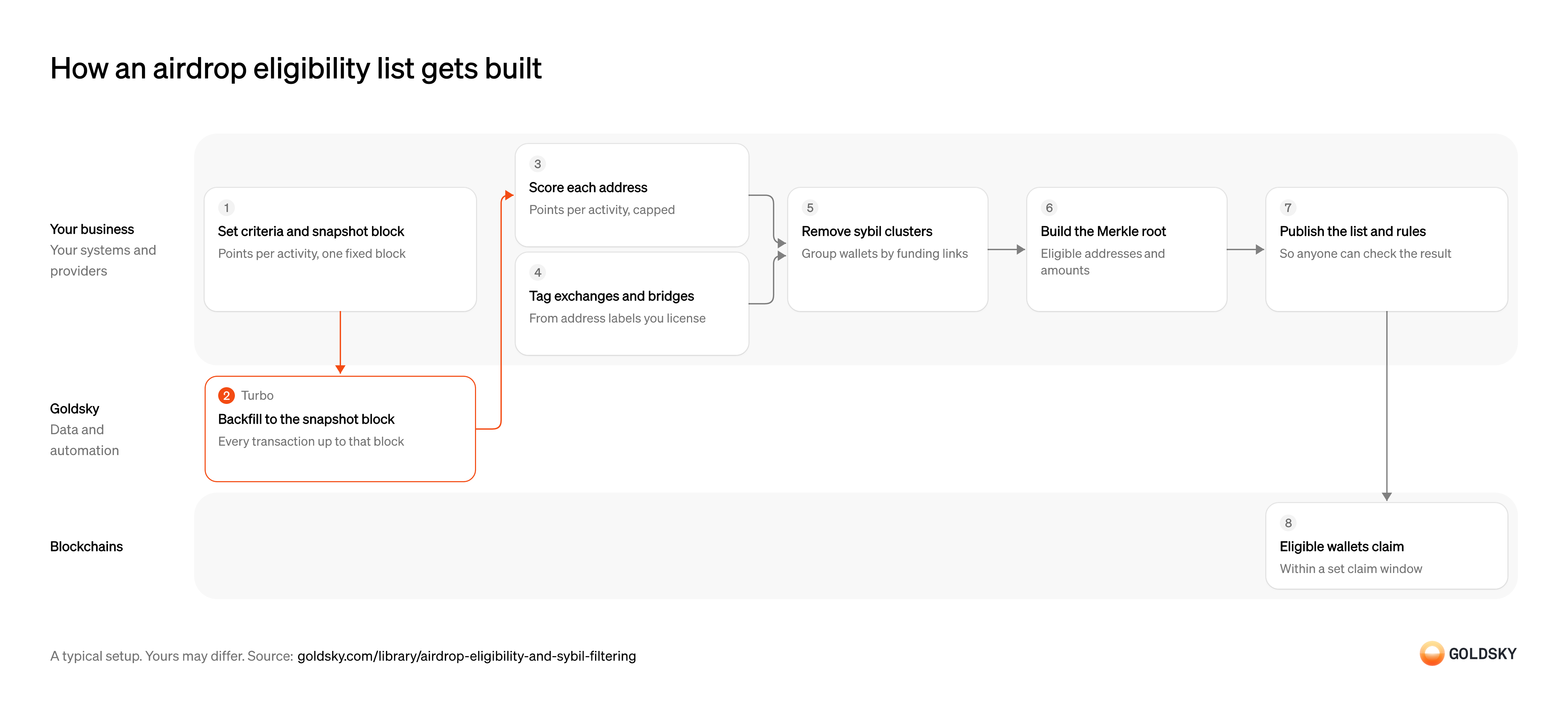
How an airdrop eligibility list gets built
The diagram follows one airdrop from the criteria and snapshot block to the wallets that claim. Your setup may differ.
Set the criteria and the snapshot block
Everyone is judged by the same rules at the same moment, so both are fixed before scoring starts.
Criteria are usually points per qualifying activity, such as bridging funds or using the chain over several months, with a cap on the total. Only activity before the snapshot block counts.
Backfill activity up to the snapshot block
Handled by Goldsky TurboScoring needs every address’s activity up to the snapshot, and nothing after it.
The history has to stop at exactly the snapshot block and cover every chain the criteria name. A rerun on the same block should return the same rows, so anyone can check the list.
With Goldsky, a Turbo Pipelines job mode pipeline loads a fixed block range that ends at the snapshot block into your warehouse, then exits.
Run a one-time backfill (opens in a new tab)Score each address
Points turn each address’s activity into an allocation.
Your warehouse counts each qualifying action per address and caps the total. Extra weight for early activity, or a minimum score to qualify, belongs in the written rules too.
Tag exchanges and bridges
Exchange deposit addresses and bridge contracts move many people’s funds, so they come off the list.
Labels come from an address labelling provider or your own research. A contract or exchange address left in takes tokens meant for users.
Remove sybil clusters
One actor running many wallets would otherwise collect many allocations.
Link wallets that were funded from the same source or swept funds to the same place, then look for tight groups of linked wallets. Publish the method and the code with the list, so anyone can check who was removed and why.
Build the Merkle root
A claim contract checks each claim against one Merkle root, a single hash that commits to the whole list.
Each eligible address and its amount become one entry, and the root goes onchain with the claim contract. Any change to the list changes the root, so finish filtering first.
Publish the list and the rules
People check their own eligibility, and the community checks the method.
Publish the criteria, the snapshot block, the list and the code that built it. With those public, anyone can rerun the list and get the same result.
Eligible wallets claim
Each address claims its tokens from the claim contract during the claim window.
The contract checks each claim against the Merkle root and pays it once. Set the window’s start and end up front, and say what happens to unclaimed tokens.
What you control
- Your team
- Set the criteria and the snapshot block
- Score each address
- Tag exchanges and bridges
- Remove sybil clusters
- Build the Merkle root
- Publish the list and the rules
Security and deployment
- SOC 2 Type IIIndependently audited security controls.
- Dedicated infrastructureSingle-tenant options for production workloads.
- Data residencyCloud, on-premises or co-located.
More use cases that automate payouts
- Stablecoin payroll and contractor payoutsPay contractors and staff in stablecoins and confirm each payout settled.
- Stablecoin payouts for marketplaces and creatorsPay sellers, gig workers and creators in stablecoins from a marketplace balance.
- Payout prefunding in USDCPrefund a payout network in USDC and track the balance so payouts never stall.
- Token distributions to holders and creditorsPay one asset out to thousands of holders, creditors or employees and prove each delivery.
- Stablecoin disbursements for public-sector programsTrack government benefit or grant payments made in stablecoins, from issue to spend.
- Stablecoin merchant settlementPay each merchant’s settlement in stablecoins to the wallet and network it chose, on any day, and record the transaction against the settlement.
- Programmable escrow for B2B stablecoin paymentsHold a buyer’s stablecoin payment until delivery, a milestone or a deadline, then release it to the seller or refund the buyer.
Build an airdrop eligibility list with Goldsky
We’ll map it to your systems and show you what Goldsky runs, so your team builds the product, not the pipelines underneath it.
 Robinhood
 HyperEVM
 Arc
 Solana
 Ethereum
 Polymarket
 Base
 Tempo
 Bitcoin