Stablecoin merchant settlement
What is stablecoin merchant settlement?
Stablecoin merchant settlement is an acquirer or payment provider paying a merchant’s proceeds in stablecoins instead of a bank transfer, to the wallet and network the merchant picked, on any day of the week.
Acquirers, payment service providers and processors offer it because merchants want their money outside banking hours and cut-offs, and every payout still has to match the settlement on the merchant’s statement.
Goldsky can run the payout as a task you write, which screens the merchant’s wallet, hands the transaction to your signer and returns the confirmed hash to record; converting the funds, holding the keys and the settlement records stay with you and your providers.
Who offers stablecoin merchant settlement?
Merchant acquirers, payment service providers and processors that let merchants take their settlement in stablecoins.
How stablecoin merchant settlement works
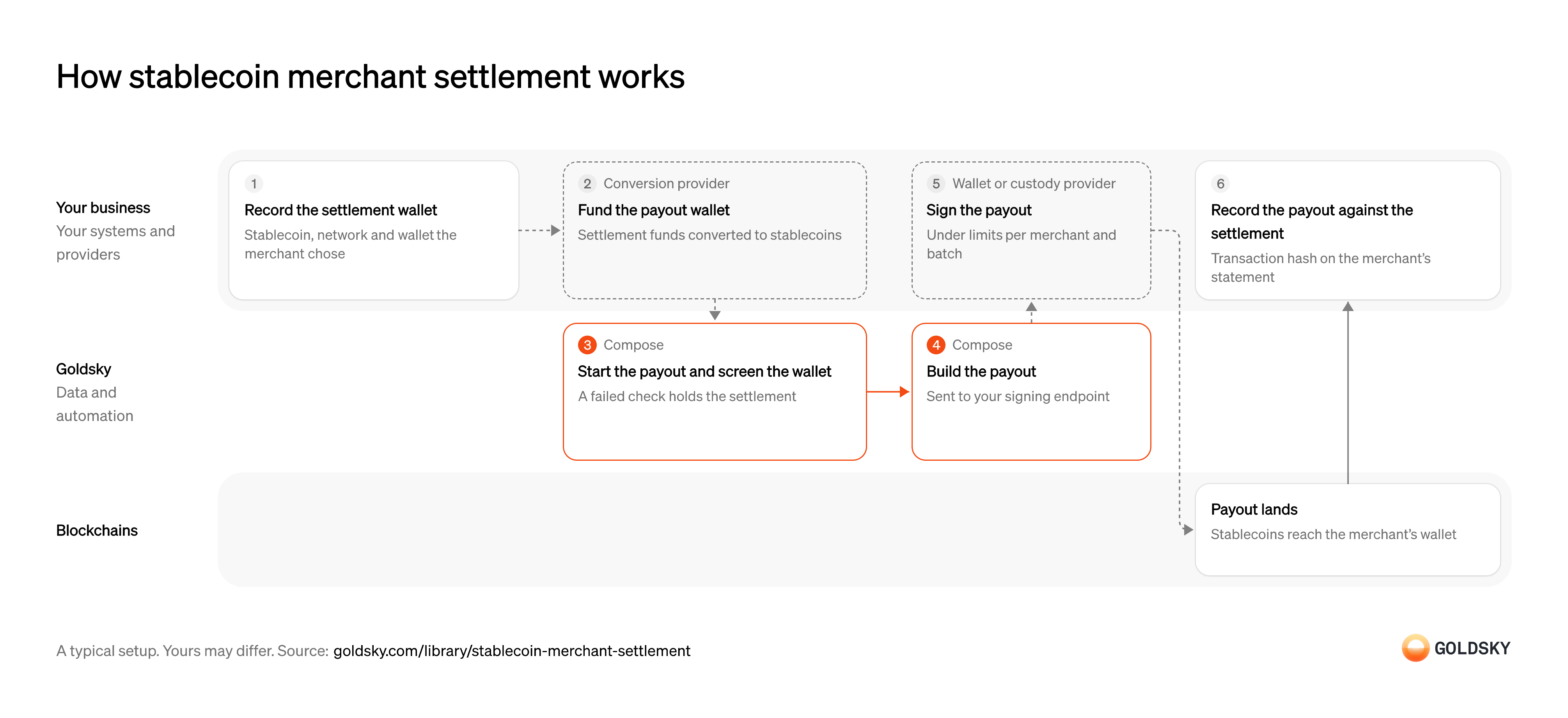
The diagram follows one merchant’s settlement from the wallet it chose to the payout on its statement, and shows who does each step. Your setup may differ.
Record the merchant’s settlement wallet
A merchant who opts into stablecoin settlement chooses the stablecoin, the network and the wallet in place of a bank account.
Your merchant records hold the wallet and network beside the bank details they replace. Treat a change of wallet like a change of bank account, with the same verification, or a takeover of the merchant’s login redirects its settlement.
Fund the payout wallet in stablecoins
Settlement funds are owed in fiat, so they’re converted before they can be paid as stablecoins.
Your conversion provider turns the batch’s settlement funds into the stablecoins merchants chose and delivers them to your payout wallet. Fund the whole batch before it starts, or some merchants are paid and the rest wait.
Start the payout and screen the wallet
Handled by Goldsky ComposeEach settlement should go only to a wallet that passes your screening when you pay.
The merchant’s wallet is checked against your sanctions and risk rules before the payout is built. A wallet that fails is held for review and the settlement stays owed.
Your settlement system can start a Compose task with an HTTP call, and the task calls your screening provider’s API before it pays.
Call a task over HTTP (opens in a new tab)Build the payout and send it for signing
Handled by Goldsky ComposeThe settlement has to become a transaction on the network the merchant chose and reach whoever holds the key.
The transaction carries the merchant’s wallet and the settlement amount, and a payout built twice for one settlement pays the merchant twice. A reorg (the chain replacing its newest blocks) can drop a payout after it was included, so it needs resending, not a second settlement.
With Goldsky Compose, a webhook wallet sends the signing endpoint you host each payout as a UserOperation (the transaction format smart-account wallets use) to sign, plus, the first time it sends on a chain, an EIP-7702 authorization that lets your address act as a smart account there. Compose submits the signed payout, gas-sponsored, waits for the confirmations you set and can replay it if a reorg drops it.
Use a webhook wallet (opens in a new tab)Sign the payout
Moving settlement funds takes a signature from a key held under rules about who can approve what.
Your signing endpoint holds your limits per merchant and per batch: it reads the recipient and amount from the payout’s call data, checks them, then asks your custody provider to sign. A key with no rules around it lets anyone who can change the settlement logic move the payout wallet’s funds.
Record the payout against the settlement
Merchants reconcile what they were paid against their statement, and so do you.
Once the task has seen the payout confirm to the depth you set, your settlement system marks the settlement paid with the transaction hash the task returned and shows it on the merchant’s statement. A payout held or still unconfirmed stays open until someone resolves it.
What you control
- Your team
- Record the merchant’s settlement wallet
- Record the payout against the settlement
- Your providers
- Conversion provider
- Wallet or custody provider
Security and deployment
- SOC 2 Type IIIndependently audited security controls.
- Dedicated infrastructureSingle-tenant options for production workloads.
- Data residencyCloud, on-premises or co-located.
More use cases that automate payouts
- Stablecoin payroll and contractor payoutsPay contractors and staff in stablecoins and confirm each payout settled.
- Stablecoin payouts for marketplaces and creatorsPay sellers, gig workers and creators in stablecoins from a marketplace balance.
- Payout prefunding in USDCPrefund a payout network in USDC and track the balance so payouts never stall.
- Token distributions to holders and creditorsPay one asset out to thousands of holders, creditors or employees and prove each delivery.
- Airdrop eligibility lists and sybil filteringScore every address up to a snapshot block, remove sybil clusters and publish the list people claim against.
- Stablecoin disbursements for public-sector programsTrack government benefit or grant payments made in stablecoins, from issue to spend.
- Programmable escrow for B2B stablecoin paymentsHold a buyer’s stablecoin payment until delivery, a milestone or a deadline, then release it to the seller or refund the buyer.
Use cases built the same way
- Authorize and capture stablecoin paymentsHold a buyer’s stablecoins in an escrow contract at checkout, capture them to the merchant as orders ship, void what can’t be filled and refund after capture.
- Idle stablecoin cash sweepsMove idle stablecoin balances into tokenized money funds when they pass a threshold.
- Tokenized stock mint and redeem against ordersTrigger mints and redemptions when a customer buys or sells, and record every step for the books.
- Smart contract automation and keepersRun recurring or event-driven contract calls a protocol needs to keep working.
Settle merchants in stablecoins with Goldsky
We’ll map it to your systems and show you what Goldsky runs, so your team builds the product, not the pipelines underneath it.
 Robinhood
 HyperEVM
 Arc
 Solana
 Ethereum
 Polymarket
 Base
 Tempo
 Bitcoin