Intercompany settlement in stablecoins
What is intercompany settlement in stablecoins?
Intercompany settlement in stablecoins is paying the amounts a group’s entities owe each other, usually after intercompany netting, with a stablecoin transfer between their wallets in place of a bank wire.
Group treasury teams use it to settle across countries at any hour, which shortens the time cash sits in transit at month end.
Goldsky watches every entity’s wallets and writes each settlement into your database beside the intercompany ledger; the netting, the approvals, matching each transfer to its netting run and the journal entries stay in your treasury system and ERP.
Who uses intercompany settlement in stablecoins?
Group treasury and controllership teams at multinationals, fintechs and stablecoin issuers that run several legal entities.
How intercompany settlement in stablecoins works
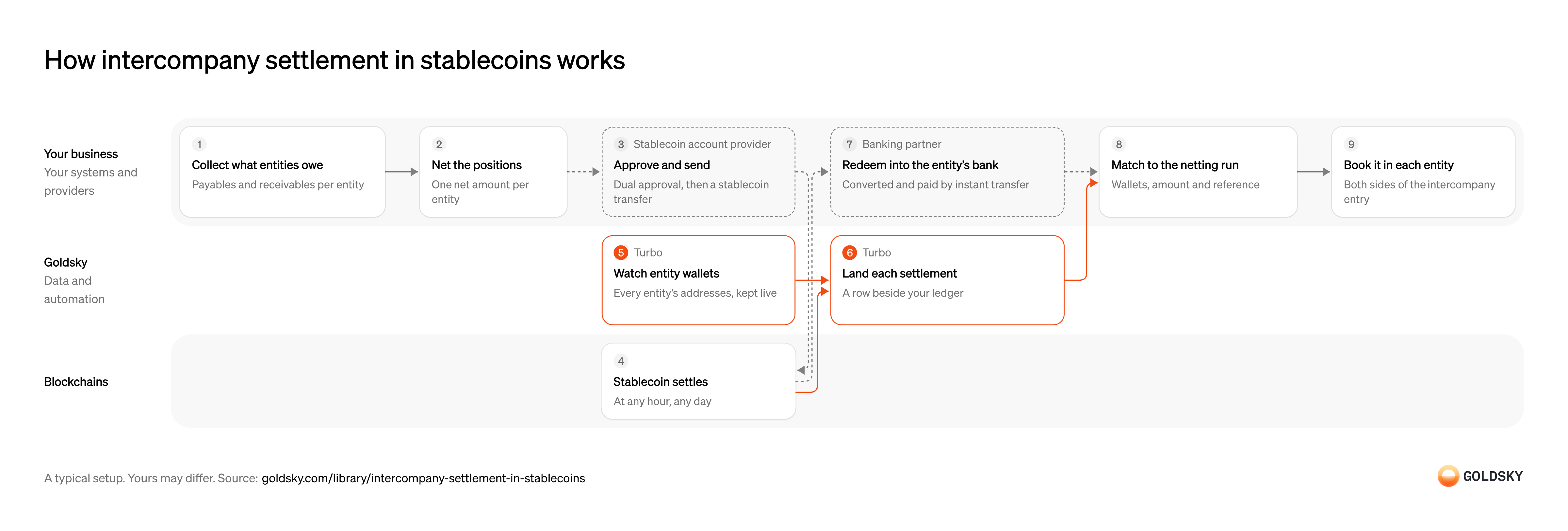
The diagram follows one netting cycle from each entity’s payables and receivables to the entry booked in both entities’ books. Your setup may differ.
Collect each entity’s intercompany balances
Netting starts from what every entity owes the others and is owed by them.
Each entity’s payables and receivables for the cycle are gathered into one system, usually your treasury management system or ERP. The netting is only as complete as the records collected here.
Net the positions
Netting turns many invoices between entities into one payment per entity, which cuts the number and cost of transfers.
Your treasury system offsets each entity’s payables against its receivables, and each entity pays or receives one net amount through a central netting center. Those net amounts, and who pays whom, are what the transfers have to match.
Approve and send the net amounts
Moving group cash needs the same controls as a bank payment.
Authorized operators start each transfer in the stablecoin account and a second person approves it, keeping duties separate. Send each payment between the two entities’ own wallets, so every transfer traces back to the entities it settles.
Settle onchain
A stablecoin transfer settles at any hour, weekends and bank holidays included, so cash lands the day it’s sent.
For a short time the newest blocks can be replaced in a reorg (the chain rewriting its most recent blocks). Treat the funds as received once the transfer has the confirmations your policy asks for.
Keep a live list of entity wallets
Handled by Goldsky TurboOnly transfers between your own entities are intercompany settlements, so the watch list is the set of entity wallets.
Record each wallet with the entity it belongs to, and add new wallets the day they open. A wallet missing from the list means its settlements never reach the ledger.
With Goldsky, the wallet list sits in a Turbo Pipelines dynamic table, which lives in a Postgres database, so the running pipeline picks up a new wallet as soon as you add it, with no redeploy.
Watch wallets with dynamic tables (opens in a new tab)Record every settlement beside the ledger
Handled by Goldsky TurboMatching is easiest when each transfer sits in the same database as the intercompany ledger.
Each transfer between entity wallets has to arrive once, with its token, amount, sender, recipient and transaction hash, and change if a reorg changes it. Transfers known only from one provider’s statement leave out wallets held anywhere else.
A Turbo Pipelines SQL transform keeps stablecoin transfers where both sides pass
Filter transfers with dynamic tables (opens in a new tab)dynamic_table_check()and writes them to a database table keyed onid, so reorg corrections update the same rows.Redeem into the receiving entity’s bank account
Most entities pay their bills in local currency, so the receiving entity often turns the stablecoins back into bank money straight away.
Your banking partner redeems the stablecoins and pays the entity’s account, by instant transfer where the currency has one. Keep the redemption reference with the settlement, so treasury can match the bank credit to the transfer it came from.
Match each transfer to its netting run
Treasury needs to see that every net amount was paid in full, by the right entity, to the right entity.
Match on the paying and receiving entity, the amount and the cycle, and use your account provider’s payment reference where it has one. A transfer with no match, or a short payment, goes to an exception queue for the treasury team.
Book the settlement in each entity
Both entities’ books have to show the payment, or the intercompany balances won’t cancel out when the group consolidates.
Your treasury system or ERP posts the settlement to the paying and the receiving entity from the same matched row, and shows the stablecoin balances and transactions beside the bank accounts. Booking both sides from one record, with the transaction hash as its reference, keeps the two entities’ intercompany accounts in agreement.
What you control
- Your team
- Collect each entity’s intercompany balances
- Net the positions
- Match each transfer to its netting run
- Book the settlement in each entity
- Your providers
- Stablecoin account provider
- Banking partner
Security and deployment
- SOC 2 Type IIIndependently audited security controls.
- Dedicated infrastructureSingle-tenant options for production workloads.
- Data residencyCloud, on-premises or co-located.
More use cases that manage treasury
- Stablecoin treasury management across chainsSee stablecoin cash across every wallet and chain in one place.
- Idle stablecoin cash sweepsMove idle stablecoin balances into tokenized money funds when they pass a threshold.
- Gas wallet monitoringKeep gas wallets funded on every chain and alert before one runs dry.
- Sponsored gas spendTotal the gas you pay for your users per user, paymaster and day, watch the paymaster’s deposit and check the provider’s bill.
Use cases built the same way
- Stablecoin wallet top-upsCredit a user’s app balance when a stablecoin transfer to their embedded wallet confirms.
- Stablecoin deposits to business bank accountsDetect stablecoin deposits into business bank and fintech accounts and post them to the account alongside fiat.
- Crypto exchange deposit detectionDetect deposits to each exchange user’s addresses, wait for enough confirmations and credit the user once.
- Accept stablecoin paymentsConfirm stablecoin payments from shoppers and mark the order paid.
Settle intercompany balances in stablecoins with Goldsky
We’ll map it to your systems and show you what Goldsky runs, so your team builds the product, not the pipelines underneath it.
 Robinhood
 HyperEVM
 Arc
 Solana
 Ethereum
 Polymarket
 Base
 Tempo
 Bitcoin