Onchain circuit breakers
What it is
An onchain circuit breaker pauses a token, market or payout contract automatically when a rule is breached, such as an outflow above a limit or a price far from its source; engineers also call it an emergency pause, and ERC-7265 proposes a standard for it.
Stablecoin issuers, tokenized-stock venues and DeFi protocols use one so transfers, trades or payouts stop while their team works out what happened, without waiting for someone to notice.
Goldsky Compose checks events against your limits, alerts your team and sends the pause call through a role your contract grants it; the rules and the decision to resume stay with your team.
You can build an onchain circuit breaker two ways: run a Compose task on every event from the contract you protect, or have a Turbo Pipelines pipeline filter events across many contracts and call the task when a rule trips.
Who it’s for
Stablecoin issuers, tokenized-stock venues and DeFi protocols that need a token, market or payout to stop when something goes wrong.
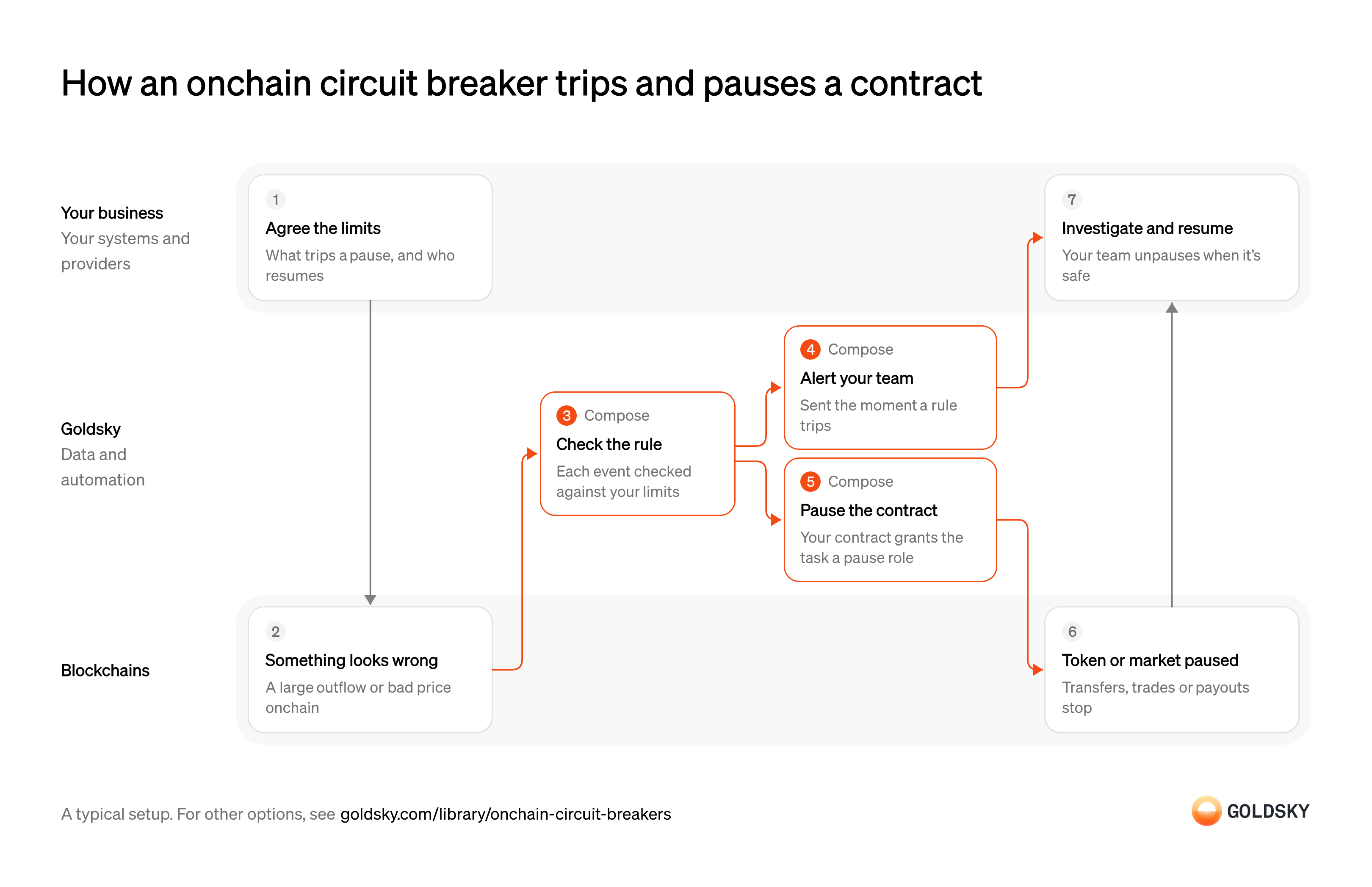
How an onchain circuit breaker trips and pauses a contract
The diagram follows one breach, from the event that looks wrong to your team resuming the contract, and shows who does each step. Your setup may differ.
Ways to build an onchain circuit breaker
An event-triggered task checks each event from one contract in TypeScript and can keep totals between events; a pipeline checks single-event rules in SQL across many contracts or chains and calls the task only on a match.
- Best for
- A few contracts, with rules that need history
- Products
- Compose
- What you run
- Nothing on Goldsky cloud; single-tenant, VPC and on-premises deployments are enterprise options
- What you write
- TypeScript tasks
- Where your data lives
- Hosted by Goldsky
- How results reach you
- Acts onchain or calls your systems
- Best for
- Many contracts or chains, with single-event rules
- What you run
- The destination: your database, queue or bucket, or a Postgres database Goldsky hosts
- What you write
- Pipeline YAML and SQL; TypeScript transforms when needed
- Where your data lives
- In your own database or systems
- How results reach you
- Pushed to you
| Usual setupOption 1: Event-triggered task | Option 2: Stream events to a task | |
|---|---|---|
| Best for | A few contracts, with rules that need history | Many contracts or chains, with single-event rules |
| Products | Compose | TurboCompose |
| What you run | Nothing on Goldsky cloud; single-tenant, VPC and on-premises deployments are enterprise options | The destination: your database, queue or bucket, or a Postgres database Goldsky hosts |
| What you write | TypeScript tasks | Pipeline YAML and SQL; TypeScript transforms when needed |
| Where your data lives | Hosted by Goldsky | In your own database or systems |
| How results reach you | Acts onchain or calls your systems | Pushed to you |
Agree the limits and who can pause
A breaker trips on rules, so the team has to agree what counts as wrong before anything goes wrong.
Write each rule as a number events can be checked against, such as the largest single outflow or a price band, and grant the pause role to the breaker’s address alone. A rule nobody signed off on gets argued over in the moment, and a breaker with broad rights is a risk of its own.
Spot the event that looks wrong
Breaches show up onchain as events: a large transfer out, a mint above plan, a trade far from the market price.
These events land in blocks like any other. Some are attacks, some are mistakes and some are normal activity that only looks unusual, which is why the rules matter more than the alarm.
Check each event against your rules
Handled by Goldsky ComposeThe breaker has to look at every relevant event, not a sample.
Each event is decoded and compared with your limits, and a rule over a period, such as outflows in the last hour, also needs a running total kept between events. Events handled out of order can throw that total off, so keep them in block order unless each one can be judged alone.
With Goldsky, an
Trigger a task from contract events (opens in a new tab)onchain_eventtrigger runs the Compose task for each log from the contract, one at a time in order by default, and a collection holds the running totals your period rules need.Alert your team
Handled by Goldsky ComposePeople have to know the moment a rule trips, whether or not the contract pauses.
The alert should name the rule, the contract and the transaction that tripped it. An alert that only says a breaker fired sends the team digging before they can act.
The task posts the alert to your alerting endpoint with
Call external APIs from a task (opens in a new tab)ctx.fetch, and the request and its response are recorded on the run.Pause the contract
Handled by Goldsky ComposePausing stops transfers, trades or payouts while the team works out what happened.
The pause call has to reach the chain even when the network is busy, and stay there. A pause that was sent but dropped looks done in your logs while the contract keeps running.
Goldsky Compose sends the call from the task’s wallet with
Handle confirmations and reorgs (opens in a new tab)writeContract, waits for the confirmations you set and, withonReorgset toreplay, sends it again if a reorg removes it.Stop transfers, trades or payouts
While paused, the contract refuses the actions you chose to stop, which limits the damage while people look.
Everyone can see the pause onchain. Transactions included before the pause still stand, so the investigation starts from what got through.
Investigate and resume
Only people can decide the cause is understood and it’s safe to restart.
Your team checks what tripped the rule, fixes the cause if there was one and unpauses from an address that holds the unpause role. If the breaker could unpause itself, anyone able to trip it on and off would control the timing.
What to know about event-triggered circuit breakers
- Rules run in TypeScript, so they can use totals from earlier events kept in a collection.
- A task takes one onchain trigger, set on one contract address, so protecting many contracts means a task for each.
- Events arrive one at a time in block order by default, which keeps running totals right.
- The task only pauses; deciding to resume stays with your team.
Agree the limits and who can pause
A breaker trips on rules, so the team has to agree what counts as wrong before anything goes wrong.
Write each rule as a number events can be checked against, such as the largest single outflow or a price band, and grant the pause role to the breaker’s address alone. A rule nobody signed off on gets argued over in the moment, and a breaker with broad rights is a risk of its own.
Spot the event that looks wrong
Breaches show up onchain as events: a large transfer out, a mint above plan, a trade far from the market price.
These events land in blocks like any other. Some are attacks, some are mistakes and some are normal activity that only looks unusual, which is why the rules matter more than the alarm.
Decode events from every watched contract
Handled by Goldsky TurboA breaker watching many contracts needs their events in one stream, in a form it can check.
Each contract’s events have to become rows with the fields your rules use. A contract left out of the source is a contract nobody is watching.
A Turbo Pipelines source can read raw logs from many contracts at once, and a SQL transform decodes them with
Decode event logs in SQL (opens in a new tab)_gs_log_decode.Keep only the events that break a rule
Handled by Goldsky ComposeMost events are normal, so the breaker should wake only for the ones that aren’t.
Each rule has to be expressible on one event, such as a transfer above a limit. A rule that needs history, like total outflows over an hour, can’t be checked this way and moves to the task.
With Goldsky, each rule is a
Feed a task from a pipeline (opens in a new tab)WHEREclause in a Turbo Pipelines SQL transform, and acompose_tasksink in the task’s trigger sends every matching row to the task.Alert your team
Handled by Goldsky ComposePeople have to know the moment a rule trips, whether or not the contract pauses.
The alert should name the rule, the contract and the transaction that tripped it. An alert that only says a breaker fired sends the team digging before they can act.
The task posts the alert to your alerting endpoint with
Call external APIs from a task (opens in a new tab)ctx.fetch, and the request and its response are recorded on the run.Pause the contract once per breach
Handled by Goldsky ComposePausing stops transfers, trades or payouts while the team works out what happened.
A match can be delivered more than once, so the task checks whether it already acted on this event before sending anything. The pause itself has to reach the chain and stay there, even when the network is busy.
The task can record each event
Keep state in collections (opens in a new tab)idit acted on in a collection and skip repeats. The pause is awriteContractthat waits for confirmations and is replayed if a reorg removes it.Stop transfers, trades or payouts
While paused, the contract refuses the actions you chose to stop, which limits the damage while people look.
Everyone can see the pause onchain. Transactions included before the pause still stand, so the investigation starts from what got through.
Investigate and resume
Only people can decide the cause is understood and it’s safe to restart.
Your team checks what tripped the rule, fixes the cause if there was one and unpauses from an address that holds the unpause role. If the breaker could unpause itself, anyone able to trip it on and off would control the timing.
What to know about streaming events to a circuit breaker
- The pipeline’s SQL checks one row at a time, so rules about totals over a period, or about something that didn’t happen, belong in the task or your own systems.
- Matches are delivered at least once, so the task skips a breach it has already acted on.
- The pipeline can read sources a simple contract trigger can’t, including many contracts and non-EVM chains.
- Matches reach the task when they’re detected, so a reorg can remove an event that already tripped the breaker. Holding them for
confirmationsneedsparallel_processing: trueon the trigger, which gives up block order.
What you control
- Your team
- Agree the limits and who can pause
- Investigate and resume
Questions and answers
What is ERC-7265?
ERC-7265 is a proposed Ethereum standard for a circuit breaker that halts or delays token outflows from a protocol when they pass a set threshold. It works inside the protocol’s own contracts, tracking outflows as they happen. A breaker that runs outside the contracts does a related job: it checks events against your rules and calls the contract’s pause function, so it works with any contract that already has one.
Security and deployment
- SOC 2 Type IIIndependently audited security controls.
- Dedicated infrastructureSingle-tenant options for production workloads.
- Data residencyCloud, on-premises or co-located.
More use cases that run protocol automation
- Run your own oracle price feedPush prices and other data to contracts on many chains.
- Smart contract automation and keepersRun recurring or event-driven contract calls a protocol needs to keep working.
- Cross-chain automationAct on one chain when an event happens on another.
- Onchain interest rate, funding rate and volatility feedsPublish interest rates, funding rates and volatility benchmarks to contracts.
- VRF and verifiable randomness for smart contractsDeliver signed random values to contracts for prize draws, lottery allocations and random selection, checkable by anyone.
Use cases built the same way
- Authorize and capture stablecoin paymentsHold a buyer’s stablecoins in an escrow contract at checkout, capture them to the merchant as orders ship, void what can’t be filled and refund after capture.
- Stablecoin payouts for marketplaces and creatorsPay sellers, gig workers and creators in stablecoins from a marketplace balance.
- B2B cross-border payments in stablecoinsPay suppliers abroad in stablecoins and track each payment from send to off-ramp.
- Idle stablecoin cash sweepsMove idle stablecoin balances into tokenized money funds when they pass a threshold.
Build an onchain circuit breaker with Goldsky
We’ll map it to your systems and show you what Goldsky runs, so your team builds the product, not the pipelines underneath it.
 Robinhood
 HyperEVM
 Arc
 Solana
 Ethereum
 Polymarket
 Base
 Tempo
 Bitcoin