Stablecoin settlement for card networks
What is stablecoin settlement for card networks?
Stablecoin settlement for card networks is the daily settlement between a card network and the issuers and acquirers on it, paid in stablecoins instead of bank wires.
Card networks, the sponsor banks behind card programs and issuer processors use it because stablecoins settle on weekends and holidays, though the treasury team still has to tie every transfer to what each party owed that day.
Goldsky watches every settlement wallet on every chain and publishes each transfer to your queue; the settlement file, the matching and the books stay in your settlement engine.
Who uses stablecoin settlement for card networks?
Card networks, sponsor banks and card issuer processors that settle card obligations with each other in stablecoins.
How stablecoin settlement for card networks works
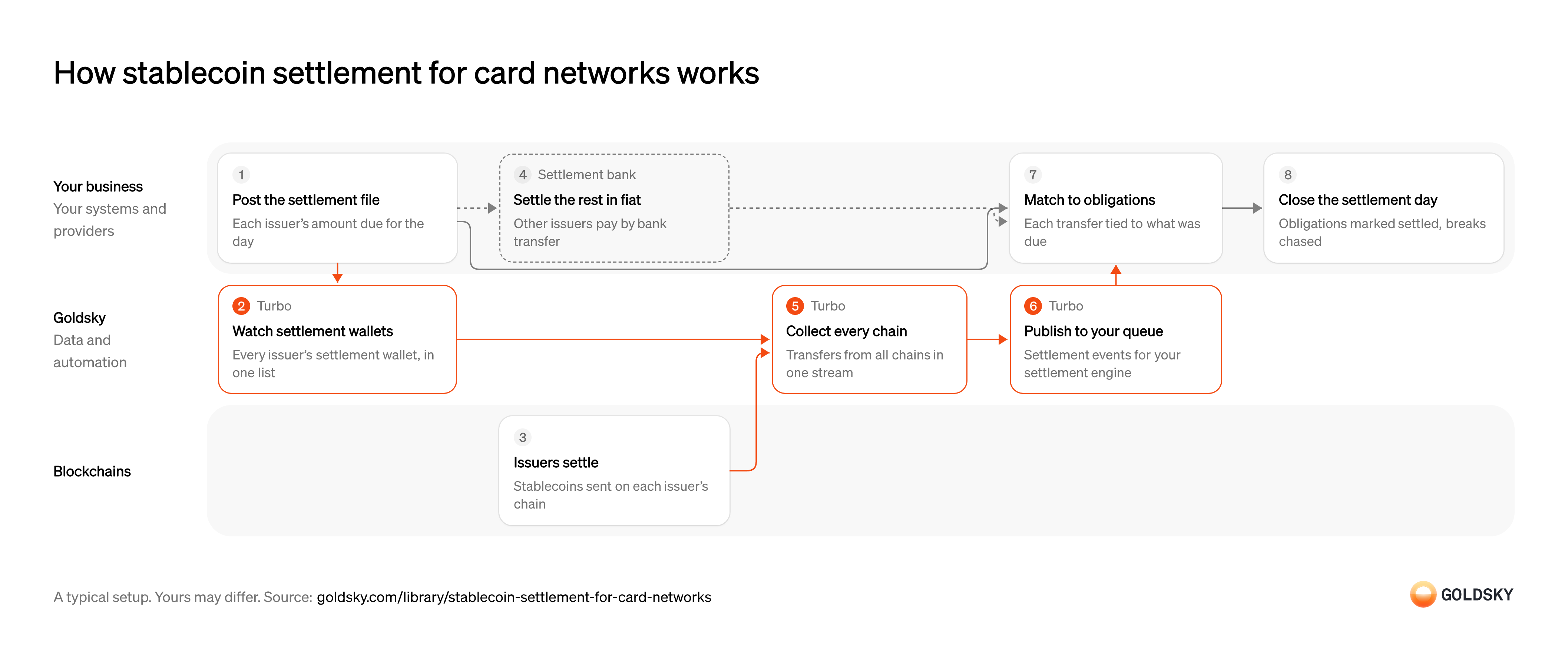
The diagram follows one settlement day from posting each issuer’s amount due to closing the day’s books. Your setup may differ.
Post each issuer’s amount due
Settlement starts with what each party owes for the day, so a transfer can be judged right or wrong.
Your settlement engine nets each issuer’s card activity into one amount due and posts it with the wallet and chain it should come from. Without a posted amount, a transfer that arrives can’t be checked. Issuer-processors building card programs that settle in stablecoins run this same step for the issuers they process.
Keep a list of every settlement wallet
Handled by Goldsky TurboYou only see settlements to wallets you watch, and issuers join and change wallets over time.
The list holds every settlement wallet on every chain, and it has to change without stopping anything. A wallet added late means its first settlement is missed.
Keep the list in a Turbo Pipelines dynamic table, which lives in a Postgres database. Add a row and the running pipeline starts matching that wallet, with no redeploy.
Learn about dynamic tables (opens in a new tab)Receive each issuer’s settlement
Issuers pay what they owe by sending stablecoins on the chain they settle on.
One day’s settlement can arrive on several chains, and in more than one currency: networks also settle euro obligations in EURC, a euro stablecoin, so each amount due names its currency as well as its chain. Each transfer sits in a block that a reorg can still replace for a short time.
Take fiat settlements from everyone else
Most issuers still settle by bank transfer, and the day can only close when both kinds of payment are in.
Your settlement bank reports each issuer’s bank payment against the same settlement day. Give fiat and stablecoin payments the same issuer and settlement-day keys, or the day’s obligations have to be matched twice.
Collect settlements from every chain
Handled by Goldsky TurboYour engine needs one stream of settlements, not one per chain.
Every transfer into a watched wallet is caught, tagged with its chain and recorded with the token, amount and transaction. A chain left out shows up as a missing payment at close.
One Turbo Pipelines pipeline can read the stablecoin transfer datasets of several chains, combine them with
Read several chains in one pipeline (opens in a new tab)UNION ALLand keep transfers to listed wallets withdynamic_table_check().Publish each movement to your queue
Handled by Goldsky TurboYour settlement engine reads settlement transfers from a queue it already consumes, so it books them in its own order and pace.
Each message needs a stable key, because delivery can repeat after a network error and your engine has to skip a message it already booked. When the chain replaces recent blocks, the engine also has to remove what it booked from them.
Goldsky’s Kafka sink publishes each row keyed on its ID, with a
Set up the Kafka sink (opens in a new tab)dbz.opheader that marks it as an insert, update or delete. A movement undone by a reorg arrives as a delete for your engine to apply.Match transfers to obligations
A transfer settles an obligation only once it’s tied to what that issuer owed.
Your engine matches each transfer to one issuer’s amount due by wallet, chain and amount. Short, late and unexpected payments are breaks someone has to explain.
Close the settlement day
The day is closed when every obligation is settled or has a named break.
Mark obligations settled, chase the breaks and post the day to the books. A day closed with an unexplained transfer carries the question into the next one.
What you control
- Your team
- Post each issuer’s amount due
- Match transfers to obligations
- Close the settlement day
- Your providers
- Settlement bank
Security and deployment
- SOC 2 Type IIIndependently audited security controls.
- Dedicated infrastructureSingle-tenant options for production workloads.
- Data residencyCloud, on-premises or co-located.
More use cases that settle across chains and currencies
- Stablecoin settlementSettle business, card-network and interbank payments in stablecoins or deposit tokens across chains.
- B2B cross-border payments in stablecoinsPay suppliers abroad in stablecoins and track each payment from send to off-ramp.
- Cross-chain transfer trackingSee every cross-chain stablecoin transfer as settled, in flight or stalled, and catch the stuck ones.
- Tokenized deposits for interbank settlementSettle payments between banks in tokenized deposits and tie each one to the core.
- Onchain FX between stablecoinsSwap between stablecoin currencies onchain and record the rate and settlement of each trade.
Use cases built the same way
- Stablecoin deposits to business bank accountsDetect stablecoin deposits into business bank and fintech accounts and post them to the account alongside fiat.
- Crypto exchange deposit detectionDetect deposits to each exchange user’s addresses, wait for enough confirmations and credit the user once.
- Post onchain transfers to your ledgerPost each confirmed onchain transfer to the fintech’s own ledger, corrected for reorgs.
- Stablecoin wallet top-upsCredit a user’s app balance when a stablecoin transfer to their embedded wallet confirms.
Settle card-network obligations in stablecoins with Goldsky
We’ll map it to your systems and show you what Goldsky runs, so your team builds the product, not the pipelines underneath it.
 Robinhood
 HyperEVM
 Arc
 Solana
 Ethereum
 Polymarket
 Base
 Tempo
 Bitcoin