Crypto client asset segregation
What is crypto client asset segregation?
Crypto client asset segregation is keeping a firm’s own crypto apart from the crypto it holds for clients, and being able to show which wallets and balances belong to whom on any date.
Custodians, exchanges and crypto banks run the check because an auditor or regulator can ask for the split on a date of their choosing, and the answer has to agree with the firm’s books.
Goldsky reads every labeled wallet’s balance at that date’s block and checks firm and client totals against your custodian’s figures and your books; your team owns the wallet labels, the books and the evidence you hand over.
Who needs crypto client asset segregation?
Crypto custodians, custodian banks, crypto exchanges and crypto-native banks that hold digital assets for clients alongside their own.
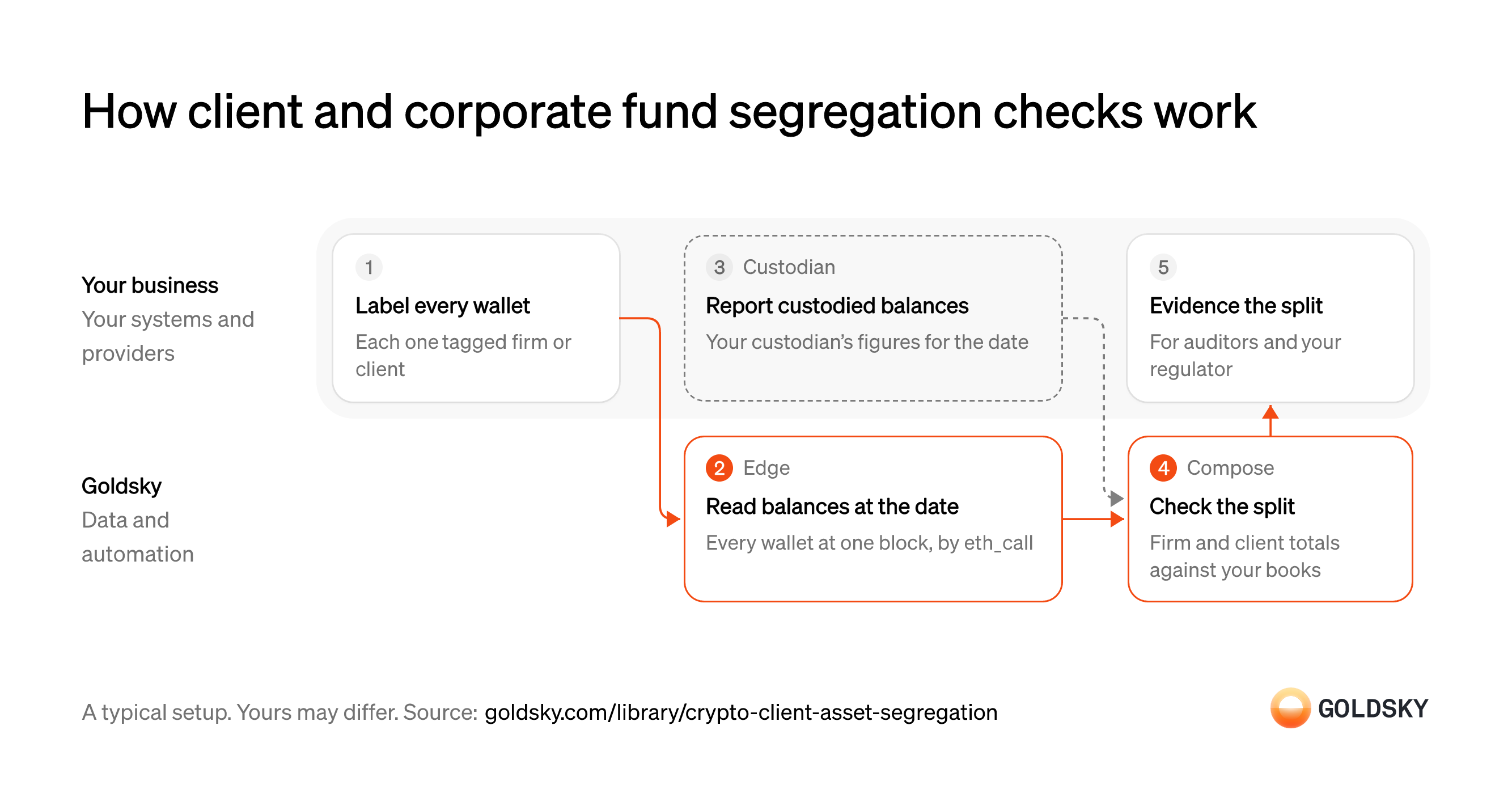
How client and corporate fund segregation checks work
The diagram follows one segregation check from labelling each wallet as firm or client to the evidence your team hands to auditors, and shows who does each step. Your setup may differ.
Label every wallet as firm or client
The split can only be shown if every wallet is known to belong to the firm or to clients.
Keep each wallet’s address, chain and label in one register, and update it the day a wallet is opened. An unlabeled wallet shows up as a balance nobody can place, and a mislabeled one moves client money into the firm’s column.
Read each wallet’s balance at the date
Handled by Goldsky EdgeBalances keep changing, so the check needs what each wallet held as of one agreed moment.
Pin the date to one block on each chain, then read every wallet’s balance of every asset at that block. Reading today’s balance for a past date gives a figure that never existed at the date being checked.
Edge RPC runs
Read state at a block (opens in a new tab)eth_callagainst any block number you pass, so abalanceOfcall returns each wallet’s balance as it stood at the date rather than now.Get the custodian’s balances for the date
Your custodian keeps its own record of what it holds, and the check compares against it.
Your custody provider reports each account’s balance for the same date. If its figures are for a different cut-off from the onchain read, every comparison shows a gap that isn’t real.
Check the split against your books
Handled by Goldsky ComposeFirm and client totals onchain have to agree with what the custodian reports and what your books say.
Total the balances by label, compare them with the custodian’s figures and your ledger, and record every difference with the inputs behind it. A check that only passes or fails, with no inputs kept, can’t answer an auditor’s follow-up questions.
With Goldsky, a Compose task can run on a schedule, fetch the custodian’s figures and your ledger with
Make recorded HTTP requests (opens in a new tab)ctx.fetch, and compare them with the onchain balances. Each fetch, its URL and its response are recorded on the task run.Evidence the split
Auditors and regulators ask to see that client assets were kept apart on the dates they choose.
Explain and clear every break, then keep each check’s balances, custodian figures and ledger totals together as one record per date. Evidence assembled by hand after the request arrives is slower to produce and harder to defend.
What you control
- Your team
- Label every wallet as firm or client
- Evidence the split
- Your providers
- Custodian
Security and deployment
- SOC 2 Type IIIndependently audited security controls.
- Dedicated infrastructureSingle-tenant options for production workloads.
- Data residencyCloud, on-premises or co-located.
More use cases that reconcile to your ledger
- Crypto reconciliationMatch onchain transfers, mints and burns to your ledger, core or reserves, and flag exceptions.
- Stablecoin invoice matchingMatch incoming stablecoin payments to invoices or customers and flag the ones that don’t match.
- Post onchain transfers to your ledgerPost each confirmed onchain transfer to the fintech’s own ledger, corrected for reorgs.
- Tokenized deposit tie-out to the core ledgerTie tokenized-deposit balances onchain to the bank’s core ledger each day.
- Stablecoin mint and burn tie-out to reservesMatch each mint and burn to a reserve movement for the monthly examination.
- Reconcile tokenized and book-entry positionsCheck that tokenized positions match the book-entry or custodial records they mirror.
- Onchain data for crypto accountingSend priced onchain activity to a crypto subledger so finance can close the books.
Evidence client and corporate fund segregation with Goldsky
We’ll map it to your systems and show you what Goldsky runs, so your team builds the product, not the pipelines underneath it.
 Robinhood
 HyperEVM
 Arc
 Solana
 Ethereum
 Polymarket
 Base
 Tempo
 Bitcoin