Stablecoin mint and burn tie-out to reserves
What it is
A stablecoin mint and burn tie-out matches every mint and burn of the token to the reserve movement behind it, also called stablecoin reserve reconciliation.
Stablecoin issuers and the platforms that issue for them run it because reserve rules such as the GENIUS Act and MiCA expect reserves to back every token in circulation, and an examiner will ask to see each event with its match.
Goldsky can record every mint and burn, fetch the matching cash movement from your custodian and flag any gap; your team keeps the reserves and answers the examiner.
Who it’s for
Stablecoin issuers, banks issuing under MiCA, branded stablecoin programs and the issuance platforms behind them.
How a mint and burn tie-out to reserves works
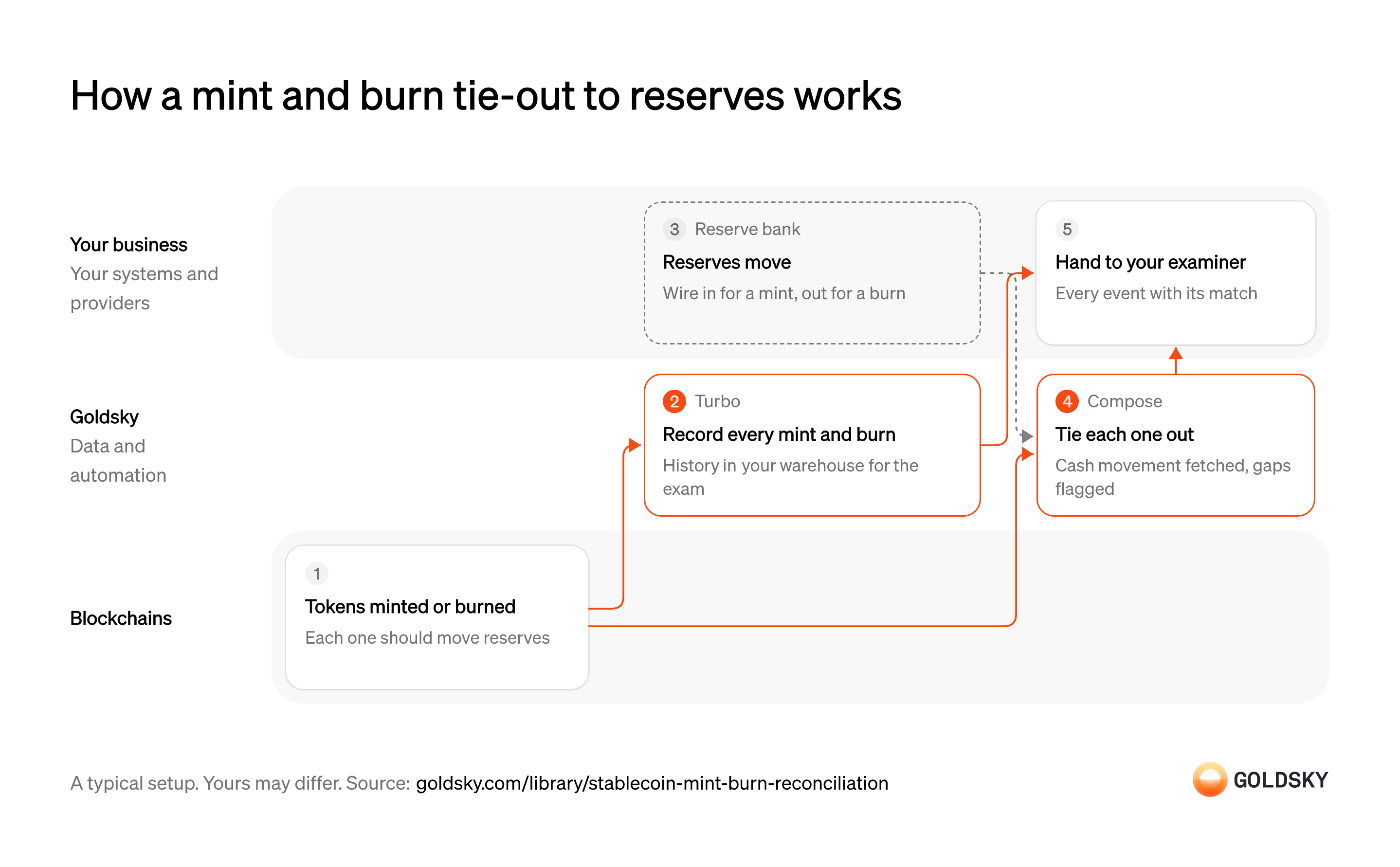
The diagram follows one mint or burn from the chain to the record you hand your examiner, and shows who does each step. Your setup may differ.
Mint or burn tokens
Every new token should be backed by cash that came in, and every burned token should match cash paid out.
Mints and burns are recorded on the chain as events from the token contract. Each one should have a reserve movement of the same amount, close to the same time.
Record every mint and burn
Handled by Goldsky TurboThe examination covers every event in the period, so you need a complete history you can query.
Decode each mint and burn with its amount, block, time and transaction hash and store it where finance and examiners can query it. A history rebuilt by hand before each exam is where gaps hide.
With Goldsky, a Turbo Pipelines pipeline decodes the token’s events with
Write events to S3 as Parquet (opens in a new tab)_gs_log_decodeand writes them as Parquet files to S3-compatible storage, which your warehouse can query.Move the reserves
The cash side of each mint or burn is booked by whoever holds the reserves.
Your reserve bank books the incoming payment for a mint or the outgoing payment for a burn. If the booking carries no reference to the onchain event, matching falls back to amount and time, and two same-sized events on one day can’t be told apart.
Tie each event to its reserve movement
Handled by Goldsky ComposeEach mint or burn is checked against the cash that should have moved with it.
For every event, fetch the matching movement from the custodian, compare amounts and record a match or a gap. A burn with no payout, or a mint with no deposit, is a reserve shortfall someone has to explain.
Goldsky Compose can run a task on each mint and burn through an onchain event trigger, fetch the custodian’s record with
Trigger a task on onchain events (opens in a new tab)fetchand log the comparison. Setconfirmationson the trigger so the task waits for the event’s block to settle, together withparallel_processing: true, which the confirmation hold needs; events then run side by side rather than in block order.Hand the record to your examiner
The examiner wants every event in the period with its matching reserve movement and any gap explained.
Export the period’s events with their matches, the gaps and how each was resolved. Totals you calculate for the report come from your warehouse, so they can be traced back to individual events.
What you control
- Your team
- Hand the record to your examiner
- Your providers
- Reserve bank
Security and deployment
- SOC 2 Type IIIndependently audited security controls.
- Dedicated infrastructureSingle-tenant options for production workloads.
- Data residencyCloud, on-premises or co-located.
More use cases that reconcile to your ledger
- Crypto reconciliationMatch onchain transfers, mints and burns to your ledger, core or reserves, and flag exceptions.
- Stablecoin invoice matchingMatch incoming stablecoin payments to invoices or customers and flag the ones that don’t match.
- Post onchain transfers to your ledgerPost each confirmed onchain transfer to the fintech’s own ledger, corrected for reorgs.
- Tokenized deposit tie-out to the core ledgerTie tokenized-deposit balances onchain to the bank’s core ledger each day.
- Reconcile tokenized and book-entry positionsCheck that tokenized positions match the book-entry or custodial records they mirror.
- Onchain data for crypto accountingSend priced onchain activity to a crypto subledger so finance can close the books.
- Crypto client asset segregationShow which wallets and balances belong to the firm and which to clients, at any date.
Use cases built the same way
- Continuous proof of reservesCompare onchain supply with reported reserves on a schedule, then publish the ratio or alert on a gap.
- Security token recovery for lost walletsRecord when an issuer reissues a lost security token to a new wallet after identity checks.
- Keep tokenized stocks backed one to oneCheck token supply on every chain against the shares or fund units held in custody, and alert on any gap.
Tie out stablecoin mints and burns to reserves with Goldsky
We’ll map it to your systems and show you what Goldsky runs, so your team builds the product, not the pipelines underneath it.
 Robinhood
 HyperEVM
 Arc
 Solana
 Ethereum
 Polymarket
 Base
 Tempo
 Bitcoin