Reconcile tokenized and book-entry positions
What it is
Reconciling tokenized and book-entry positions means checking, holder by holder, that the token balances on the chain match the book-entry or custody records the tokens mirror; it’s securities position reconciliation with a token on one side.
Transfer agents, tokenization platforms and custodian banks run it because either record can drift, through a transfer the books missed or a booking with no transfer behind it, and the official record has to be right.
Goldsky can rebuild every holder’s balance at the cutoff, compare it with the positions your transfer agent or custodian sends and flag each break; resolving it stays with whoever keeps the books.
Who it’s for
Transfer agents, tokenization platforms, custodian banks and market infrastructure firms that keep a book-entry record next to a token.
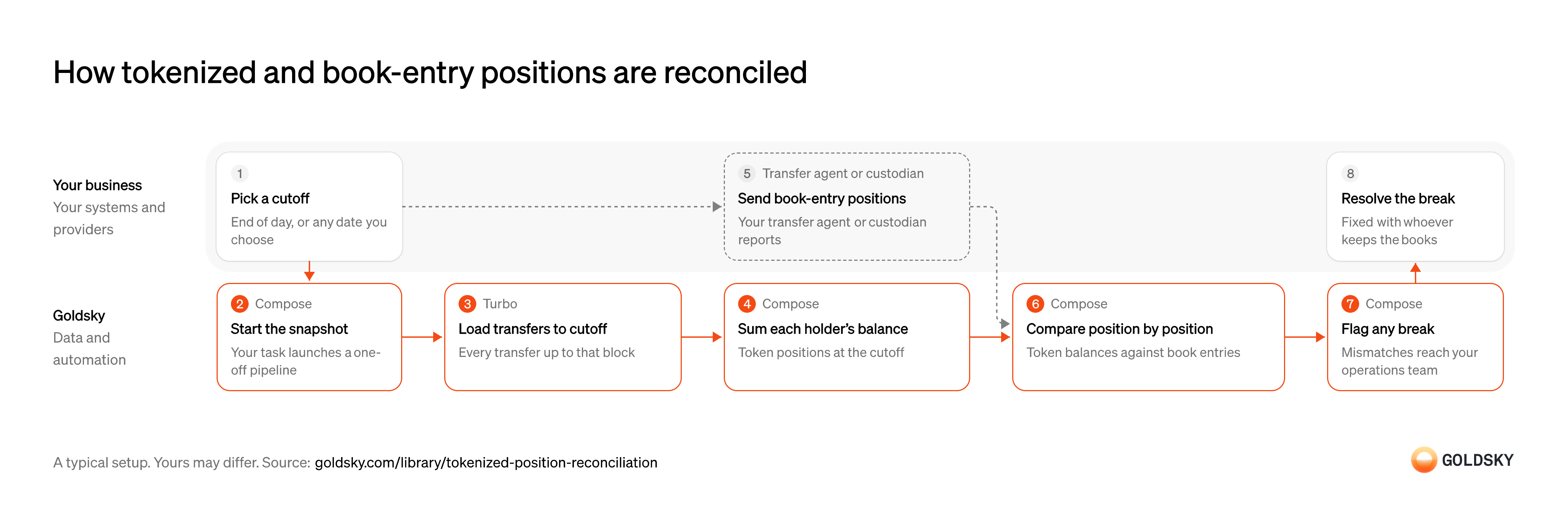
How tokenized and book-entry positions are reconciled
The diagram follows one reconciliation from the cutoff you pick to the break your team resolves, and shows who does each step. Your setup may differ.
Pick the cutoff
Both records have to be compared at the same moment, so the reconciliation starts with an agreed cutoff.
Choose the cutoff, usually end of day, and the block on the token’s chain that matches it. If the books and the snapshot use different cutoffs, transfers in between show up as breaks.
Start the snapshot
Handled by Goldsky ComposeThe token side is rebuilt fresh for each cutoff, so nothing needs to run between reconciliations.
The run starts a backfill bounded at the cutoff block and waits for it to finish. A backfill still running when the comparison starts reports holders with missing transfers.
With Goldsky, a Compose task can start a Turbo Pipelines job with
Manage pipelines from a task (opens in a new tab)turbo.createJob, poll it until it completes and delete it afterwards.Load every transfer up to the cutoff
Handled by Goldsky TurboA holder’s balance at the cutoff is the sum of every transfer in and out of their wallet up to that block.
Load the token’s full transfer history from its first block to the cutoff block, with nothing after it. Missing early history understates every balance it touches.
Turbo Pipelines job mode runs the backfill once and exits, with the token address and a
Run a one-time backfill job (opens in a new tab)block_numberbound in the source filter so the job stops at the cutoff.Sum each holder’s balance at the cutoff
Handled by Goldsky ComposeThe reconciliation compares positions, so the transfers become one balance per holder.
Add up credits less debits for each wallet and drop wallets with a zero balance. Mints and burns move to and from the zero address, which has to be left out of the holder list.
The job writes the transfers to the Postgres database behind your Compose app, and the task sums each holder’s credits and debits there with a SQL query, the same way Goldsky’s corporate-actions guide builds its holder snapshot.
Run SQL from a task (opens in a new tab)Report book-entry positions at the cutoff
The other side of the reconciliation is the official record the token mirrors.
Your transfer agent or custodian reports each account’s position as of the same cutoff. Positions reported at a different time, or without an account reference you can map to a wallet, can’t be compared one to one.
Compare position by position
Handled by Goldsky ComposeEach holder’s token balance should equal their book-entry position.
Map each wallet to its account and compare the two balances, in the same units. A holder present on only one side is a break as much as a holder whose balances differ.
Compose reads the book-entry positions from your provider’s API with
Make auditable requests with fetch (opens in a new tab)fetch, and each request and response is recorded in the task’s run alongside the comparison.Flag every break
Handled by Goldsky ComposeEach mismatch needs someone who can look at both records.
Send each break with the holder, both balances and the cutoff. A list of differences with no inputs means rebuilding the check before investigating it.
The same Compose task posts the breaks to your operations endpoint, and its run log keeps the snapshot, the positions it fetched and the result together.
How Compose logs each run (opens in a new tab)Resolve the break
The official record has to be right, so every break ends with one side corrected.
Your team works with whoever keeps the books to find the transfer or booking one side missed. Fix the record that’s wrong; changing the token to match a booking error moves the problem instead of solving it.
What you control
- Your team
- Pick the cutoff
- Resolve the break
- Your providers
- Transfer agent or custodian
Security and deployment
- SOC 2 Type IIIndependently audited security controls.
- Dedicated infrastructureSingle-tenant options for production workloads.
- Data residencyCloud, on-premises or co-located.
More use cases that reconcile to your ledger
- Crypto reconciliationMatch onchain transfers, mints and burns to your ledger, core or reserves, and flag exceptions.
- Stablecoin invoice matchingMatch incoming stablecoin payments to invoices or customers and flag the ones that don’t match.
- Post onchain transfers to your ledgerPost each confirmed onchain transfer to the fintech’s own ledger, corrected for reorgs.
- Tokenized deposit tie-out to the core ledgerTie tokenized-deposit balances onchain to the bank’s core ledger each day.
- Stablecoin mint and burn tie-out to reservesMatch each mint and burn to a reserve movement for the monthly examination.
- Onchain data for crypto accountingSend priced onchain activity to a crypto subledger so finance can close the books.
- Crypto client asset segregationShow which wallets and balances belong to the firm and which to clients, at any date.
Use cases built the same way
- Continuous proof of reservesCompare onchain supply with reported reserves on a schedule, then publish the ratio or alert on a gap.
- Keep tokenized stocks backed one to oneCheck token supply on every chain against the shares or fund units held in custody, and alert on any gap.
- Keep gold and commodity tokens backedKeep gold and other commodity tokens matched to vaulted holdings, and alert on any gap.
- Wrapped bitcoin reserve monitoringCheck a wrapped bitcoin token’s supply on every chain against the BTC at its custodian’s reserve addresses, and alert on any gap.
Reconcile tokenized and book-entry positions with Goldsky
We’ll map it to your systems and show you what Goldsky runs, so your team builds the product, not the pipelines underneath it.
 Robinhood
 HyperEVM
 Arc
 Solana
 Ethereum
 Polymarket
 Base
 Tempo
 Bitcoin