Tokenized deposit tie-out to the core ledger
What is a tokenized deposit tie-out?
A tokenized deposit tie-out is the daily check that the deposit tokens on the chain add up to the deposit balances in the bank’s core ledger, also called tokenized deposit reconciliation.
Banks that issue deposit tokens run it at each close, because a token balance with no matching deposit, or the reverse, is a break that operations has to explain before the next business day.
Goldsky can start the check when your close finishes, read total supply at the cutoff block, compare it with the core and flag the difference; your core ledger and the fix stay with your team.
Who runs a tokenized deposit tie-out?
Banks that issue tokenized deposits, including crypto-native banks, custodian banks and global banks.
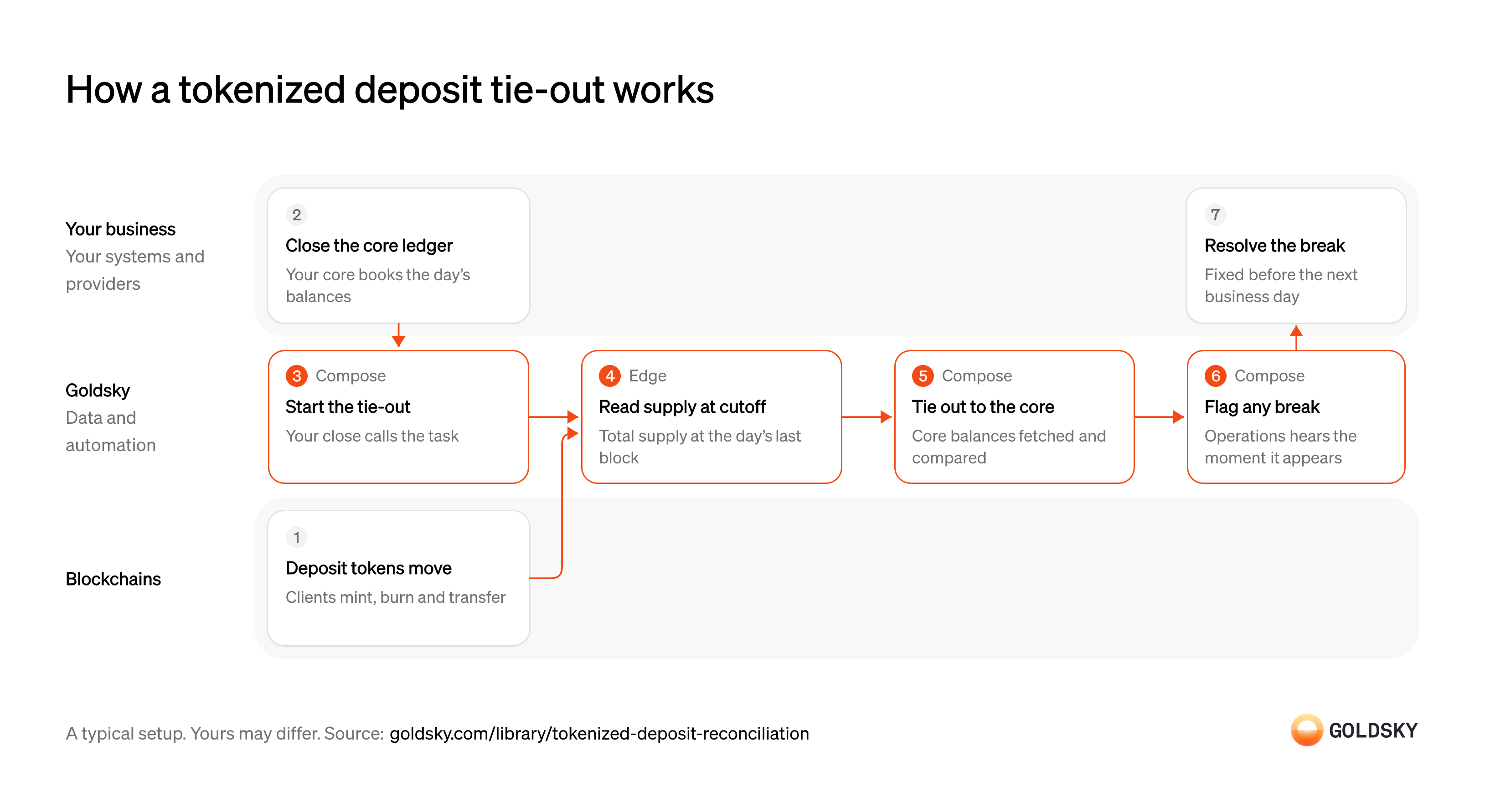
How a tokenized deposit tie-out works
The diagram follows one day’s tie-out from the deposit tokens moving on the chain to the break your team resolves, and shows who does each step. Your setup may differ.
Move deposit tokens on the chain
Clients mint, burn and transfer deposit tokens through the day, and each mint or burn should change the core balance by the same amount.
The chain records every mint, burn and transfer. Total supply at any block is the amount of tokenized deposits outstanding at that moment.
Close the core ledger for the day
The tie-out compares two records at one moment, so the core has to settle its numbers first.
Your core books the day’s balances for the deposits that back the tokens, as of a cutoff time. Pick the cutoff once and record which block it maps to, or the two sides are measured at different moments and every day shows a break.
Start the tie-out when the close finishes
Handled by Goldsky ComposeRunning the check as soon as the core closes gives operations the whole next morning to fix a break.
The close calls the tie-out with the business date and the cutoff. A tie-out started on a fixed timer can run before the close finishes and report breaks that aren’t real.
With Goldsky, the tie-out is a Compose task with an HTTP trigger that your close process calls with the date and cutoff in the payload.
Start a task from an HTTP trigger (opens in a new tab)Read total supply at the cutoff block
Handled by Goldsky EdgeThe onchain side of the tie-out is how many deposit tokens existed at the cutoff.
Read supply at the exact block that matches the cutoff, not the latest block, or tokens minted after the close count against yesterday’s balances.
The task can call
Read contract state with eth_call (opens in a new tab)eth_callon Edge RPC with the token’stotalSupply()and the cutoff block number, so the read is pinned to that block.Compare supply with the core balances
Handled by Goldsky ComposeThe tie-out passes when the tokens outstanding equal the deposits the core holds for them.
Fetch the core’s total for the same cutoff and compare it with supply, in the same units. A token with six decimals compared with a core balance in cents shows a break that isn’t one.
Compose fetches the core’s balances from your API with
Make auditable requests with fetch (opens in a new tab)fetch, which retries a failed read and records each request and response in the task’s run.Flag any break
Handled by Goldsky ComposeA difference between the token and the core is a break that someone has to explain.
Send the break with both figures, the cutoff and the block to the people who own the fix. A break reported without its inputs means someone rebuilds the check by hand before they can start on the cause.
Goldsky Compose posts the break to your alert endpoint from the same task, and the run’s log keeps the supply read, the core figures and the result side by side.
How Compose logs each run (opens in a new tab)Resolve the break
The books have to agree before the next business day starts.
Your operations team traces the difference to a mint, burn or booking that one side missed and corrects the side that’s wrong. A break carried into the next day mixes with that day’s activity and gets harder to trace.
What you control
- Your team
- Close the core ledger for the day
- Resolve the break
Questions and answers
What are tokenized deposits?
Tokenized deposits are bank deposits recorded on a blockchain or similar distributed ledger instead of, or as well as, the bank’s traditional ledger. They stay deposits: a claim on the bank that is repayable at par and can pay interest. In the cases EU bank regulators have observed, each token is tied to the account holder rather than passing freely from holder to holder like a stablecoin. Where the tokens mirror balances still kept in the core ledger, the two records have to be reconciled, which is what the tie-out does.
Security and deployment
- SOC 2 Type IIIndependently audited security controls.
- Dedicated infrastructureSingle-tenant options for production workloads.
- Data residencyCloud, on-premises or co-located.
More use cases that reconcile to your ledger
- Crypto reconciliationMatch onchain transfers, mints and burns to your ledger, core or reserves, and flag exceptions.
- Stablecoin invoice matchingMatch incoming stablecoin payments to invoices or customers and flag the ones that don’t match.
- Post onchain transfers to your ledgerPost each confirmed onchain transfer to the fintech’s own ledger, corrected for reorgs.
- Stablecoin mint and burn tie-out to reservesMatch each mint and burn to a reserve movement for the monthly examination.
- Reconcile tokenized and book-entry positionsCheck that tokenized positions match the book-entry or custodial records they mirror.
- Onchain data for crypto accountingSend priced onchain activity to a crypto subledger so finance can close the books.
- Crypto client asset segregationShow which wallets and balances belong to the firm and which to clients, at any date.
Use cases built the same way
- Continuous proof of reservesCompare onchain supply with reported reserves on a schedule, then publish the ratio or alert on a gap.
- Tokenized money market funds in stablecoin reservesTrack stablecoin reserves held as tokenized money market fund shares and check them against the reserve record.
- Sponsored gas spendTotal the gas you pay for your users per user, paymaster and day, watch the paymaster’s deposit and check the provider’s bill.
- Keep tokenized stocks backed one to oneCheck token supply on every chain against the shares or fund units held in custody, and alert on any gap.
Tie out tokenized deposits to the core ledger with Goldsky
We’ll map it to your systems and show you what Goldsky runs, so your team builds the product, not the pipelines underneath it.
 Robinhood
 HyperEVM
 Arc
 Solana
 Ethereum
 Polymarket
 Base
 Tempo
 Bitcoin