Optimize your RPC endpoints and cut RPC costs
What it is
Automatically optimizing your RPC endpoints means putting an RPC CDN in front of your existing RPC provider that answers reads for blocks, transactions, receipts and logs from indexed data and forwards everything else.
Indexers, risk vendors and wallet backends use it because they read the same historical data again and again, and each of those reads is a billable RPC call.
Goldsky’s Boost answers the reads it can from Goldsky’s indexed data and forwards state reads, traces and writes to your provider, so you lower billable RPC calls while keeping your provider, your client code and the decision about which calls to route.
You can optimize your RPC endpoints two ways: put Boost, an RPC CDN, in front of your current provider so indexed reads are answered before they reach it, or move your calls to Edge RPC.
Who it’s for
Chain teams, transaction-monitoring and risk vendors, and wallet and custody platforms whose backends make a large volume of historical RPC reads.
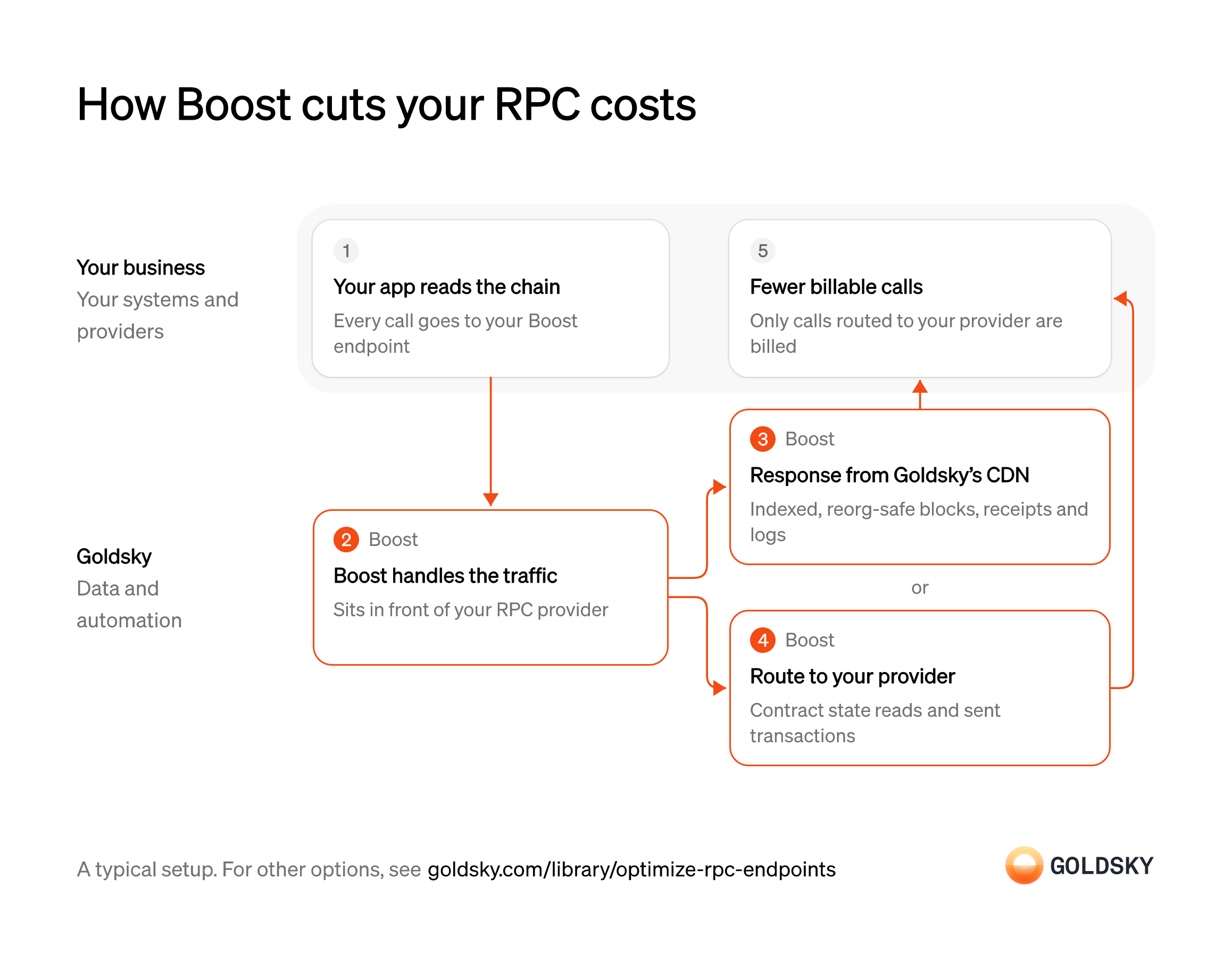
How Boost cuts your RPC costs
The diagram follows your app’s RPC calls through Boost, and shows which get a response from Goldsky’s CDN and which go on to your provider. Your setup may differ.
Ways to optimize your RPC endpoints
Boost sits in front of the provider you already use and forwards whatever it can’t serve, while moving to Edge RPC replaces that provider and its failover.
- Best for
- Read-heavy backends that keep their current provider
- Products
- Boost
- What you run
- Your current RPC provider
- What you write
- One URL change
- Best for
- Teams replacing their provider and its failover in one move
- Products
- Edge
- What you run
- Your own client code
- What you write
- JSON-RPC calls, and the decoding of what comes back
| Usual setupOption 1: RPC CDN in front of your provider | Option 2: Move to Goldsky’s RPC | |
|---|---|---|
| Best for | Read-heavy backends that keep their current provider | Teams replacing their provider and its failover in one move |
| Products | Boost | Edge |
| What you run | Your current RPC provider | Your own client code |
| What you write | One URL change | JSON-RPC calls, and the decoding of what comes back |
Find which calls cost you the most
Boost only lowers billable calls for reads it can answer, so you need to know what your app sends.
Count your calls by method and block tag from your provider’s usage report or your own logs. Calls for fixed blocks, receipts and log ranges are the ones Boost can answer; state reads and traces stay with the provider.
Send reads through Boost
Handled by Goldsky BoostBoost can only answer calls that reach it.
Point each service’s RPC URL at Boost and give Boost your provider’s endpoint as its upstream. Services left on the old URL keep sending every call to the provider, so list every place the URL is set.
Boost keeps the same JSON-RPC interface, so your app swaps its RPC URL for a Boost URL and Boost uses your project’s configured provider as the upstream.
How Boost fits into your stack (opens in a new tab)Answer historical reads from indexed data
Handled by Goldsky BoostReads for blocks, receipts and logs that already exist give the same response every time, so they don’t need to reach a paid provider.
A read can be served from indexed data only when it names a fixed block, a hash or the latest block. Ranges written with tags such as
finalizedcan’t be answered from indexed data, so rewriting them with block numbers moves more calls off the provider.Goldsky’s Boost serves
Which calls Boost serves (opens in a new tab)eth_getBlockByNumber,eth_getTransactionReceipt,eth_getLogswith concrete heights and similar reads from Goldsky’s indexed data, which follows the chain through reorgs. Traces,eth_calland other state reads still go to your provider.Route the rest to your provider
Handled by Goldsky BoostState reads, traces and writes need a live node, so they still go to the provider you pay.
Calls that can’t be served from indexed data are forwarded with the same method, parameters and ID, and the response comes from your provider. If the provider is down, those calls fail as they would without Boost.
Boost forwards
Which calls Boost forwards (opens in a new tab)eth_call, traces, transaction sends and any other call it can’t serve from indexed data to the provider set as your project’s upstream.Lower your RPC bill
Every read served from indexed data is a call your provider no longer bills.
Your provider now sees only the calls routed to it: state reads, traces and writes. With usage-based pricing, your bill falls with that call count, and the more of your traffic is historical reads, the larger the drop.
What to know about an RPC CDN
- You keep your provider and contract; state reads, traces, writes and
pending,safeorfinalizedtags still reach it. - Only reads with a concrete block height or hash, or
lateston block lookups, can be answered from indexed data. - Response headers show which calls Boost answered, so you can measure the change on your own traffic.
List the chains and methods you call
A move only works if the new provider serves everything your app sends.
Pull the chains, methods and any WebSocket subscriptions from your logs or provider report. A method you didn’t list is the one that breaks after the switch.
Point your services at the new endpoint
Handled by Goldsky EdgeCalls move only when each service’s RPC URL changes.
Change the URL service by service, starting with one that reads history, and compare responses with the old provider before moving the rest. Code that relies on WebSocket subscriptions needs rewriting to poll.
Edge RPC takes standard JSON-RPC over HTTPS; to watch the chain without WebSocket, it supports polling with
Edge RPC transport and methods (opens in a new tab)eth_newFilterandeth_getFilterChanges.Serve reads and writes with failover
Handled by Goldsky EdgeOnce you’ve moved, there’s no second provider behind your app unless the new one fails over itself.
The endpoint has to respond when one node lags or fails, and log queries have to come back complete. A provider that returns partial logs without an error gives your app silently wrong data.
With Goldsky, Edge RPC fails over across upstream nodes, cross-checks their responses and merges identical requests from many users into one upstream call.
How Edge RPC handles failover (opens in a new tab)Retire the old provider
The saving arrives only when the old contract stops billing.
Once traffic has run on the new endpoint long enough to trust it, remove the old URLs and end the contract by its terms. Leaving one service on the old provider keeps the bill alive.
What to know about moving to a different RPC provider
- Goldsky runs the provider layer and the failover between nodes; you no longer manage a provider contract alongside it.
- Every call moves, including writes and state reads, so check each chain and method you use is covered.
- Edge RPC is served over HTTPS only, so code that subscribes over WebSocket has to poll with filter methods.
What you control
- Your team
- Find which calls cost you the most
- Lower your RPC bill
Security and deployment
- SOC 2 Type IIIndependently audited security controls.
- Dedicated infrastructureSingle-tenant options for production workloads.
- Data residencyCloud, on-premises or co-located.
More use cases that access chains reliably
- Archive node RPCRead any past state through archive RPC.
- Archive RPC and indexing for a new chainGive a new chain archive RPC and indexing from mainnet day one.
- RPC and indexed data for a payments blockchainProvide RPC and indexed data for a chain run by a fintech.
- Improve RPC uptime and reliability with failoverRun a second data provider behind the incumbent and fail over when it drops data.
- Improve blockchain data API reliability and coverageKeep wallet balances, transfers and token prices arriving when a third-party blockchain data API has an outage, rate limits you, lacks a chain or returns wrong balances.
- Improve subgraph uptime and reliability with failoverKeep app screens up when a hosted subgraph lags, stops syncing or goes down, with a backup to fail queries over to.
- Improve blockchain webhook reliabilityKeep onchain event notifications arriving at your backend, with retries, reorg corrections and a backup feed.
Optimize your RPC endpoints and cut RPC costs with Goldsky
We’ll map it to your systems and show you what Goldsky runs, so your team builds the product, not the pipelines underneath it.
 Robinhood
 HyperEVM
 Arc
 Solana
 Ethereum
 Polymarket
 Base
 Tempo
 Bitcoin