Archive RPC and indexing for a new chain
What is archive RPC and indexing for a new chain?
Archive RPC and indexing for a new chain is the data access a chain team arranges before mainnet: an RPC endpoint that serves every block back to genesis, plus indexed data that apps can query, sometimes called rollup or appchain infrastructure.
Chain teams set it up because builders decide where to launch partly on whether they can read the chain on the first day without running their own nodes.
Goldsky serves RPC through Edge RPC, streams the chain’s history with Turbo Pipelines and hosts subgraphs for builders, while the chain team runs the chain itself and decides what its builders get.
You can give a new chain archive RPC and indexing two ways: serve RPC and host subgraphs for builders, or serve RPC and stream the chain into your own database.
Who uses archive RPC and indexing for a new chain?
Layer 1 and layer 2 teams, rollup and appchain operators, and foundations preparing a mainnet launch for their builders.
How archive RPC and indexing for a new chain work
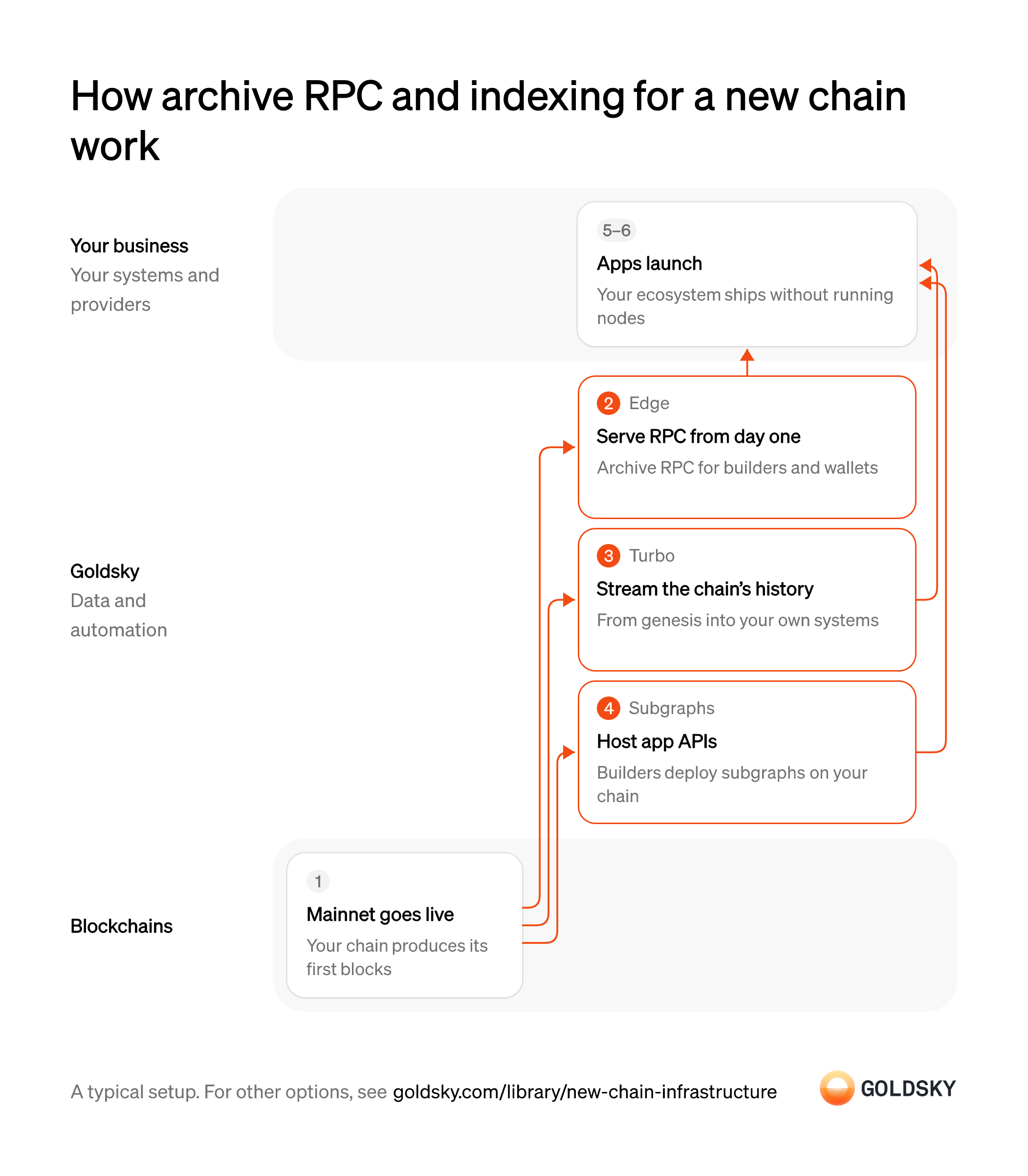
The diagram follows a chain from its first mainnet blocks to the first apps launching on it, and shows who serves each kind of data in between. Your setup may differ.
Ways to give a new chain archive RPC and indexing
Hosted subgraphs let each builder deploy and query a GraphQL API of their own, while streaming lands the chain’s history in a database the chain team owns and serves from its own API.
- Best for
- A new EVM chain whose builders want indexed APIs on day one
- What you run
- Your own client code
- What you write
- JSON-RPC calls, and the decoding of what comes back
- Where your data lives
- Read from the chain
- How results reach you
- Returned when you call
- Best for
- A chain team that owns its indexed data and serves its own API
- What you run
- The destination: your database, queue or bucket, or a Postgres database Goldsky hosts
- What you write
- Pipeline YAML and SQL; TypeScript transforms when needed
- Where your data lives
- In your own database or systems
- How results reach you
- Pushed to you
| Usual setupOption 1: RPC and hosted subgraphs | Option 2: RPC and your own database | |
|---|---|---|
| Best for | A new EVM chain whose builders want indexed APIs on day one | A chain team that owns its indexed data and serves its own API |
| Products | EdgeTurboSubgraphs | EdgeTurbo |
| What you run | Your own client code | The destination: your database, queue or bucket, or a Postgres database Goldsky hosts |
| What you write | JSON-RPC calls, and the decoding of what comes back | Pipeline YAML and SQL; TypeScript transforms when needed |
| Where your data lives | Read from the chain | In your own database or systems |
| How results reach you | Returned when you call | Pushed to you |
Open mainnet
Nothing can be read or indexed until the chain is producing blocks that builders and users treat as real.
Your validators or sequencer produce blocks from genesis onward, and at least one archive node keeps every past state. If the archive is missing or incomplete, anything that needs old blocks, from an indexer’s backfill to a wallet’s history screen, has nothing to read.
Serve archive RPC to builders and wallets
Handled by Goldsky EdgeRPC is how wallets, apps and tools talk to a chain: every balance read, transaction lookup and submitted payment goes through it.
Builders need an endpoint that serves the newest block and every block back to genesis, and that keeps responding when one node falls over. If the only endpoint is a single node the chain team runs, every builder’s app goes down with it.
Goldsky’s Edge RPC serves the chain over HTTPS with automatic failover across several upstream nodes, routes requests for old blocks to archive nodes and splits large
What Edge RPC serves (opens in a new tab)eth_getLogsranges so indexers get complete results.Stream the chain’s history from genesis
Handled by Goldsky TurboExplorers, dashboards and the chain team’s own reports need every block and event since launch in a database, not only the latest state.
The copy has to start at the first block and keep following the tip, including when the newest blocks are replaced in a reorg (the chain swapping its most recent blocks for another version). A copy that starts late or ignores reorgs gives the chain team numbers that don’t match the chain.
With Turbo Pipelines, an Edge EVM source can read any EVM chain through Edge RPC from
Stream any EVM chain from genesis (opens in a new tab)start_at: earliestand write blocks, transactions and logs to your database, with reorg corrections applied to tables keyed on aprimary_key.Let builders deploy subgraphs on the chain
Handled by Goldsky SubgraphsMost apps need their own contracts’ events in a form they can query, which is what a subgraph (a schema plus code that turns events into records) gives them.
Builders deploy their subgraph against the chain and get a GraphQL endpoint for it. Without hosted indexing, each team runs its own indexer and node before it can ship, and a decentralized indexing network may need community testing and a governance vote before it indexes a new chain.
Goldsky Subgraphs supports custom EVM chains, so builders can deploy to your chain with
How Subgraphs index a chain (opens in a new tab)goldsky subgraph deployand query the hosted GraphQL API that comes back.Tell builders where the data is
Endpoints only help if developers can find them on the first day.
Publish the RPC URL, the chain ID and how to deploy a subgraph in your developer docs before mainnet opens. If builders learn about them after launch, the first apps ship late or not at all.
Launch apps on the chain
A chain’s value to its users is the apps built on it.
Builders point their apps at the RPC endpoint and their subgraph APIs and ship without running nodes. Your team watches usage from the chain’s own history and fixes gaps that builders report.
What to know about launching with hosted subgraphs
- Goldsky runs the RPC layer and hosts the subgraphs; the chain team runs the chain and its archive nodes.
- Each builder writes and deploys their own subgraph, so the indexed API matches their contracts and nobody waits on the chain team.
- Subgraphs give builders a GraphQL API to query, while the chain team’s own copy of the history comes from the pipeline.
Open mainnet
Nothing can be read or indexed until the chain is producing blocks that builders and users treat as real.
Your validators or sequencer produce blocks from genesis onward, and at least one archive node keeps every past state. If the archive is missing or incomplete, anything that needs old blocks, from an indexer’s backfill to a wallet’s history screen, has nothing to read.
Serve archive RPC to builders and wallets
Handled by Goldsky EdgeRPC is how wallets, apps and tools talk to a chain: every balance read, transaction lookup and submitted payment goes through it.
Builders need an endpoint that serves the newest block and every block back to genesis, and that keeps responding when one node falls over. If the only endpoint is a single node the chain team runs, every builder’s app goes down with it.
Goldsky’s Edge RPC serves the chain over HTTPS with automatic failover across several upstream nodes, routes requests for old blocks to archive nodes and splits large
What Edge RPC serves (opens in a new tab)eth_getLogsranges so indexers get complete results.Backfill the chain’s history from genesis
Handled by Goldsky TurboEverything your API will return about the past depends on a complete copy of the chain since launch.
The backfill has to cover every block from the first one, so it needs an archive node behind it. A gap of even a few blocks shows up later as missing transactions that nobody can explain.
A Turbo Pipelines job with an Edge EVM source can read a fixed range from
Run a one-time backfill job (opens in a new tab)start_at: earliestto anend_atblock, write it to your database and exit once the range is done.Keep the database following the chain
Handled by Goldsky TurboAfter the backfill, new blocks keep arriving, and your copy has to keep up and stay correct.
Each new block’s transactions and events have to land in the same tables, and a reorg has to update or remove rows that no longer exist on the chain. If reorgs aren’t applied, your API serves transactions that were dropped.
Goldsky keeps a long-running pipeline streaming new blocks into the same tables, and Turbo Pipelines passes reorg corrections through as updates and deletes to any sink with a
How reorgs reach your tables (opens in a new tab)primary_key.Serve the indexed data from your own API
Builders need a way to query the data you hold, such as an explorer, a REST API or a GraphQL layer.
Your team builds and runs the API on top of the database and decides what it exposes. If it can’t keep up with builders’ traffic, their apps slow down with it, so it needs the same care as any production service.
Launch apps on the chain
A chain’s value to its users is the apps built on it.
Builders point their apps at the RPC endpoint and your API and ship without running nodes. Your team watches usage in its own tables and adds the fields builders ask for.
What to know about streaming a new chain into your database
- The chain team owns the tables and the API on top of them, and runs that API.
- The pipeline’s SQL decides which columns each table holds, so the schema is yours.
- Tables with a primary key take reorg corrections as updates and deletes; an append-only destination such as a queue receives correction records and has to apply them.
Related jobs
Pick the chains and data to index
An explorer can only show what it has indexed, so start from what users look up.
List the chains, and for each the blocks, transactions, logs and traces you’ll show. Traces record internal calls between contracts, and leaving them out means value moved by a contract never appears on an address page.
Load every block since genesis
Handled by Goldsky TurboUsers look up old transactions as often as new ones, so the index has to start at the first block.
An index that starts late shows addresses with missing transactions. A backfill from the first block needs archive data, because ordinary nodes drop old state.
Goldsky’s Turbo Pipelines Edge EVM datasets stream blocks, transactions, logs and traces from any EVM chain through Edge RPC, which routes historical requests to archive nodes, starting from
Stream any EVM chain (opens in a new tab)earliestand carrying on at the chain tip.Keep up with new blocks and reorgs
Handled by Goldsky TurboAn explorer that lags, or still shows a block the chain dropped, gives users the wrong answer.
New blocks have to land within moments, and blocks the chain replaces in a reorg have to disappear from search. Rows keyed on a block hash or log ID let each correction update the right row.
Each Edge EVM row carries a
See how reorgs reach your database (opens in a new tab)_gs_opcolumn,cfor an insert anddfor a delete when a reorg orphans it, and a Postgres sink with aprimary_keyapplies both, so the database converges to the canonical chain.Decode contract events
Users want to read “transfer of 100 tokens to this address”, not encoded log data.
Your explorer decodes logs and calls with each contract’s ABI or verified source, so pages show event names and fields. Contracts nobody has verified stay raw until someone does.
Serve search and pages
An explorer is only useful if any address, transaction or block comes up quickly.
Your database indexes the tables for lookups by hash, address and block, and your API serves the pages. Balances and contract state change with every block, so read them live rather than from the index.
Read live state over RPC
Handled by Goldsky EdgeCurrent balances and contract reads come straight from the chain.
Pages call the chain for balances, contract code and reads at the latest block. A single provider that falls behind leaves every page showing stale numbers.
With Goldsky, Edge RPC serves those calls over HTTPS, fails over across several upstream providers and cross-validates their responses.
See how Edge RPC fails over (opens in a new tab)
What you control
- Your team
- Tell builders where the data is
- Launch apps on the chain
Security and deployment
- SOC 2 Type IIIndependently audited security controls.
- Dedicated infrastructureSingle-tenant options for production workloads.
- Data residencyCloud, on-premises or co-located.
More use cases that access chains reliably
- Archive node RPCRead any past state through archive RPC.
- RPC and indexed data for a payments blockchainProvide RPC and indexed data for a chain run by a fintech.
- Improve RPC uptime and reliability with failoverRun a second data provider behind the incumbent and fail over when it drops data.
- Optimize your RPC endpoints and cut RPC costsAutomatically optimize your RPC endpoints and lower billable calls while keeping your current provider.
- Improve blockchain data API reliability and coverageKeep wallet balances, transfers and token prices arriving when a third-party blockchain data API has an outage, rate limits you, lacks a chain or returns wrong balances.
- Improve subgraph uptime and reliability with failoverKeep app screens up when a hosted subgraph lags, stops syncing or goes down, with a backup to fail queries over to.
- Improve blockchain webhook reliabilityKeep onchain event notifications arriving at your backend, with retries, reorg corrections and a backup feed.
Give a new chain archive RPC and indexing with Goldsky
We’ll map it to your systems and show you what Goldsky runs, so your team builds the product, not the pipelines underneath it.
 Robinhood
 HyperEVM
 Arc
 Solana
 Ethereum
 Polymarket
 Base
 Tempo
 Bitcoin