Improve RPC uptime and reliability with failover
What it is
Improving RPC uptime means adding a backup RPC provider that your app fails over to when the main one times out, falls behind or returns incomplete results, so calls keep getting answered.
Teams that hold customer money build in that redundancy because an outage at a single blockchain data provider becomes their outage, with balances that stop updating and payments that can’t be sent, and high availability can’t depend on one provider.
Goldsky’s Edge RPC can serve the calls your client fails over, or replace your provider outright, since it fails over between several upstream nodes and checks their responses itself.
You keep your failover rules and the decision about when to switch.
You can improve RPC uptime and reliability three ways: fail over your RPC calls to Edge RPC as a backup provider, move all your calls to Edge RPC, which fails over between upstream nodes itself, or cross-check your main provider’s balances and transfers against the Feeds API.
Who it’s for
Neobanks, consumer finance apps, wallet and custody platforms, and stablecoin issuers that already have a main blockchain RPC provider and can’t go dark when it fails.
How RPC failover keeps your app up
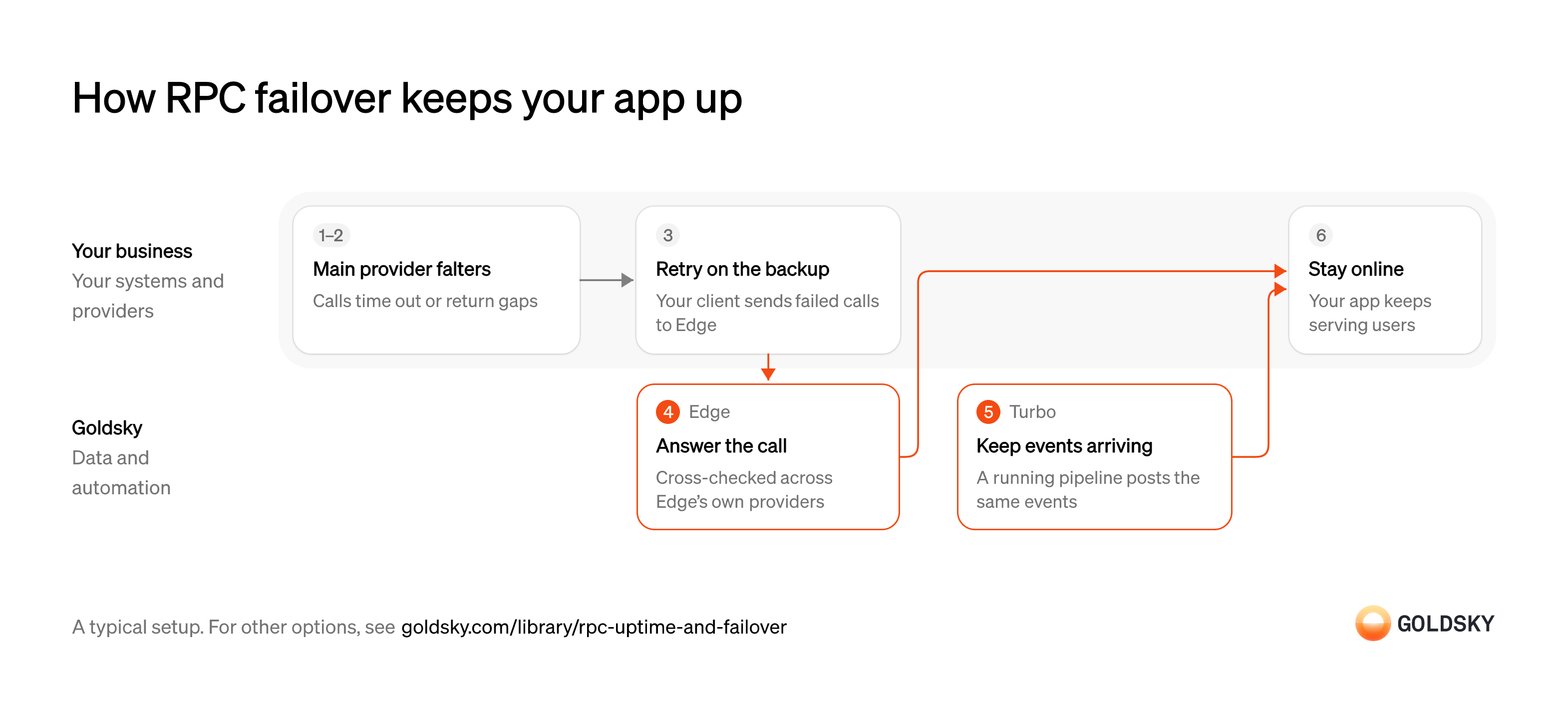
The diagram follows one failed call from the moment your main provider falters to your app still serving users. Your setup may differ.
Ways to improve RPC uptime and reliability
Failover keeps your provider and puts Edge RPC behind it. Moving replaces your provider with Edge RPC and its built-in redundancy. Cross-checking leaves your provider in the path and compares its balances and transfers with the Feeds API, which catches wrong data rather than downtime.
- Best for
- Apps that must keep working when the main provider fails
- What you run
- Your own client code
- What you write
- JSON-RPC calls, and the decoding of what comes back
- Where your data lives
- Read from the chain
- Best for
- Teams that want failover built into one provider
- Products
- Edge
- What you run
- Your own client code
- What you write
- JSON-RPC calls, and the decoding of what comes back
- Where your data lives
- Read from the chain
- Best for
- Spot checks and per-wallet comparisons against the main provider
- Products
- Feeds
- What you run
- Nothing; you call an endpoint and keep what you need
- What you write
- REST requests
- Where your data lives
- Hosted by Goldsky
| Usual setupOption 1: RPC failover | Option 2: Move to Edge RPC | Option 3: Cross-check with an API | |
|---|---|---|---|
| Best for | Apps that must keep working when the main provider fails | Teams that want failover built into one provider | Spot checks and per-wallet comparisons against the main provider |
| Products | EdgeTurbo | Edge | Feeds |
| What you run | Your own client code | Your own client code | Nothing; you call an endpoint and keep what you need |
| What you write | JSON-RPC calls, and the decoding of what comes back | JSON-RPC calls, and the decoding of what comes back | REST requests |
| Where your data lives | Read from the chain | Read from the chain | Hosted by Goldsky |
Keep your main provider as the first call
A second source is a backup, so your app still sends its calls to the provider it already uses.
Your client has a list of endpoints in order of preference, with the main provider first. If the order lives in several services that each pick their own provider, a failover in one service can leave another still calling the endpoint that’s down.
Notice when the main provider falters
Failover only helps if your app can tell a bad response from a slow one before users notice.
Set what counts as a failure: a timeout, an error, or a block height that stops moving or lags the chain. A provider can also return a log query with gaps and no error, so checks on height and completeness catch more than error codes alone.
Retry failed calls on the backup
A call that failed at the main provider has to be served somewhere before the user notices.
Your client sends the same call to the second endpoint, once, within the time your app can wait. Retrying the same failing provider in a loop adds load and delay without an answer.
Answer the call from a checked source
Handled by Goldsky EdgeThe backup only helps if its response is complete and current.
The second source has to return the same data the main provider should have, including archive reads and complete log ranges. A backup that returns stale or partial data turns an outage into wrong balances.
Edge RPC fails over between its own upstream nodes, tracks block heights across them and cross-checks responses so stale, incorrect or partial data doesn’t reach your app.
How Edge RPC checks responses (opens in a new tab)Keep event notifications arriving
Handled by Goldsky TurboIf your main provider also pushes events to you, such as incoming transfers, those stop during its outage too.
Whether to run a second event feed is your choice. If you do, your endpoint receives each event twice in normal times, so it needs a stable ID per event to drop repeats.
A running Turbo Pipelines pipeline can post the same events to your endpoint through its webhook sink, with retries on failure; corrections after a reorg arrive as records your endpoint applies.
Set up the webhook sink (opens in a new tab)Keep serving users through the outage
The point of the second source is that customers see balances and history as usual while the main provider is down.
Your app serves from whichever source responded and records which one it was, then returns to the main provider when it recovers by the rule you set. Without that record, support can’t explain a balance that briefly looked different.
What to know about RPC failover
- Your client decides when to fail over and when to return; Goldsky runs the second endpoint and its own failover between nodes.
- The backup is in the request path, so it has to cover the same chains and methods your app calls.
- A second event feed is optional, and its webhook receives reorg corrections that your endpoint applies itself.
List the chains and methods you call
A move only keeps your app up if the new provider serves everything your app sends.
Pull the chains, methods and any WebSocket subscriptions from your logs or provider report. A method you didn’t list is the one that fails after the switch.
Point your services at Edge RPC
Handled by Goldsky EdgeCalls move only when each service’s RPC URL changes.
Change the URL service by service and compare responses with the old provider before moving the rest. Code that relies on WebSocket subscriptions needs rewriting to poll.
Edge RPC takes standard JSON-RPC over HTTPS; to watch the chain without WebSocket, it supports polling with
Edge RPC transport and methods (opens in a new tab)eth_newFilterandeth_getFilterChanges.Serve every call with failover
Handled by Goldsky EdgeWith one provider, your uptime is its uptime, so it has to fail over inside itself.
The endpoint has to respond when one node lags or fails, and log queries have to come back complete. A provider that returns partial logs without an error gives your app silently wrong data.
With Goldsky, Edge RPC fails over across upstream nodes, tracks block heights across them and cross-checks their responses before answering.
How Edge RPC handles failover (opens in a new tab)Retire the old provider or keep it as a fallback
Once Edge RPC carries your traffic, the old provider is either a cost or a second line of defense.
After traffic has run on Edge RPC long enough to trust it, remove the old URLs and end the contract, or keep one as a client-side fallback behind Edge RPC. Leaving a service on the old provider by mistake keeps its outages yours.
What to know about moving to Edge RPC
- Goldsky fails over between upstream nodes, so availability no longer depends on your client’s retry logic.
- Every call moves, including writes and state reads, so check each chain and method you use is covered.
- Edge RPC is served over HTTPS only, so code that subscribes over WebSocket has to poll with filter methods.
Keep your main provider as the first call
A second source is a backup, so your app still sends its calls to the provider it already uses.
Your client has a list of endpoints in order of preference, with the main provider first. If the order lives in several services that each pick their own provider, a failover in one service can leave another still calling the endpoint that’s down.
Choose the wallets to check
A second source is most useful on the wallets where a wrong answer costs most.
Pick the wallets, chains and how often to compare them, such as treasury wallets daily and a sample of customer wallets. Checking everything every few seconds costs more than the errors it catches.
Read the same wallets’ balances from a second source
Handled by Goldsky FeedsYou need an independent response to compare with what your main provider says.
The second response has to be for the same wallet, chain and token. A balance read from a different moment can differ for honest reasons, so note when each was taken.
Goldsky’s Feeds Balances endpoint returns a wallet’s native and ERC-20 holdings with USD values, and the docs note it works as a second source alongside another provider.
Read wallet balances (opens in a new tab)Read the same wallets’ transfers
Handled by Goldsky FeedsBalances can match while a transfer is missing, so the transfer history is checked too.
Pull transfers in and out for the same window from both sources. A transfer one source has and the other doesn’t is the clearest sign of dropped data.
The Feeds Transfers endpoint returns a wallet’s transfers newest first and can be limited by time or, on one chain, by
Query a wallet’s transfers (opens in a new tab)from_blockandto_block.Compare the two sources and chase breaks
A mismatch only helps if someone finds out which source is wrong and fixes what depended on it.
Your code compares balances and transfers and records each difference with both answers. Someone on your team checks the chain itself and corrects any customer balance that was built on the wrong answer.
What to know about cross-checking with an API
- Your app pulls both sources, so a mismatch shows up only when you run the check.
- The main provider stays in the request path, so this catches wrong data but doesn’t keep your app up during an outage.
- The API covers the chains Feeds supports, so check your chains are on the list.
- Your code does the comparing, so you decide what counts as a match and what to do with a break.
Related jobs
Line up independent RPC providers
A node that reads and writes through one provider stops reporting when that provider does.
Oracle networks ask the chains they integrate to have at least three separate, independent RPC providers. Independent means separate infrastructure, since two endpoints in front of the same nodes fail together.
List every endpoint in the node’s configuration
The node can only switch to an endpoint it already knows about.
Give each chain several endpoints with a priority order, and mark any that should only send transactions as send-only. Oracle node software can pick the endpoint with the highest block, rotate through them, or follow the priority order.
Add a provider with its own failover
Handled by Goldsky EdgeA provider that fails over across its own upstream nodes keeps answering when one of them drops.
Check what the node needs from each endpoint: some node features need a WebSocket connection, and every endpoint has to serve the
finalizedandlatestblock tags the node relies on.Goldsky’s Edge RPC fails over across several upstream providers and cross-validates their responses. It serves HTTPS only, with no WebSocket endpoint, so add it where the node accepts an HTTP endpoint.
Check Edge RPC transports (opens in a new tab)Drop endpoints that fall behind
An endpoint that answers with old blocks is worse than one that doesn’t answer at all.
The node polls each endpoint, marks it unreachable after repeated failed polls, and treats one that lags too far behind the best as out of sync. Alert on those changes, because a pool that has quietly shrunk to one endpoint has lost its redundancy.
What you control
- Your team
- Keep your main provider as the first call
- Notice when the main provider falters
- Retry failed calls on the backup
- Keep serving users through the outage
Security and deployment
- SOC 2 Type IIIndependently audited security controls.
- Dedicated infrastructureSingle-tenant options for production workloads.
- Data residencyCloud, on-premises or co-located.
More use cases that access chains reliably
- Archive node RPCRead any past state through archive RPC.
- Archive RPC and indexing for a new chainGive a new chain archive RPC and indexing from mainnet day one.
- RPC and indexed data for a payments blockchainProvide RPC and indexed data for a chain run by a fintech.
- Optimize your RPC endpoints and cut RPC costsAutomatically optimize your RPC endpoints and lower billable calls while keeping your current provider.
- Improve blockchain data API reliability and coverageKeep wallet balances, transfers and token prices arriving when a third-party blockchain data API has an outage, rate limits you, lacks a chain or returns wrong balances.
- Improve subgraph uptime and reliability with failoverKeep app screens up when a hosted subgraph lags, stops syncing or goes down, with a backup to fail queries over to.
- Improve blockchain webhook reliabilityKeep onchain event notifications arriving at your backend, with retries, reorg corrections and a backup feed.
Improve RPC uptime with failover on Goldsky
We’ll map it to your systems and show you what Goldsky runs, so your team builds the product, not the pipelines underneath it.
 Robinhood
 HyperEVM
 Arc
 Solana
 Ethereum
 Polymarket
 Base
 Tempo
 Bitcoin